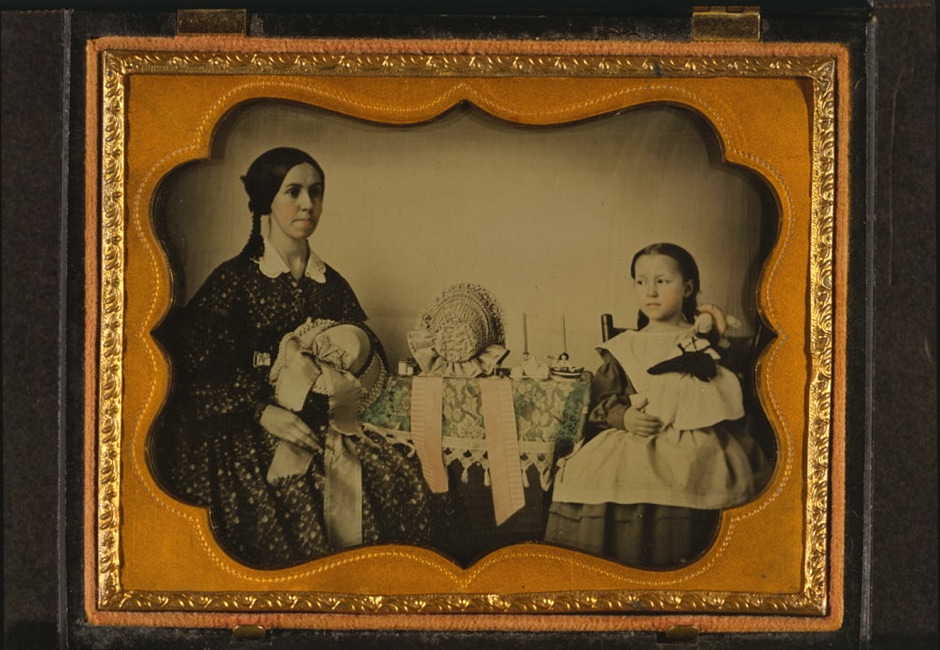
A woman and a girl sit beside a table, surrounded by the small business of dressing: bonnets, fabric, a doll. The Library of Congress calls this photograph Milliner and her daughter and dates it to about 1854.[1] The arrangement gives work and family a shared stage. The sitters hold still; the objects around them make the scene busy.
The pale faces and ribbons are easy to read. Less obvious is the material that makes this kind of photograph legible. An ambrotype's thin glass negative reads as a positive against a dark backing.[2][3] The finished portrait depends on something the viewer might mistake for packaging.
That dependence makes these small photographs rewarding to study. The camera supplies a likeness, but the object must be finished in a way that lets us see it. Glass, silver, backing, and the surrounding presentation all participate.
A negative that keeps its place
The starting point is wet collodion photography. A photographer coats glass with collodion, sensitizes it in a silver-salt solution, exposes it in the camera, and develops it. As Getty's account explains, the sequence must happen within minutes, before the coating dries.[2]
An ordinary glass negative can yield a separate paper print. An ambrotype's underexposed negative becomes the object the customer sees. Black lacquer, a separate backing, or colored glass supplies its darkness.[2][3]
The clearer parts of the plate allow the dark background to show through. The image-bearing portions appear lighter against it, so the tonal relationships resolve into a face. Without the backing, a clear-glass example reads as a negative again. Graphics Atlas demonstrates this with a plate removed from its case.[3]
The important distinction is between recording an image and presenting it. Nothing about the sitter has changed when the backing changes; what changes is the relationship through which the viewer reads the plate. The shadow is partly an achievement of assembly.
The hand returns after the camera
Finishing offered room for further choices. Graphics Atlas records hand coloring with dry pigment applied after processing and before varnishing. Cheeks, lips, clothes, and jewelry could receive selective attention. It also describes the usual assembly of image plate, cover glass, brass mat, and retaining frame, while noting that the arrangement varied.[3]
These additions give a portrait several kinds of emphasis. A bright ornament can direct the eye toward a hand; a colored cheek can make a face feel more present. The mat determines where the image stops and the object begins. Each choice influences how the likeness reaches its viewer.
In Milliner and her daughter, the enclosing border gathers the two sitters and their possessions into a single, bounded scene. Work materials become part of a formal presentation. We can read that arrangement without inventing a conversation between the sitters or treating their stillness as evidence of their feelings.
Nor can this reproduction tell us exactly how its backing was made. Knowing the process's possibilities does not establish which combination a particular photographer used. The visible portrait and the hidden construction answer different questions.
Affordable to buy, particular to own
The Library of Congress describes ambrotypes and tintypes as quicker and cheaper to produce than daguerreotypes, and notes their extensive use for portraiture and keepsakes.[1] Lower cost widened the commercial possibilities of the small cased likeness. It also complicates the assumption that elaborate presentation must signal an expensive commission.
A surviving Boston advertisement makes the market concrete. Getty's hand-colored Portrait of a young woman, dated 1856–1862 and attributed to John B. Heywood, retains printed information from his gallery. Its backing advertises ambrotypes for “25 cents and upwards”; photographs are offered for a dollar, with duplicates at 25 cents.[4] This is one studio's offer, rather than a national price schedule, but it puts an entry price beside a material object.
The young woman's image measures just 5.1 by 3.8 centimeters.[4] Such dimensions suggest an encounter at close range: a face small enough to invite a viewer toward it, surrounded by materials that announce it is worth keeping. Modest size and modest starting price could coexist with careful presentation.
An ambrotype is a single camera-made original, rather than one of multiple paper prints from a negative.[2] A later reproduction can share the view, as this one does, while the original plate and its finishing remain particular. Reproducibility of the image and uniqueness of the object can coexist.
What the reproduction leaves behind
On a screen, the photograph arrives with its tonal relationships already settled. We cannot turn this reproduction over to inspect the glass or distinguish a separate backing from a coating. We see the result of an arrangement while losing much of our access to its parts.
Yet understanding those parts changes the experience of looking. The photograph's dark tones become something to consider alongside the bonnets and the doll. Their likeness has survived through an encounter between a recorded scene and a deliberately constructed object. The dark material behind the glass helped bring their faces forward.
Sources
- Library of Congress, “Ambrotypes & Tintypes,” American Women: Resources from the Prints & Photographs Collections — portrait and keepsake context, and the illustrated Milliner and her daughter, ca. 1854; source of the archival image.
- J. Paul Getty Museum, “Sally Mann: A Thousand Crossings,” sections “The Collodion Wet-Plate Process” and “Variations on the Collodion Process: Ambrotypes and Tintypes” — preparation, dark backgrounds, and the distinction between direct originals and paper prints.
- Image Permanence Institute, Rochester Institute of Technology, Graphics Atlas, “Ambrotype: Object View” — glass supports, milky highlights, backing materials, case components, and hand coloring.
- J. Paul Getty Museum, John B. Heywood, “Portrait of a young woman,” 1856–1862, object 84.XT.1586.4 — dimensions, medium, and the studio advertisement preserved on its backing.