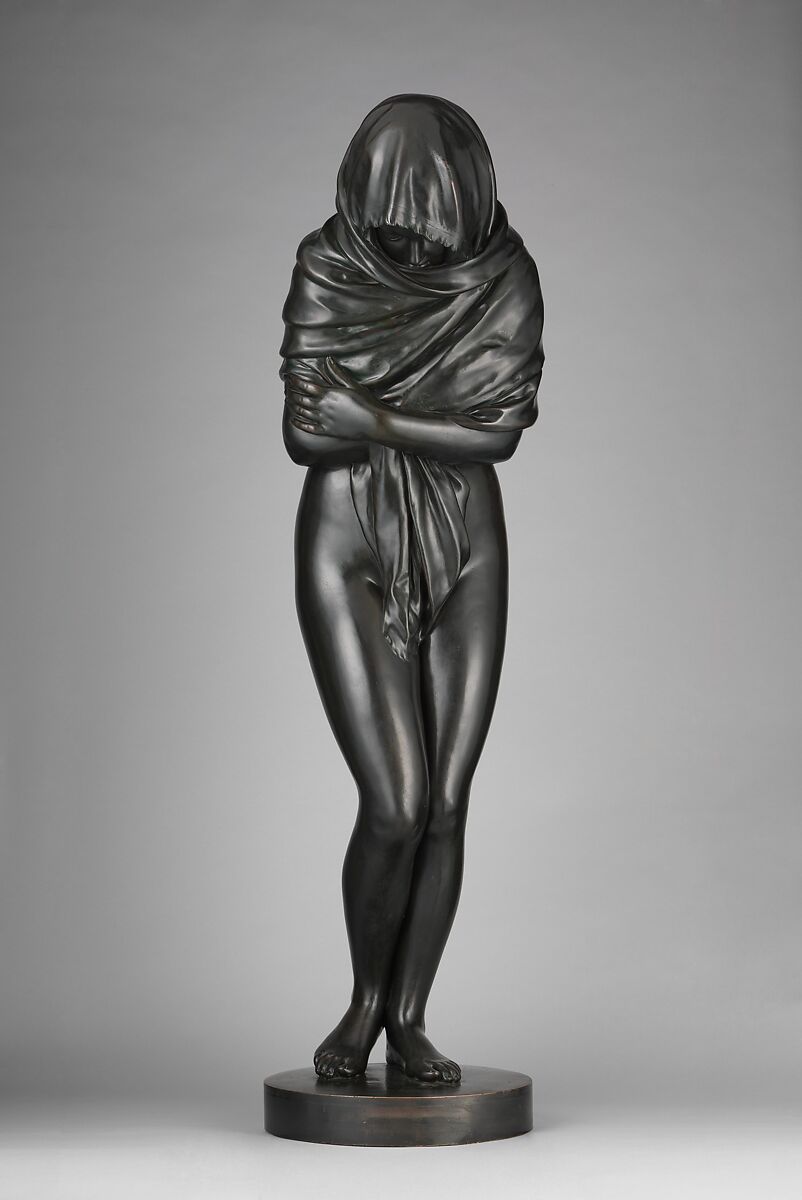
The shawl is doing almost everything except keeping her warm. It covers the head, gathers around the shoulders and is held against the chest. Below the folded arms, much of the body remains exposed. Jean Antoine Houdon's Winter makes us recognize an effort to find shelter, then notice how little shelter the sculpture provides.
The bronze shown here belongs to the Metropolitan Museum of Art. Dated 1787 and standing 143.5 centimetres high, it was cast by Houdon himself. Its other name, La Frileuse, describes a woman susceptible to cold. The title names a condition; the compressed pose makes that condition legible before we read it.[1]
The work of the shawl
Start with the difference between the figure's upper and lower halves. Around the head and chest, the cloth creates overlapping edges and sheltered recesses. The limbs below give the eye longer, more continuous passages. One part of the sculpture seems to gather itself inward while another remains available to view.
That uneven distribution is the source of the work's tension. An adequately dressed figure would tell us less about the cold reaching her body. A completely unclothed figure would lack this particular gesture of resistance. The shawl supplies both the response to cold and a measure of what the response cannot accomplish.
The face participates in the withdrawal. Its lowered position makes the cloth feel like a small enclosure, a place into which the figure can retreat. Yet the retreat remains partial. We can follow the body's outline even as the pose suggests a wish to draw away from its surroundings. The sculpture gives us access to someone whose attention appears directed inward.
These are effects of arrangement, not evidence of a sitter's feelings. Nothing in the bronze establishes a particular freezing day or a named woman's experience. Houdon has made a bodily reaction available for inspection. The stillness is especially effective: the figure cannot finish pulling the shawl around herself, so the effort continues for as long as we look.
A season brought into the body
An earlier marble Winter, dated 1783, is in the Musée Fabre in Montpellier. The museum contrasts Houdon's young woman with the familiar personification of winter as an old bearded man. It also draws attention to the contrast between smooth flesh and rougher cloth.[2] Winter has become something we can recognize through the body's surfaces and posture, rather than through age alone.
The marble nevertheless carries an identifying prop: a vessel behind the figure has been split by frost. The Musée Fabre's educational dossier describes this damaged vase and the sculpture's relationship to its companion, Summer.[4] The vessel gives cold a visible consequence in an object. The woman gives it a consequence in a gesture.
In the Met bronze, the vessel is absent. The museum describes Houdon as reducing the composition to its essentials.[1] Without that explanatory object, the shawl and the exposed body must carry more of the meaning. We do not need to identify the damage caused by freezing water; we can recognize the attempt to conserve warmth.
This bodily precision connects Winter with a larger concern in Houdon's work. In her account of the artist, Met curator Johanna Hecht emphasizes his anatomical study, notably the Écorché, or flayed figure, made during his Roman years. She also describes his combination of naturalism with ancient and Baroque models.[3] Such training helps explain the resources available to him. It does not make this particular pose an unmediated observation of nature. The selection and arrangement remain conspicuous: Houdon lets us see exactly enough protection to understand its insufficiency.
When covering became provocative
Eighteenth-century objections reached that same contradiction from another direction. The Musée Fabre reproduces correspondence in which Jean-Baptiste Pierre, the king's first painter, worried that the figure's partial drapery made it less decent than complete nudity. The cloth could suggest a performance of modesty while directing attention toward what remained uncovered.[4]
This was an argument about the organization of looking. A covering changes the significance of the surface beside it. The shawl makes the exposed body seem exposed to something: to the weather within the allegory, and to a viewer standing outside it. Protection and display become inseparable.
The museum's dossier also quotes a critic in the Petites affiches de Paris who found the response to cold implausible: someone truly freezing would gather the limbs together and cover the body more effectively. The criticism acknowledged the figure's visual appeal while questioning its behavior.[4] That reservation deserves to remain in the encounter. We can recognize cold in the pose without accepting it as a practical demonstration of keeping warm.
Nor must every viewer choose between sympathy and an awareness of display. The sculpture makes both responses possible. Its gathered upper body can prompt an impulse to offer more covering; its long exposed contours can make us aware of the pleasure the sculptor has organized for the eye. The discomfort lies in how easily those responses coexist.
Return to the shawl's edge. It is the point where an attempt at shelter becomes an invitation to notice bare skin. Houdon has given a season a human gesture, but he has also left that gesture unresolved. The cloth will never fall, tighten or spread. It will remain enough to make us think about warmth, and too little to let us forget the cold.
Sources
- The Metropolitan Museum of Art, “Winter,” object 62.55 — 1787 bronze, dimensions, casting, interpretation and source photograph.
- Musée Fabre, “L'Hiver (La frileuse),” inventory 828.5.1 — 1783 marble, winter iconography and the contrast of flesh and cloth; French collection record.
- Johanna Hecht, “Jean Antoine Houdon (1741–1828),” The Metropolitan Museum of Art, October 2008 — anatomical study and the artist's combination of naturalism, classical models and Baroque influence.
- Musée Fabre, “Les Salons et la critique d'art: La sculpture (XVIIIe–XXe siècles),” pages 7–8 — marble's frost-split vessel, companion Summer, correspondence about partial nudity and contemporary criticism; French educational dossier, PDF.