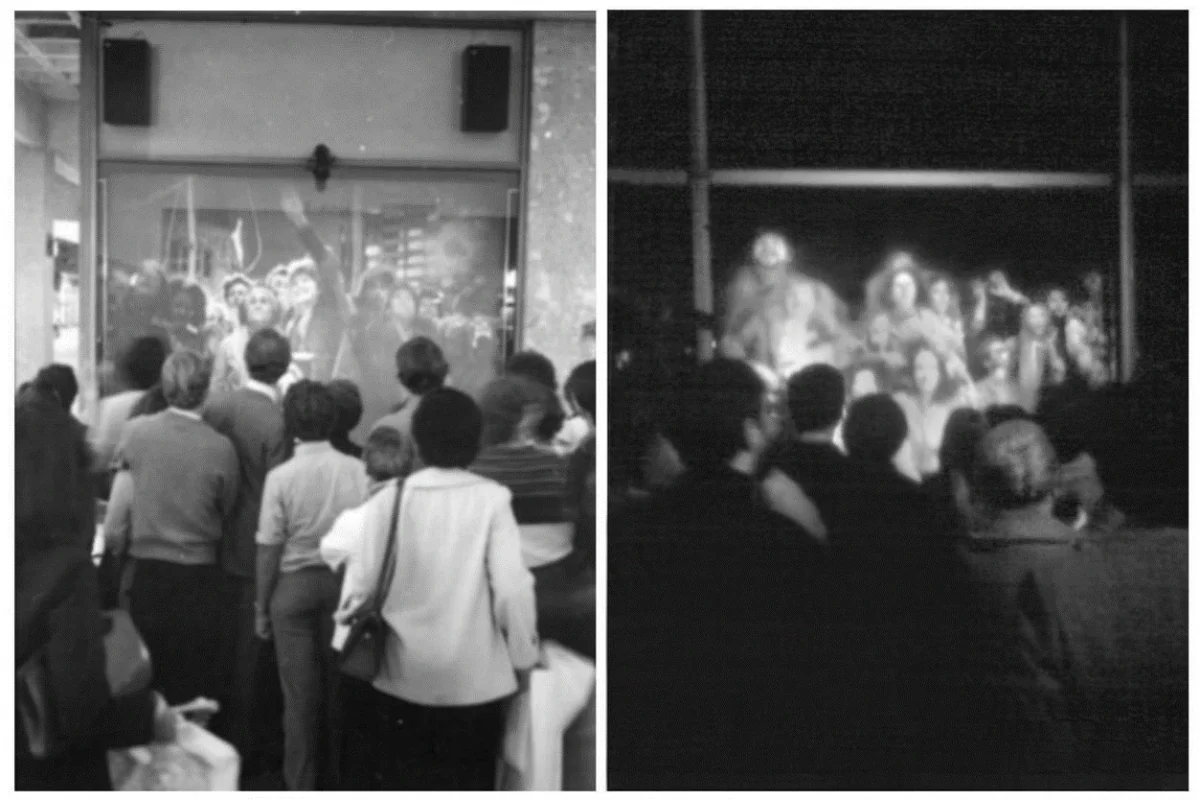
Image context: this post uses one archival photograph of the actual 1980 live artwork in Los Angeles and New York, published by Panorama under CC BY-NC 4.0 and converted from PNG to WebP. It is not a generated image, diagram, chart, or symbolic illustration.[4]
The first thing a passerby met was not a computer. It was a person, larger than life, apparently standing on the other side of a shopwindow—and asking where, exactly, you were.
For three evenings in November 1980, Kit Galloway and Sherrie Rabinowitz linked a sidewalk-facing window at New York's Lincoln Center with a window at The Broadway department store in Los Angeles's Century City shopping center. Cameras and microphones gathered people at each site; a live satellite circuit carried their black-and-white images and voices across the continent; rear-projection screens returned the distant crowd at architectural scale. There was no keyboard, account, contact list, or explanatory sign. The artists called the result Hole in Space: A Public Communication Sculpture.[1][2][3]
It is tempting to file the work as a remarkably early video call. That description gets the chronology right and the art wrong. Galloway and Rabinowitz did not miniaturize a meeting into a personal device. They enlarged a communications channel until it became part of the street. Their decisive material was not the satellite alone, but the situation around it: two public thresholds, two surprised crowds, and enough ambiguity for strangers to discover a protocol together.
Hole in Space made transmission behave like place.
The interface was a window
By 1980, satellite television was already familiar as an image of technological power. It brought distant events into the home, but its ordinary direction remained one-way: a network transmitted; an audience received. Galloway and Rabinowitz reversed that posture without disguising the apparatus as domestic convenience. Their screens faced sidewalks. Their participants remained standing, dressed for different coasts and climates, with other bodies pressing behind them.[2][3]
The technical system was substantial. Anastasia Howe Bukowski's history of the work identifies support from Western Union, General Electric, Scharff Communications, Rayburn Electronics, the Long Beach Museum of Art, and the National Endowment for the Arts. The live images depended on night-view cameras, ambient and infrared-enhanced lighting, amplified sound, projection, and satellite capacity. Each connection ran for roughly two to three hours on November 11, 13, and 14.[3]
Yet the encounter suppressed the usual signs of a control room. The Museum of Modern Art's 1982 account describes life-size projections in windows, with microphones and speakers placed unobtrusively. People walking past became participants before they had been briefed on what participation meant.[2] This concealment was not a magic trick designed to make technology seem frictionless. It displaced attention from the machine to the relationship the machine permitted.
That is why the window mattered. A department-store window normally keeps viewers outside and merchandise inside. A performing-arts façade usually separates ticket holders from pedestrians. Hole in Space put a distant public behind the glass instead. The screen looked less like an appliance than an opening cut into familiar architecture. Viewers did not merely watch New York or Los Angeles; they adjusted their position, volume, gesture, and timing in response to people who could answer.
The photograph above preserves this bodily intelligence. Faces on the projected image gather into one plane while backs and shoulders mass in front of it. The image is grainy, but the social geometry is crisp: people lean toward the screen, occupy one another's sightlines, and make the crowd itself part of the work.[4]
Three nights taught the public what the work could do
The artists did not announce the first connection in advance. On the opening night, discovery became the subject. Documentary footage studied by Howe Bukowski shows people trying to establish the most basic coordinates: Was the other crowd really live? Was it in New York? Where in New York? One Los Angeles participant's uncertainty—whether the distant people were in New York while she remained in Los Angeles—captures the useful instability of the piece. The screen made distance visually collapse while conversation kept insisting that distance was real.[3]
This was not a defect awaiting better bandwidth. The slight lags, streaked pictures, flaring light, echo, and distorted audio made simultaneity something participants had to produce together. They repeated questions, matched a voice to a face, leaned into the frame, and waited for a response. The connection worked socially because it was technically incomplete. Every successful exchange contained evidence of the continent it crossed.[3]
By the second evening, word had traveled through local news and ordinary conversation. The crowds arrived with expectations. They sang, told jokes, played charades, and tested how a collective could perform for its counterpart.[2][3] The change is crucial. An audience that had spent the first night locating the channel began to invent genres for it. The screen became variety stage, party line, civic rivalry, and impromptu theater—not because software offered those modes, but because people proposed them and the distant crowd accepted or refused.
Across the three evenings, MoMA's contemporary release records telephone numbers being exchanged.[2] On the final night, Howe Bukowski describes a New York woman seeing her brother on screen after fifteen years apart.[3] The work had changed again. Surprise now made room for recognition, and public spectacle briefly carried an existing private relationship. A person could be reunited in front of strangers while those strangers supplied the noise, witness, and pressure of the encounter.
This three-night sequence is the artwork's hidden engine. The hardware remained largely stable while the public's literacy changed. First came orientation, then performance, then personal recognition layered into public exchange. Galloway and Rabinowitz did not prescribe that progression, but their decision to reopen the channel let a culture accumulate around it. The users learned from the previous night and returned with new ideas. In contemporary language, the system acquired features without receiving a software update.
Scale turned communication into choreography
A private call asks whether two people can connect. Hole in Space asked what happens when connection has to accommodate a crowd.
The answer was unruly. Participants jostled for a place in the camera's field, called out over competing voices, and tried to direct attention across two sites at once.[3] No one owned the frame. The life-size projection promised face-to-face contact, but the public setting continually interrupted the fantasy of effortless presence. To be seen, a person had to negotiate with bodies nearby; to be heard, they had to make sense at the far end through shared speakers and ambient street sound.
That friction distinguishes the work from a technology demonstration. A demo isolates a capability and asks us to admire that it functions. Galloway and Rabinowitz exposed a capability to uncontrolled use and made the consequences visible. The crowd supplied congestion, etiquette, comedy, exclusion, patience, and generosity. Satellite transmission was only one layer in a system that also included architecture, urban foot traffic, television habits, word of mouth, and the unequal ability to reach the front.
Cary Levine and Philip Glahn place the artists' later Electronic Café project within a politics of telecommunications: technology understood not as a parade of novel devices but as a way of organizing who can speak, meet, and form a public.[4] Hole in Space already contains that argument in compact form. Its innovation was not merely faster delivery across distance. It converted receivers into respondents and treated social behavior as the medium through which a network became meaningful.
The two sites also prevented the fantasy of placelessness. Lincoln Center and a Century City department store were not neutral coordinates. Their façades, surrounding neighborhoods, pedestrian rhythms, and cultural associations entered the exchange. The work joined specific places rather than dissolving them into an abstract online world. Participants' repeated questions about location were therefore not naïve preliminaries. They were how the artwork kept its two ends real.[3]
The artwork survives as evidence of an event
MoMA now describes Hole in Space as a two-channel, standard-definition video recording of a life-size, interactive public satellite link, jointly acquired with the San Francisco Museum of Modern Art.[1] That museum object is necessarily different from the event. The 1980 work existed in the feedback loop among live transmission, storefronts, weather, surprise, and bodies. Its recording lets later viewers study the loop, but cannot place us inside it.
The distinction protects the work from an easy story of prediction. Hole in Space did anticipate a world of routine live video, but its value is not that it resembles today's calls at lower resolution. Most current interfaces make remote communication smaller, cleaner, individualized, and administratively legible. Galloway and Rabinowitz made it oversized, public, collectively negotiated, and briefly ownerless at the point of use.
That choice remains bracing. The artists secured an extraordinary technical chain, then refused to make the machinery the protagonist. They built a channel and watched strangers turn it into a place—awkwardly, joyfully, one social rule at a time.
Sources
- Museum of Modern Art, “Kit Galloway, Sherrie Rabinowitz, Hole In Space, 1980” — collection record for the two-channel recording, medium, duration, ownership, and work description.
- Museum of Modern Art, “Video: Experiments with Satellite” press release, September 9, 1982 — contemporary institutional account of the storefront setup, unannounced connection, audience uses, recording process, and satellite-art context.
- Anastasia Howe Bukowski, “'I'm in Los Angeles, right?': Charting a Hole in Space,” Spectator 41.1, Spring 2021 — scholarly reconstruction of the three nights, technical infrastructure, crowd behavior, televisual context, and tension between proximity and distance.
- Cary Levine and Philip Glahn, “Interrogating Invention: Electronic Café and the Politics of Technology,” Panorama 2.1, Summer 2016 — art-historical account of Mobile Image's telecommunications practice and source of the CC BY-NC 4.0 archival event photograph used here, converted from PNG to WebP.