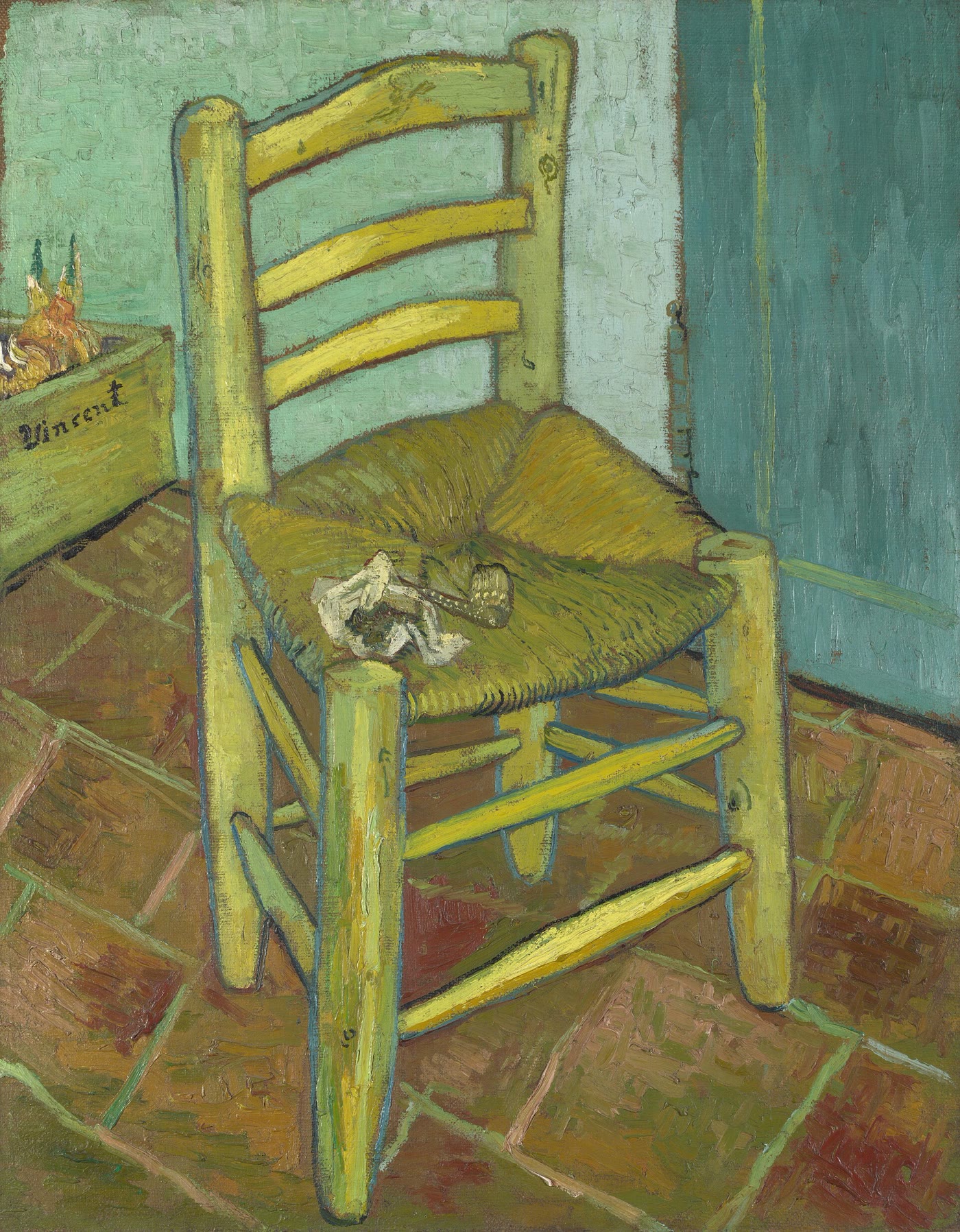
Image context: this post uses one archival reproduction of Vincent van Gogh's actual painting, sourced from the National Gallery work record via Wikimedia Commons. It is not a generated image, a diagram, or a symbolic stock photograph.[1][6]
A chair is built around a body that is not there yet. Its seat predicts weight; its back predicts posture; its height predicts where knees will bend. Even when empty, it preserves an invitation in human scale. That is why a chair can feel occupied after its sitter has left—and why artists repeatedly use it to make large questions about identity, usefulness, and representation feel close enough to touch.
Vincent van Gogh, Marcel Duchamp, and Joseph Kosuth did not use chairs to say the same thing. Van Gogh painted two empty chairs as surrogate portraits. Duchamp fixed a bicycle wheel to a kitchen stool, preventing both objects from doing their ordinary jobs. Kosuth placed a chair beside its photograph and dictionary definition, then asked which version carries the idea. Across those transformations, the chair remains unusually potent because it is three things at once: a household object, an outline for a body, and a social instruction to sit.
The chair does not merely symbolize absence. It gives absence a posture.
Furniture becomes a portrait
In late 1888, Van Gogh painted his own plain rush-bottomed chair and a more elaborate armchair associated with Paul Gauguin. The National Gallery describes the canvases as a pair designed to hang together, one chair turned right and the other left. Van Gogh's yellow wooden chair stands in daylight with a pipe and tobacco pouch on its seat. Gauguin's darker, carved armchair appears at night with two novels and a burning candle.[1]
No face is present, but the comparison behaves like portraiture. One chair is workmanlike, sunlit, and close to the red-tiled floor; the other is polished, nocturnal, and furnished with the signs of literary sophistication. The National Gallery calls them surrogate portraits because Van Gogh distributes character across material, light, and selected belongings rather than facial resemblance.[1] The chairs do not show what either man looked like. They stage how Van Gogh understood the difference between them.
The timing sharpened that effect. On 17 January 1889, after Gauguin had left Arles, Van Gogh wrote to his brother Theo about the painting of Gauguin's armchair and its pendant. He described the candle and novels placed on an “empty armchair,” then said he had just been working again on his own empty chair with its pipe and tobacco pouch.[2] The letter does not hand us a complete symbolic code. It does establish that emptiness was not an accidental by-product of painting furniture. Van Gogh named it twice.
The two canvases therefore hold presence and absence in the same device. The objects on the seats make their owners specific, while the open seats make those owners unavailable. A conventional portrait gives us a body and asks us to infer a person. Van Gogh removes the body and lets a chair, a pipe, books, candlelight, and daylight perform the inference.
That reversal also changes the viewer's role. An empty chair normally invites occupation, but these painted chairs cannot be used. Their seats face us as shallow stages. We read them instead of sitting down. The familiar bodily invitation survives, only to be redirected into attention.
A chair is already social design
The contrast between the two paintings works because furniture is never neutral. A straight, unpolished chair without arms asks the body to sit differently from a carved armchair. Materials imply cost, labor, setting, and habit. A pipe left on a rush seat suggests one rhythm of life; contemporary novels beside a candle suggest another. Van Gogh did not have to invent those associations from nothing. He intensified instructions already built into the objects.[1][2]
This is the chair's advantage over a generic symbol. It is designed evidence of an anticipated person. A coat can retain a body's shape, but it is usually private and individually sized. A doorway frames a body, but it primarily organizes passage. A chair waits. It turns a room toward the possibility that someone will stop, occupy a place, face a certain direction, and enter a relation with other people.
Artists can exploit that waiting because the viewer understands it before interpretation begins. We know with our muscles what a chair is for. Every artistic interruption—an empty seat, a blocked seat, a photographed seat—registers against that knowledge.
Duchamp makes the invitation impossible
Marcel Duchamp's Bicycle Wheel changes the problem by using a real stool rather than representing one. The original 1913 construction is lost; the Museum of Modern Art holds a third version made in 1951, consisting of a metal wheel mounted on a painted wooden kitchen stool.[3] The combination is almost aggressively simple. Yet each component cancels the other's expected use. The stool cannot receive a sitter because the wheel occupies its seat. The wheel cannot carry a rider because it has been lifted from the road and fixed above furniture.
The shift from chair to stool is a category edge worth keeping visible. Both are seats calibrated to a body, but a stool offers that instruction in stripped-down form: support weight. Occupying it with a wheel makes the cancellation unusually legible.
What remains is motion without transport and support without rest. Duchamp recalled enjoying the turning wheel in his studio as one might enjoy watching flames in a fireplace. MoMA also notes that the exact physical appearance mattered less than transmitting the readymade's concept; other people sourced components for the 1951 version before Duchamp assembled them.[3] The stool is no longer a modest platform for the body. It becomes a platform for an idea.
The work matters here not because it is another famous work built from a seat, but because it breaks the chair's social instruction. Van Gogh's painted seats remain available in imagination: their absent owners might return. Duchamp's stool has been structurally reassigned. It supports useless, mesmerizing rotation. By isolating ordinary objects from their intended purposes and designating them as art, the readymade shifted emphasis from fabrication toward selection and context.[3]
Still, the body has not vanished entirely. The wheel sits at roughly hand and eye level because the stool raises it. A viewer can imagine reaching out to set it spinning. Duchamp disables sitting but preserves encounter. The household object becomes strange without losing the scale that made it familiar.
Kosuth divides one chair into three claims
Joseph Kosuth's One and Three Chairs of 1965 makes the interruption more analytical. MoMA's installation consists of a manufactured folding chair, a mounted photograph of a chair, and an enlarged dictionary definition of the word “chair.” Kosuth did not craft the chair, take the photograph, or write the definition; his artistic act was to select and assemble the three forms.[4]
Each element appears to answer the same basic question—what is a chair?—with a different kind of evidence. The object offers material and use. The photograph offers a visual likeness. The definition offers a verbal category. None can fully absorb the others. A person could sit on the object but not on the photograph; recognize the photograph without touching the object; understand the definition without knowing the particular chair's scratches, weight, or proportions.
Van Gogh used furniture to let objects describe people. Kosuth uses a chair to make systems of description expose themselves. That move belongs to the broader turn in 1960s Conceptual art toward ideas and toward questions about how art is produced, distributed, and displayed.[5] The chair is no longer a substitute for one absent sitter. It becomes the point where thing, image, and language fail to coincide.
Yet the work is not an abstract philosophy exercise illustrated by convenient furniture. Its force depends on the chair's ordinary legibility. Replace it with a rare scientific instrument and the viewer would first need to learn the object. A chair arrives already known through the body. Kosuth can divide it into three claims because recognition happens almost immediately—and then becomes unstable.
The absent body keeps changing jobs
Seen together, these works trace no simple march from emotion to intellect. Van Gogh's chairs are formally rigorous arrangements of complementary color as well as intimate surrogates; his January letter emphasizes the bright-light effects he was seeking.[2] Duchamp's construction is conceptually disruptive, but its turning wheel offered him sensory pleasure.[3] Kosuth's proposition is analytical, but it only works because viewers bring physical knowledge of sitting to it.[4]
The stronger connection is that each artist redistributes the body's role. Van Gogh removes the sitter and lets possessions, furniture, and light carry personality. Duchamp blocks the seat and transfers bodily attention from resting to looking and imagined turning. Kosuth leaves a usable object in view but surrounds it with representations that sitting alone cannot resolve.
The archival reproduction at the top of this article makes the first shift visible.[6] Van Gogh's yellow chair is not merely unoccupied. It is insistently addressed to someone: the pipe lies where a body would settle; the front edge faces the viewer; the uneven legs hold their place on a floor whose perspective seems to tilt. The painting gives us enough bodily information to feel the vacancy, then enough personal detail to resist filling it with just anyone.[1]
That is why the chair endures as more than a convenient motif. It can carry biography without a face, become sculpture without skilled manufacture, and trigger an argument about language without surrendering its everyday form. Its meaning changes because its first instruction remains so clear.
A chair says: a body belongs here. Art begins by asking what else might take its place.
Sources
- National Gallery, London, “Van Gogh's Chair” — collection record and interpretive account of the paired chairs as surrogate portraits, including their contrasting furniture, objects, light, and intended orientation.
- Vincent van Gogh, letter 736 to Theo van Gogh, Arles, 17 January 1889, Vincent van Gogh: The Letters — Van Gogh's firsthand description of Gauguin's empty armchair, his own empty chair, and the bright-color effects he sought.
- Museum of Modern Art, “Marcel Duchamp, Bicycle Wheel” — object record on the lost 1913 original, the 1951 third version, its wheel-and-stool construction, studio movement, and transmission of the readymade concept.
- Museum of Modern Art, “Joseph Kosuth, One and Three Chairs” — object record and collection text on the chair, photograph, dictionary definition, and Kosuth's act of selecting and assembling them.
- Museum of Modern Art, “Conceptual art” — institutional overview of the 1960s emphasis on ideas and challenges to conventional artistic production, distribution, and display.
- Wikimedia Commons, “File: Vincent Willem van Gogh 138.jpg” — high-resolution archival reproduction of the National Gallery's Van Gogh's Chair, used as this article's single image source.