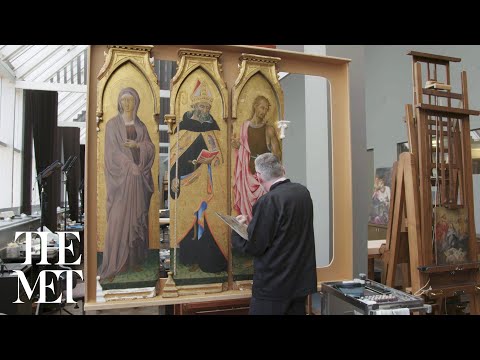
Giovanni di Paolo's Madonna and Child with Saints is easy to misread when seen only as a devotional image. The Virgin sits enthroned at the center, saints stand in pointed side panels, the ground shines gold, and the whole thing seems to belong to a familiar late-medieval category: sacred painting before Renaissance naturalism fully took over.[2][4] The Met's conservation film is valuable because it refuses that first simplification. It keeps reminding the viewer that this work is not only painted imagery. It is an assembled object, a polyptych with a structure, a frame logic, a damage history, and a surface hierarchy that can become illegible when later repairs grow too thick.[1][3][5]
That shift matters because the object page itself already points beyond a single flat picture. The Met identifies the work as a multipanel altarpiece painted in 1454 for a chapel in an Augustinian church, possibly in Cortona, with Saint Nicholas of Tolentino on the far right and missing components that once completed the ensemble: five pinnacles with the evangelists and Christ, a predella telling the story of Saint John the Baptist, and pilasters with smaller saints.[2] In other words, the surviving object is already a partial architecture. It asks to be read through assembly, loss, and survival as much as through iconography.
The museum's short perspective on Gothic altarpieces sharpens that point with unusual bluntness: before you can put a Gothic altarpiece together, you first have to know how to take it apart.[5] That sentence could stand as the thesis of the video. The conservators are not merely polishing a venerable image. They are reopening the logic of joins, gilded edges, replaced frame members, and painted intervals that once organized how the work held space. What looks like one devotional surface from a distance turns out to be a coordinated system of separate panels, painted fields, and carpentry decisions.[1][3][5]
The broader Sienese context matters here as well. The Met's Heilbrunn essay describes Sienese painting as a school shaped by Gothic elegance, refined color, and a continued commitment to gold-ground sacred art even as early Renaissance spatial thinking developed around it.[4] Getty's Giovanni di Paolo exhibition page adds a more technical note, stressing his ability to work with and on gold in order to produce luminous effects.[6] The conservation film becomes interesting precisely where those two descriptions meet. It shows that luminosity is not a mystical property floating free of matter. It depends on how frame, bole, gilding, paint, abrasion, and reconstruction are managed across the entire object.[1][3][6]
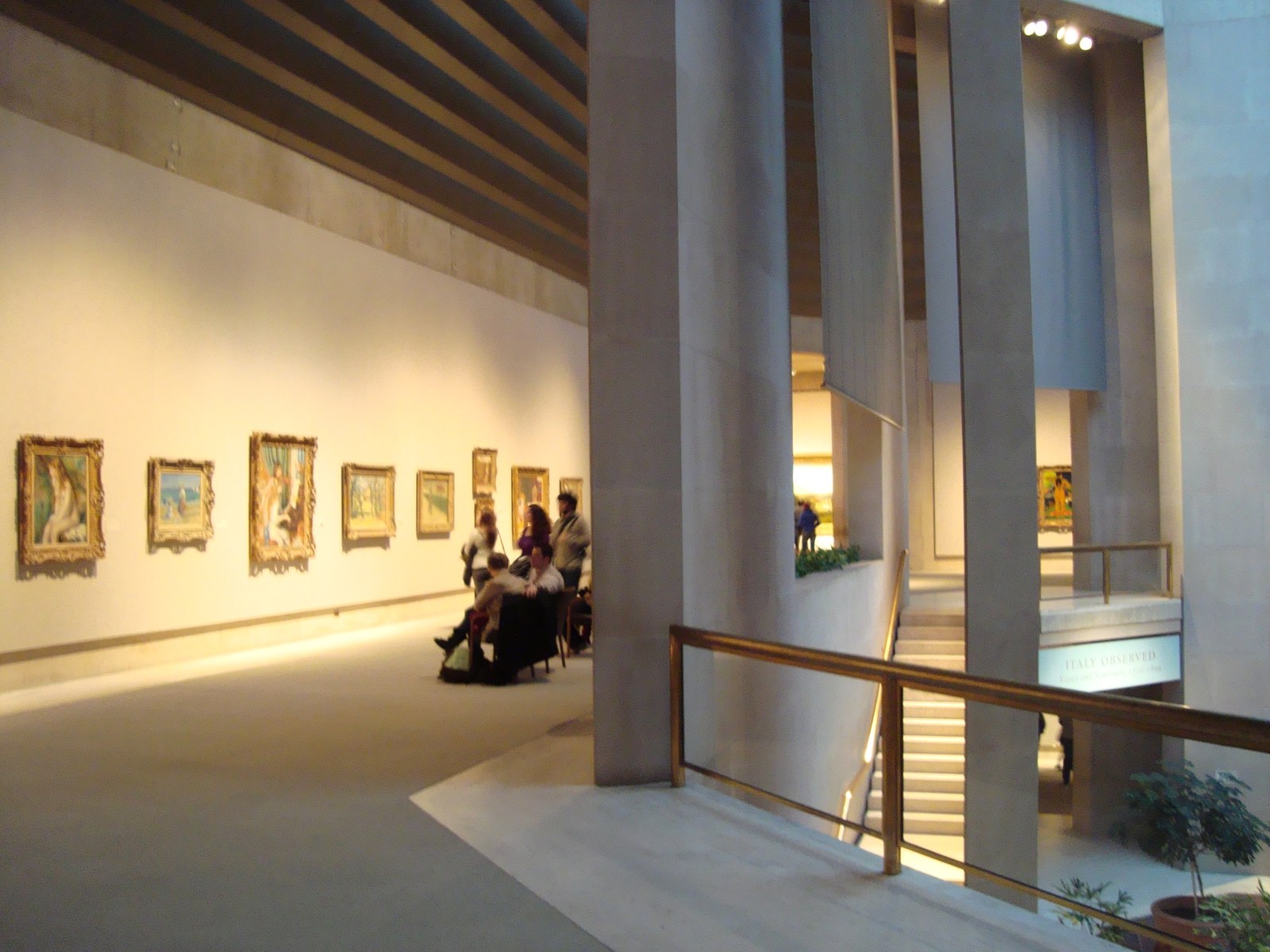
Image context: the lead image now uses an immersive museum-gallery photograph rather than an artwork reproduction. That better fits the post-publish image rule while preserving the article's structural argument: frames, wall spacing, viewer distance, and warm display light are part of how a restored object returns from lab logic into public looking.[1][2][7]
Around 1:00, isolating the polyptych against black reveals that the gold ground is structural, not background
The film's first strong move comes when the altarpiece is shown against a black field rather than in the gallery.[1] That staging changes the work immediately. In the museum, the eye can drift into "Madonna and saints" as a genre label and stop there. Against black, the pointed panel tops, lateral rhythm, and differences among the compartments become harder to ignore. The work stops behaving like one large gold rectangle and starts behaving like an articulated structure.
That matters because Giovanni di Paolo's object page already says the surviving panels once belonged to something more extensive.[2] The black presentation in the video makes that incompleteness visible without turning it into ruin fetish. One begins to see why the predella, pinnacles, and pilasters named by the museum are not marginal scholarly details but part of the picture's original thought.[2] A polyptych directs attention by distributing it. The central enthronement carries weight, but the side saints, pointed tips, and gilded separators pace the viewer's looking in a ceremonial sequence.
The close-ups in the opening minutes push the same lesson further. The Madonna's face appears with visible abrasions and interruptions in the paint; elsewhere the camera lingers on gilded edges and cracks that make the object look less like timeless devotion than like a surface that has endured handling, movement, and repeated intervention.[1] Once that physical life is admitted, the gold background no longer reads as a generic medieval sign. It reads as a worked field that can either clarify or blur the painting's hierarchy depending on how later restorers have treated it.
Around 3:00, the dismantled frame shows why overgilding can flatten a polyptych's hierarchy
The middle of the film is where the conservation argument becomes clearest. The Met's video page states that the treatment involved removing discolored varnish, old overpaints, overgildings, and reconstructions, then retouching paint losses, ingilding abrasions, and replacing missing or damaged frame elements.[3] On paper that sounds procedural. On screen it becomes interpretive. Detached frame sections sit on the worktable with dark fills, raw losses, and worn gilded edges exposed; the object looks less like a fixed relic than like a set of negotiated boundaries.[1]
This is where "overgilding" becomes an important word. More gold is not always more radiance. When later gilding or repainting grows blunt, it can erase differences that originally mattered: the distinction between painted field and frame, between sacred figure and border, between surviving medieval surface and later compensation. The video's stripped sections suggest that conservation here is partly subtractive. The aim is not to make the work uniformly splendid. It is to recover the sharpness of its intervals.[1][3]
That insight fits the larger history of Sienese painting. The Met's essay describes the tradition as one in which richly tooled surfaces and Gothic elegance remained active values, not leftovers waiting to be replaced by Florentine realism.[4] If so, then frame logic matters. Borders, pointed gables, and gilded moldings are not external decoration added after the "real" painting is finished. They belong to how the painting thinks. The film makes this easier to grasp because it repeatedly places carved and gilded members on the same interpretive plane as faces, hands, and drapery.[1][4][5]
Around 4:30, reingilding and red bole make the border legible again without pretending the object is new
The most instructive passage arrives when the camera watches a conservator brushing fresh gold across prepared frame sections and then working fine lines back into worn decorative bands.[1] It would be easy to treat this as mere finish work, the visually satisfying stage when the object begins looking expensive again. The film suggests something more exacting. Reingilding here is not about flooding the whole object with generalized brilliance. It is about restoring enough continuity that the frame can resume directing the eye.
That distinction matters because Giovanni di Paolo's art depends on luminous control, not simply on lavish material. Getty's exhibition page emphasizes his technique of working with and on gold to create masterful light effects.[6] The video translates that large claim into a local truth. Gold is persuasive only when its edges are properly disciplined. If the border is too broken, the saints lose containment. If it is too broadly renewed, the frame starts shouting over the painting. The conservators therefore work in a narrow band between legibility and falsification.[1][3][6]
The red bole visible beneath new gilding is especially revealing.[1] It reminds the viewer that sacred radiance is constructed in layers. Gold leaf is the final surface, but it depends on groundwork, pressure, and adherence. The painting's spiritual authority is inseparable from this craft sequence. That is why the article's real subject is not "restoration success" in the abstract. It is the return of relation: gilded architecture holding painted figures at the proper intensity.
Around 6:30, rehanging returns scale and interval to the saints
By the time the film moves back into the gallery, the altarpiece looks calmer, but the calm has changed character.[1] The later shots of the full ensemble on the wall make scale newly persuasive. From close range in the lab, one sees losses, joins, and tools. From the gallery distance, those repairs settle into rhythm. The pointed tops once again pull upward; the black Augustinian habit of Saint Nicholas anchors the far right; the pink drapery on the opposite side rebalances the composition; the Virgin and Child regain their central gravity.[1][2]
This return to display matters because altarpieces are made to organize looking at a distance as well as up close. The short Met perspective on Gothic altarpieces is only a minute long, but it names the core problem succinctly: assembly is interpretation.[5] Once the object is rehung, the viewer can finally test whether the restored frame members and ingilded abrasions do what they are supposed to do. They do not ask to be admired separately. They help the work breathe again as a coordinated whole.
The result is that the gold ground stops feeling like a blank medieval convention and starts acting like pictorial atmosphere. That is the strongest gift of the film. It turns a familiar art-historical shorthand, "gold-ground polyptych", back into a material drama of compartments, joins, saints, and light. The conservation process does not make the work modern. It makes the older logic legible on its own terms.[1][2][4]
Why this video is worth keeping
Many museum conservation videos are disposable once the treatment is done. This one has a longer life because it teaches viewers how to see a polyptych. It insists that devotional painting at this scale is neither pure image nor pure object. It is image built through objecthood.[1][3][5] The painted saints matter. So do the pointed frames, the losses, the removed overgilding, and the newly reestablished borders that keep one panel from dissolving into the next.
That is why Giovanni di Paolo's altarpiece starts acting like architecture once conservation reopens its joins. The film restores more than polish. It restores the work's pacing. Gold becomes interval again, not wallpaper. The frame becomes structure again, not accessory. And the saints recover the ceremonial spacing that lets the central Madonna hold the ensemble without swallowing it.[1][2][3][6]
Sources
- The Met, "Conserving the Giovanni di Paolo Altarpiece," YouTube video.
- The Metropolitan Museum of Art, "Madonna and Child with Saints" - official object page with date, chapel context, polyptych structure, and public-domain image record.
- The Metropolitan Museum of Art, "Conserving the Giovanni di Paolo Altarpiece" - video page on the two-year treatment and the removal of varnish, overpaint, overgilding, and reconstructions.
- The Metropolitan Museum of Art, "Sienese Painting" - Heilbrunn essay on Siena's Gothic elegance, gold grounds, and Giovanni di Paolo's place in the school.
- The Metropolitan Museum of Art, "Gothic Altarpiece" - short perspective on Giovanni di Paolo's Cortona polyptych as an assembled object.
- Getty, "The Shimmer of Gold: Giovanni di Paolo in Renaissance Siena" - exhibition page on Giovanni's technique of working with and on gold to create luminous effects.
- "Robert Lehman Wing - Visitors Watching Impressionist Masters," Wikimedia Commons.