
Archival footage of artists often gets reduced to charisma evidence. A studio appears, the painter speaks, the camera catches a few pauses, and the viewer leaves with the feeling of having met the person behind the work. The Met's restored presentation of The 24 Hour a Day Life of Benny Andrews is more useful than that.[1][2] It shows an artist who never lets the category of "successful painter" stand on its own. Studio practice, teaching, museum protest, and prison arts appear in the film as one connected field of obligation.
That is what makes the documentary a strong archival spotlight subject for art writing now. Andrews is easy to summarize too quickly: a figurative painter from Georgia, a master of fabric collage, a cofounder of the Black Emergency Cultural Coalition, an educator who spent decades at Queens College.[3][4][5] All of that is true, but the film gives those facts a working rhythm. It shows that Andrews's idea of art was never organized around private ascent. The question of whether he had "made it" only matters because he keeps pushing back against the idea that individual recognition could settle anything important.[1][3]
The longer historical frame sharpens that refusal. The Benny Andrews Estate biography traces his early life through Plainview, Georgia, sharecropping labor, interrupted schooling, Air Force service during the Korean War, and then the GI Bill path that brought him to the School of the Art Institute of Chicago before he moved to New York in 1958.[5] The Studio Museum's biography adds the next decisive turns: collage entered his practice before graduation, he began teaching in 1966, started what became a thirty-year tenure at Queens College two years later, and in 1969 helped found the BECC after Harlem on My Mind excluded both Black artists and Harlem residents from meaningful authorship.[4] By the time the documentary camera arrived, Andrews was already living inside several roles at once. The film matters because it does not simplify that multiplicity. It preserves it.
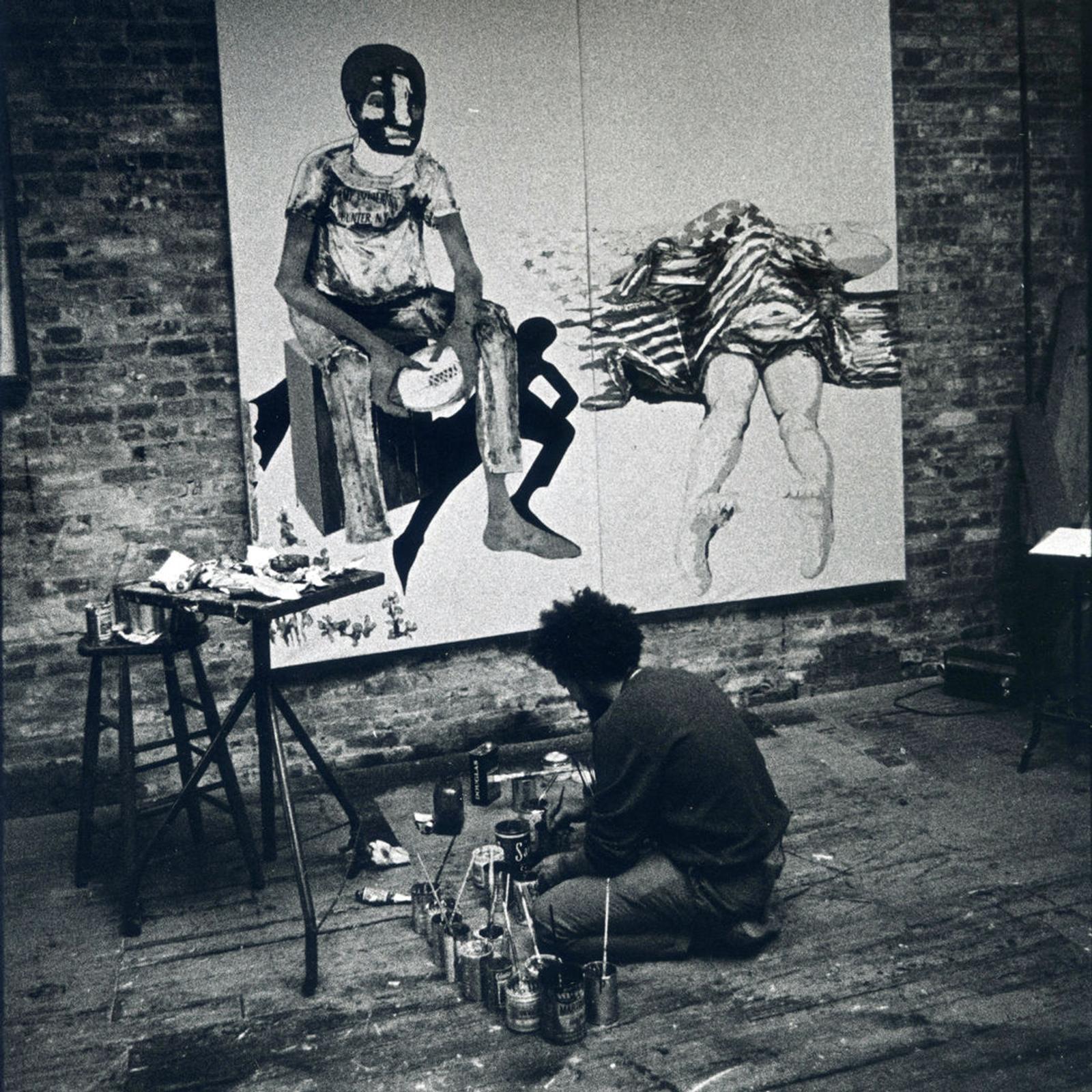
Image context: the cover uses The Met's archival black-and-white photograph of Andrews in his studio, back turned toward the camera while he faces No More Games in progress. It fits this piece because the article's central claim depends on seeing Andrews not as a detached public intellectual but as a painter whose political commitments are inseparable from the room where the work is actually made.[3]
The provenance is unusually clear. The Benny Andrews Estate identifies The 24 Hour a Day Life of Benny Andrews as a 1974 documentary produced and directed by John Wise, filmed in New York during the spring and summer of 1972.[2] The same estate note says the film was restored by The Met and newly shared through the museum's From the Vaults program, while the museum's official YouTube upload places that republication on February 4, 2022.[1][2] What we have, then, is not loose internet footage but a documented archival object with a visible preservation path.
1) The historical context matters because Andrews built his practice against the fantasy of solitary arrival
The film opens with the most useful possible question: whether Andrews feels he has "made it."[1][3] The obvious answer, given the documentary's date, would have been yes. By the early 1970s he had established a visible New York career, developed a recognizable collage language, and moved into teaching and institutional debate with unusual force.[3][4] Yet the power of the footage lies in how quickly he refuses to let professional recognition count as a full measure of success.
Williams's Met essay quotes Andrews's answer in language that still feels bracing: publicity or a sale or two does not mean much if the artist cannot involve more people from the community and involve himself more deeply in that community.[3] That statement is the hinge for the entire documentary. It reorders everything that follows. The studio is not a private refuge after public conflict. It is one node in a larger argument about access, representation, and artistic usefulness.
This is where the earlier biographical facts stop reading as background and start reading as structure. Andrews's childhood in rural Georgia and his late, hard-won path into formal art education mattered because they made social exclusion impossible for him to romanticize.[5] His later teaching career mattered for the same reason. The artist in this film is not speaking from the illusion that institutions will naturally widen themselves. He already knows that education, museum access, and public recognition have to be fought over.
2) The documentary's studio scenes matter because No More Games turns the room into a political argument
The most striking visual thread in the archival material is Andrews in the studio beside or facing No More Games.[1][3] The Met essay identifies the work as a 1970 painting built from oil, canvas, garment fragments, and printed fabrics, a two-part composition that stages a Black boy on one side and a body covered by the American flag on the other.[3] That description helps explain why the studio footage feels so charged. The work is not simply present as one picture among others. It functions like a declaration of the scale Andrews thought painting had to bear.
That scale is crucial. Andrews had already committed himself to figurative art that kept the pressure of American race relations inside the body and inside material surfaces.[3][4] Collage, in his hands, is never decoration. Fabric carries class, touch, labor, and damage into the painting. When the film places him in front of No More Games, it shows a painter who is not separating formal experiment from historical argument. The room is full of evidence that those two things are the same practice.
The image used for this article intensifies that point.[3] Andrews is seen from behind, his face withheld, while the unfinished painting holds the viewer's attention. It is an ideal archival photograph for this subject because it reverses the usual artist-portrait logic. Instead of inviting us to admire personality first, it puts labor first: a body at work, a canvas still unresolved, a political image mid-formation. That is exactly how the documentary wants to be watched.
3) The footage becomes even more important once teaching and prison arts enter the frame
The documentary would already matter if it only preserved Andrews talking in the studio. It becomes much stronger because it follows him into teaching spaces.[2][3][4] Williams notes that by the 1972 filming, the BECC had shifted much of its focus toward the Prison Arts Program that Andrews established the previous year, and the documentary tracks him, fellow artist Cliff Joseph, and other volunteers into the Manhattan Detention Center.[3] The Studio Museum biography confirms that the program expanded nationally and remained central to Andrews's work through the 1970s.[4]
This is the section that prevents the film from being mistaken for a studio profile with political garnish. Andrews's remarks about higher education and underserved communities are not abstract policy commentary.[1][2] They are tied to practice: who gets taught, who gets taken seriously as a maker, who gets invited into the category of culture at all. The art world often prefers activist artists when their activism can be staged as a moral supplement to already-legible work. This documentary records something harder. Andrews is building cultural infrastructure at the same time that he is painting, and he does not let the viewer imagine one activity as nobler or more "real" than the other.
That is why the archival footage feels contemporary without needing to be updated. The central question is still live: what does it mean for an artist to succeed in institutions that remain structurally unequal?[1][3][4] Andrews's answer is not to reject institutions wholesale, but to keep forcing them toward wider use while building parallel structures where they fail. The film preserves that strategy in motion.
4) Why this footage matters now
The easiest way to honor Andrews would be to split him into a few admirable nouns: painter, educator, activist.[1][4][5] The documentary refuses that convenience. It shows that each role altered the others. Teaching changed what the studio was for. Prison arts changed what it meant to talk about audience. Museum protest changed the meaning of recognition. Even the language of "making it" gets exposed as too narrow for the kind of life Andrews was trying to build.[1][3]
That is why this archival spotlight matters now. Contemporary institutions are better at celebrating socially engaged art than at preserving the difficult relation between art and obligation that produced it. Andrews's documentary keeps that relation visible. It shows an artist who wanted freedom of imagination, who insisted on the right to make pictures that looked and felt like Black life, and who also treated access to art as a public problem rather than a private prize.[1][2][3][4]
The film's afterlife completes the argument. A documentary filmed in 1972, released in 1974, restored decades later, and uploaded by The Met in 2022 now returns to viewers carrying not only Andrews's voice but also an institutional record of what museums once resisted and later had to learn to preserve.[1][2][3] That does not settle the contradictions. It makes them legible. The archive is valuable here because it lets us watch a painter refusing to leave his community behind, even at the exact moment when the culture around him wanted to measure success that way.
Sources
- The Met, "The 24 Hour a Day Life of Benny Andrews," YouTube video, published February 4, 2022.
- Benny Andrews Estate, "The 24 Hour A Day Life of Benny Andrews, 1974" in Interviews and More - documentary note with director, filming dates, and restoration context.
- Kyle Williams, "Benny Andrews: Looking for That 'Bigger Thing'," The Metropolitan Museum of Art.
- Studio Museum in Harlem, "Benny Andrews" - artist biography covering collage, BECC, Queens College, and prison arts.
- Benny Andrews Estate, "Biography" - illustrated chronology of Andrews's early life, military service, study, and career.