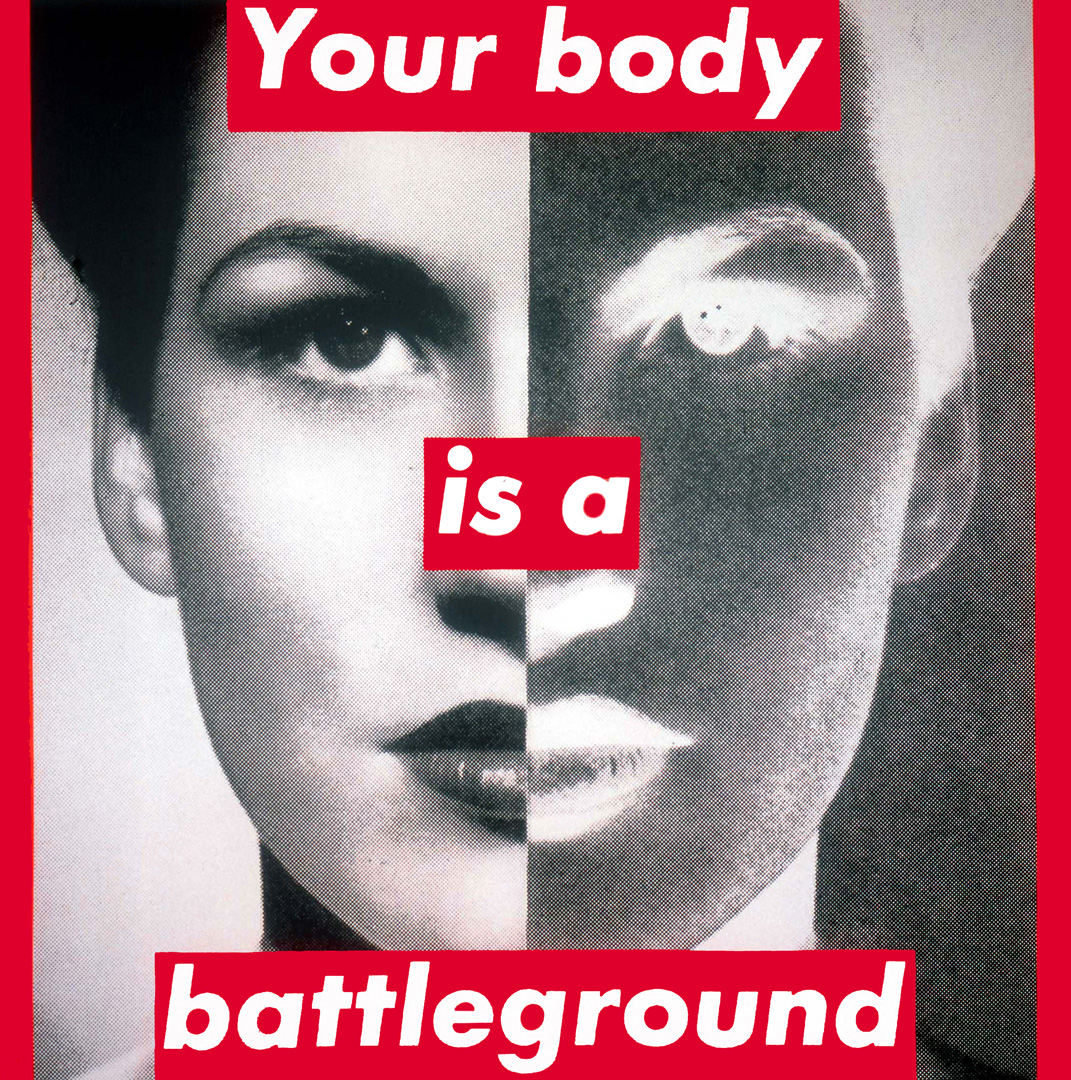
Barbara Kruger's Untitled (Your body is a battleground) does not ask to be contemplated from a comfortable distance. It acts more like public language that has found its final form: frontal, compressed, accusatory, and almost impossible to soften. The work was produced in 1989 for the Women's March on Washington in support of reproductive freedom, and The Broad's collection text places it inside the renewed pressure on abortion rights after the 1973 Roe v. Wade decision.[1] That origin matters, but it is not enough to explain why the image has kept its charge.
The stronger reason is formal. Kruger turns a protest sentence into an image machine. A woman's face is split into positive and negative exposures. The words sit across it like a command, not a caption. Red, white, and black organize the field with the force of a warning label, a tabloid headline, and a street poster at once.[1][3] The result is neither only graphic design nor only political art. It is a work about what happens when bodies are argued over by language that claims to speak for them.
The Face Is Already Divided
The work's most efficient decision is the bisected face. One half reads as positive photographic information; the other reverses into negative. This is not a decorative before-and-after effect. It makes division visible before the viewer has time to process the slogan. The body is already a contested field. The face has already been split by systems of looking, naming, legislating, advertising, and moralizing.[1]
That split also prevents the image from becoming a simple portrait. The woman is anonymous, cropped, and held near the surface. We do not learn her biography. We are not invited to turn her into a case study. Instead, her face becomes a public interface, the place where social claims about femininity, sexuality, autonomy, and vulnerability arrive as visual pressure. The individual does not vanish, but she is made to carry a collective argument.
This is where the work differs from a campaign poster that merely illustrates a cause. Kruger does not show the viewer a scene of protest. She makes protest happen inside the structure of the image. Positive and negative, exposed and obscured, face and type, body and command: every part of the composition is built from opposition.
The Sentence Uses The Second Person
"Your body is a battleground" is powerful partly because it refuses the safer grammar of description. It does not say "women's bodies are contested" or "the body is political." It says "your." That pronoun drags the viewer into the argument. The work does not let the body remain abstract, even when the face is not named.
Kruger's broader practice often depends on this kind of address. The Broad's artist page frames her work around the merger of words and images in a language borrowed from mass media, advertising, and politics.[5] Sprueth Magers similarly identifies her use of pointed text and photographic imagery across formats that move between print, installation, and public address.[4] In Your body is a battleground, that strategy becomes unusually exact. The phrase sounds like a slogan, but it also behaves like an accusation and a diagnosis.
The red word block is crucial. It does not float politely over the image. It interrupts the face at mouth level, where speech would be expected. The figure's own voice is covered by a sentence that speaks outward. That placement turns the work into a problem about representation: who gets to speak about the body, who is spoken over, and how public language can both mobilize and compress lived experience.
Poster Design Becomes Fine Art Without Becoming Polite
David Zwirner's artwork page gives the material fact plainly: the 1989 work is a photographic silkscreen on vinyl, 112 by 112 inches, in The Broad, Los Angeles.[3] Those details matter because scale changes the poster logic. A small flyer can be handled, folded, taped, or carried. At nearly nine and a half feet square, the image becomes architectural. It confronts a viewer with the bluntness of a sign but the physical authority of a museum-scale object.
Kruger's background in magazine and graphic language is often mentioned because it is visibly embedded in the work's grammar. Yet the image should not be reduced to a clever transfer from commercial design to art. Its force comes from keeping the commercial language abrasive. The clean typography, cropped face, and limited palette promise instant legibility, then make that legibility uncomfortable. The work is easy to read and difficult to neutralize.
This is why the square format is so effective. It denies the drifting space that a more atmospheric composition might allow. The face is centered; the text is centered; the border holds the field. Everything presses toward declaration. The image uses design discipline to remove exits.
A Protest Origin That Keeps Reopening
The 1989 context is not a period detail. It is part of the work's engine. The Broad identifies the piece with the Women's March on Washington and the politics of reproductive freedom.[1] JSTOR Daily's retrospective account likewise treats the image as a work whose historical moment keeps returning, especially whenever reproductive autonomy is pushed back into public crisis.[2] The reason the work remains current is not that nothing has changed. It is that the image was built around a structure of conflict that can be reactivated.
That afterlife is visible in later versions and exhibitions. Art Basel's account of Kruger's Your body is a battleground traces the work's movement through later installation contexts, including the 1989/2019 form shown at David Zwirner.[7] The shift from silkscreened image to later media does not simply update the work for a new technical platform. It tests whether the sentence can survive new circuits of attention: gallery wall, LED panel, social-media image, museum collection, street memory.
It can, because the original design already understood circulation. Kruger's image does not depend on painterly nuance that disappears in reproduction. It was built to move through reproduction while still feeling severe. A small phone image weakens its scale, but not its grammar. The split face and red command still arrive fast.
The Work Refuses A Stable Viewer
The most important thing to notice is that the work does not offer one settled viewing position. If you approach it as a feminist protest image, it works. If you approach it as a critique of media language, it works. If you approach it as a study in photographic reversal and graphic compression, it works. But each reading corrects the others. Politics without form makes the work sound like a slogan. Form without politics makes it look like style. Media critique without bodily stakes makes it too cool. Kruger binds the three together.
That binding is why the piece still feels sharp rather than merely iconic. An icon can become decorative once people know how to recognize it. Your body is a battleground resists that fate because recognition is only the first step. Once recognized, the image asks what kind of public world makes such a sentence necessary. It asks why a face must be split in order to describe a body under dispute. It asks why graphic certainty is needed when legal, social, and bodily certainty is exactly what is being contested.
Kruger's achievement is not that she made an unforgettable protest poster and then museums preserved it. It is that she made a work in which preservation does not tame protest. The museum object still speaks in the grammar of the street. The slogan still interrupts the face. The viewer is still addressed as "your." The battleground is not safely behind the image. It is the space the image creates between public language and the person standing in front of it.
Sources
- The Broad, "Untitled (Your body is a battleground) - Barbara Kruger" - collection page for the 1989 photographic silkscreen, including origin, medium, image, and interpretive text.
- JSTOR Daily, "The History of 'Your Body Is A Battleground'" - retrospective account of the image's 1989 political context and later resonance.
- David Zwirner, "Barbara Kruger, Untitled (Your body is a battleground), 1989" - artwork page with medium, dimensions, collection, and image.
- Sprueth Magers, "Barbara Kruger" - artist page with selected works, biography, media, and later versions of Your body is a battleground.
- The Broad, "Barbara Kruger" - artist page summarizing Kruger's use of words, images, media language, and politics across the collection.
- The Broad, source JPEG for Barbara Kruger's Untitled (Your body is a battleground) used as the article image.
- Art Basel, "Your body is a battleground" - article on the work's afterlife, later installation views, and 1989/2019 presentation contexts.