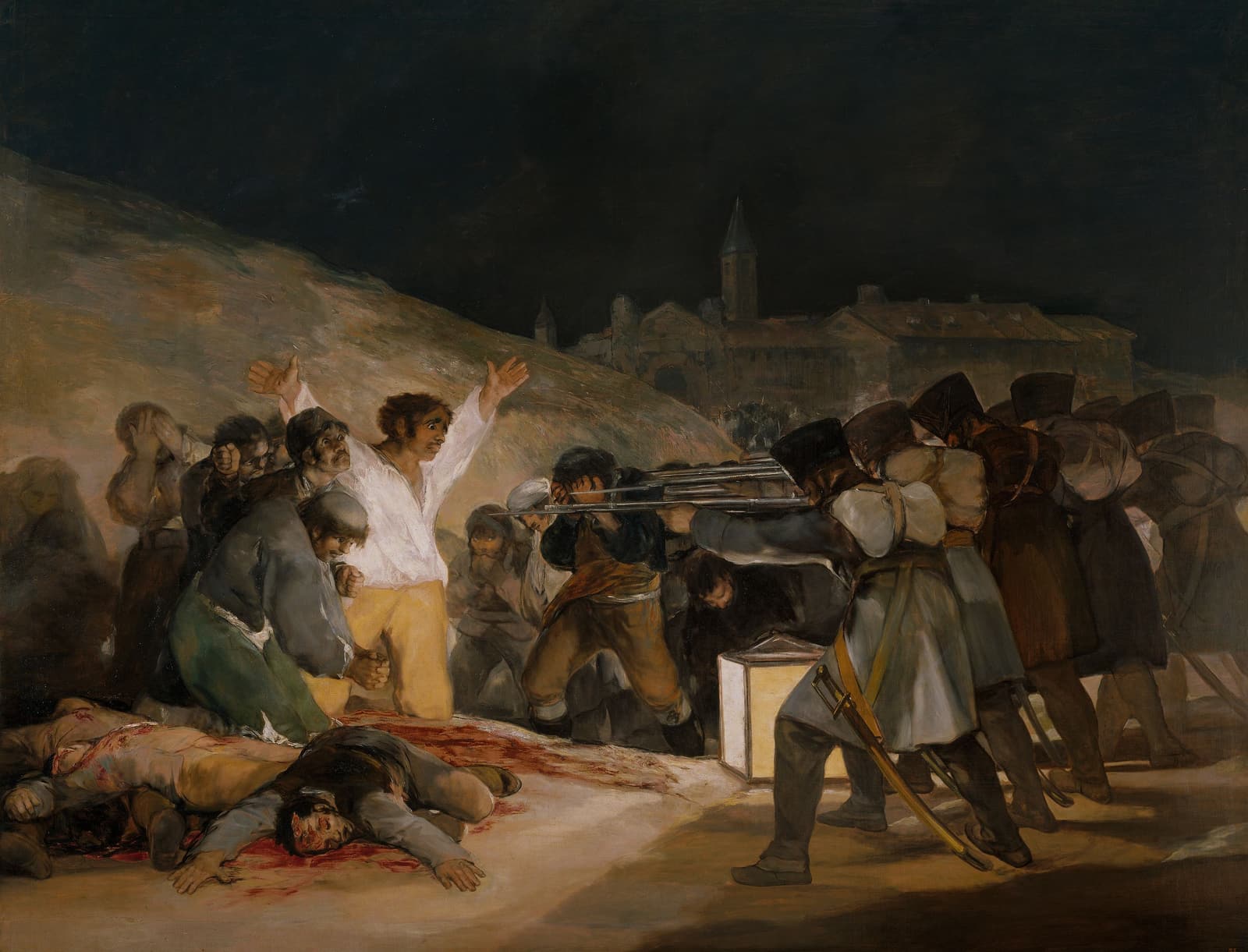
Francisco Goya’s The Third of May 1808 (1814) is often treated as a canonical anti-war image, but the phrase is too broad to explain why this canvas still feels immediate.[1][2] A closer look shows a more exact mechanism: the painting does not simply represent violence, it stages the viewer’s moral position inside violence through where light falls, where faces disappear, and how space is cut into irreversible sequence.
The painting’s first decision: two human systems, only one face-system
Prado’s catalogue anchors the basic scene: French troops execute Spanish captives outside Madrid after the Dos de Mayo uprising and subsequent repression.[1] Goya builds this into a split machine.
On the right, the firing squad appears as near-identical backs and shakos: a compact block with synchronized posture. On the left, the condemned group is structurally heterogeneous—praying, recoiling, stunned, already collapsed. One side is a procedure; the other is a spectrum of human response.
That contrast is not just narrative. It is formal governance. The soldiers are painted as repeatable units; the victims are painted as singular bodies. The eye reads this asymmetry before it reads history.
Lantern logic: illumination as accusation, not consolation
The center lantern is the operational hinge. Its light does not reveal a neutral scene; it assigns ethical priority.
- It fully exposes the man in white with raised arms.
- It partially catches the waiting line behind him.
- It leaves the armed line mostly in darkness from the viewer’s side.
The result is an inversion of heroic battle painting. Traditional battle canvases often dramatize victorious command through illumination. Here, illumination isolates vulnerability.[2][3] The brightest figure is not the actor with power; he is the next body in a queue.
This is why the painting feels modern in a specifically political sense: light behaves like evidence.
Gesture architecture: the raised arms are not a single symbol
The central figure’s outstretched arms are often read through Christian echo (a cruciform pose), and that reading is valid as one layer.[2][4] But close viewing suggests a double register.
At the same moment, the pose reads as:
- surrender (palms open, body exposed), and
- involuntary enlargement (a body making itself visible under terminal pressure).
Goya keeps both readings active. He does not let the figure settle into pure martyr iconography or pure documentary realism. This semantic instability is crucial: it widens the painting’s audience beyond one doctrinal frame and makes the scene legible as recurring state violence, not a single sacred episode.
Ground and distance: why the hill and city are painted this way
The hill behind the execution and the dim architecture of Madrid are intentionally under-specified.[1][5] They do two jobs.
First, they deny scenic relief: there is no expansive landscape exit for the eye. Second, they prevent the city from becoming a sentimental backdrop. Urban presence remains, but muted and inert, as if civic life has temporarily failed to intervene.
Compositional pressure therefore stays on the foreground chain: armed line → muzzle direction → kneeling/waiting figures → dead bodies with visible blood. The viewer is kept inside temporal succession, not invited to panoramic contemplation.
Serial time in one frame: already dead, about to die, watching death
One reason the painting retains force is its time-structure. Goya fuses at least three moments into one field:
- bodies already executed in the foreground,
- the central imminent shot,
- witnesses-in-wait behind him.
In other words, this is not an instant snapshot but a compressed cycle. Art-historically, that move helps explain why later war imagery—from Manet’s execution scene to modern photojournalism—can treat repetition, not just singular climax, as the core grammar of political horror.[2][6]
Why this work still reads clearly in 2026
The painting survives constant reproduction because its legibility does not depend on owning the full Napoleonic timeline. The core visual contract is immediate:
- anonymous force is systematized,
- individual vulnerability is illuminated,
- death is shown as process rather than event.
That contract remains transferable across eras. In this sense, The Third of May 1808 is not only a historical image of Spain in 1814; it is a durable interface for seeing how power arranges bodies in public.
Sources
- Museo Nacional del Prado, The Third of May 1808 in Madrid, or “The Executions” (catalogue entry)
- Khan Academy, Goya, The Third of May 1808
- Encyclopædia Britannica, Francisco Goya
- Smarthistory, Goya, The Third of May 1808
- Museo Nacional del Prado, The Second of May 1808 in Madrid (The Charge of the Mamelukes)
- The Metropolitan Museum of Art, Heilbrunn Timeline of Art History, Goya (1746–1828)
- Wikipedia, The Third of May 1808
- Wikimedia Commons file record, El tres de mayo de 1808 en Madrid (image metadata/source)