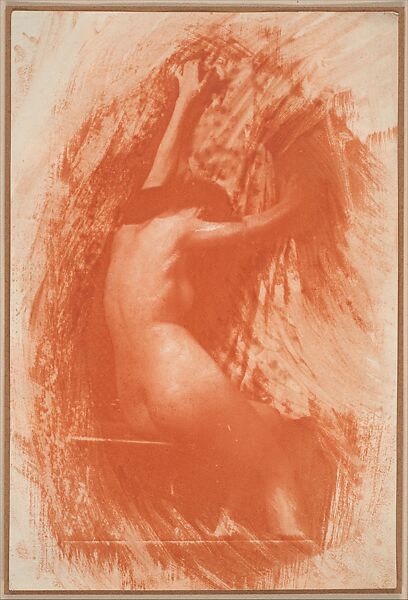
The orange in Robert Demachy's Struggle belongs to the print. It is a choice of material, carrying the photograph toward the warm, powdery world of a life drawing. The Metropolitan Museum of Art dates its example to 1903 or earlier and identifies that color as a deliberate evocation of sanguine, the reddish chalk used by draftsmen.[1]
That resemblance begins with the way the image was made. In gum bichromate printing, pigment is held in a light-sensitive gum coating. Exposure and washing determine how much of that coating remains; a brush can intervene along the way.[2][3] A photographer could therefore make decisions about the image after the camera had done its work, changing the balance between a recorded subject and a worked surface.
The attraction is easy to understand. A negative fixes a view. It need not fix every decision about the picture that follows.
Light decides what stays
The process starts with paper coated in gum arabic, pigment, water, and a bichromate sensitizer. The V&A describes the usual exposure as a contact print: the negative rests against the sensitized surface while light passes through it.[2] The negative regulates illumination across the sheet, translating its pattern into differences in the coating's resistance to washing.
Getty's technical vocabulary makes the division of labor clear. Gum arabic supplies the binder; pigment supplies the visible image. Light hardens the sensitized coating in proportion to exposure. Washing removes the unhardened material, allowing the underlying support to appear as highlights and intermediate tones.[3]
Think of a highlight as a place where more paper is allowed back into the picture. In a darker passage, more pigmented material remains. The image emerges through selective survival: some of the coating stays attached, and some leaves in the water.
This explains why the word pigment matters. A colored gum print is not necessarily a record of the subject's original colors. The printer chooses the material that will carry the image. Demachy's orange can make a photographic figure recall a chalk study because its hue belongs to that choice.[1] The camera and the printing surface contribute different kinds of information.
The brush has something to negotiate
The V&A emphasizes the control available through brushing and washing: working the exposed coating could alter contrast and produce effects associated with drawing or painting.[2] Local intervention was an artistic possibility, rather than a requirement to redraw every part of every gum print. Light had already established a pattern for the printer to work with.
That distinction gives the technique its tension. A brush meets a surface whose response has been shaped by exposure. Removing material can lighten a passage or reduce its insistence; leaving pigment can preserve a dark mass. The printer works with a photographic structure while deciding how strongly different parts of it should speak.
For a viewer, this makes softness worth a second look. An indistinct edge might help a shoulder turn, let a background recede, or draw attention toward a firmer contour. Those are possibilities for reading a print, not a license to reconstruct its manufacture from a reproduction. A soft passage alone cannot tell us which brush moved where.
Demachy's practice had an institutional purpose as well as a tactile pleasure. The Met places him at the center of French Pictorialism and connects his painterly photographs to an effort to distinguish art photography from commercial pictures and amateur snapshots.[1] Visible craft could serve as an argument about status. Looking at the print today, we can recognize that ambition without accepting a hierarchy in which every brushstroke automatically improves a photograph.
Color can be another printing
Gum also allowed photographers to build on an image made by another process. The Met's The Flatiron, photographed by Edward Steichen in 1904 and printed in 1909, has a platinum-print foundation. Steichen added color through layers of pigmented, light-sensitive gum. The museum holds other versions in different colors.[4]
Here, the distinction between the date of a photograph and the date of a print becomes especially useful. The camera exposure supplies an image that can be returned to. A later printing interprets it through materials and color. A city view can retain its recognizable structure while its atmosphere changes from one version to another.
MoMA documents a related layering in Steichen's Moonrise—Mamaroneck, New York of 1904. Its account describes repeated printing in different colors and the rubbing away of parts of the image to reveal bright paper in the moon and between the trees. The museum also identifies platinum and ferroprussiate alongside gum bichromate in the object's medium.[5] It is a composite construction, and its effects cannot all be assigned to gum alone.
These examples expand what handwork can mean. It includes choosing pigments, building layers, and removing material, as well as leaving an obvious brush mark. The artist's decisions may be most effective where they become difficult to isolate.
Look at the print as an object
An online reproduction gives us access to Struggle while compressing its physical presence. The Met records an image only 17.4 centimeters high.[1] On a screen, it may appear larger than the original. Enlargement can make surface marks assertive without reproducing the experience of approaching a small sheet of paper.
Still, the reproduction offers a useful way in. The seated figure turns away, an arm raised beside the head. The pale back has a rounded, bodily presence; around it, streaks of orange make the surface restless. Look from the curve of the back to those broken marks. Attention travels between the body and the substance carrying its likeness.
Gum bichromate gave that second encounter unusual room. The shutter closed; the picture stayed open to work.
Sources
- The Metropolitan Museum of Art, Robert Demachy, Struggle, 1903 or earlier — object record, dimensions, orange pigment, Pictorialist context, and image source.
- Victoria and Albert Museum, “An A to Z of photographic processes,” gum bichromate section — coating, contact exposure, and manipulation through brushing and washing.
- Getty Research Institute, Art & Architecture Thesaurus, “gum bichromate process” — binder, image material, light hardening, and wash development.
- The Metropolitan Museum of Art, Edward J. Steichen, The Flatiron, 1904, printed 1909 — gum layers over platinum and differently colored versions.
- The Museum of Modern Art, Edward Steichen, Moonrise—Mamaroneck, New York, 1904 — combined processes, repeated color printing, and selective removal of image material.