Follow Gudea’s bare arm from the shoulder to the elbow. There is a good deal of muscle for a man sitting quietly on a stool. At the elbow the arm turns inward, and the hand folds into its partner. The sculptor has taken some trouble to show how much strength goes into a gesture that a worshipper could hold for hours. For Gudea, ruler of the southern Mesopotamian city-state of Lagash, even hours would have been too short. He commissioned stone likenesses that could take his place in a temple and keep praying when he went home. [1][2]
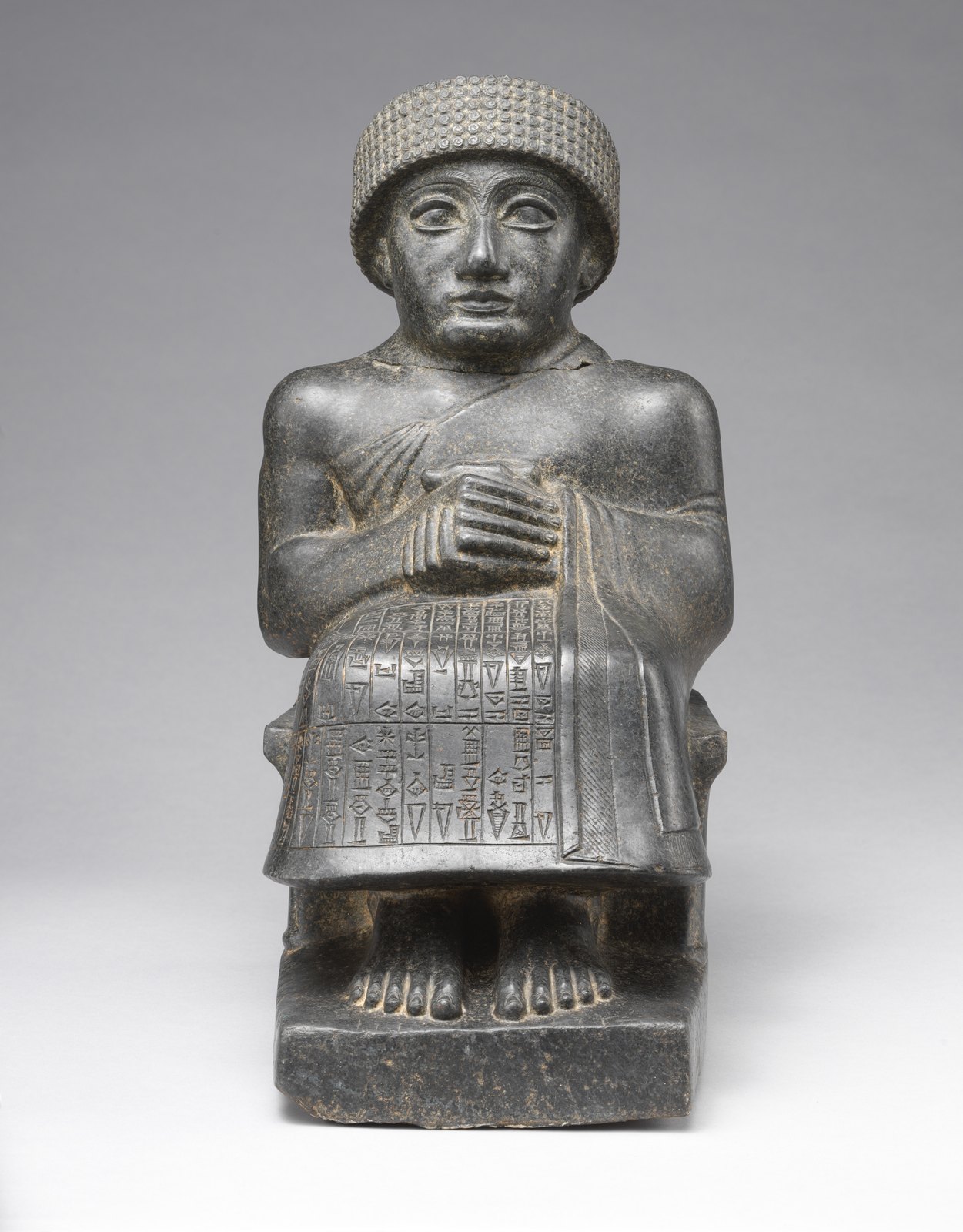
The head and the seat give him an air of command. He faces straight ahead. The brim of his cap makes a ledge above the eyes, and the little curls carved into it suggest the texture of fleece. The seat allows him to receive an audience like a ruler. His hands complicate the question of who has come to see whom. In a temple, before a god, Gudea himself is the visitor. His hands offer the same greeting for as long as the figure stays in place. [1][2]
Below them, the robe gives the eye a different kind of work. The broad stretch of stone across the knees could have accommodated a whole building plan. We know this because another seated Gudea, now in the Louvre, has just such a plan on his lap, complete with a stylus and a graduated ruler. That figure gives a god something like a drawing to inspect. On the Metropolitan Museum’s Gudea, the first wedge-shaped signs begin just below the hands. They travel over the curve of the knees and down the front of the skirt. A narrow strip of cloth alongside the writing hangs as straight as the margin of a page. The tools have disappeared, and the builder gets to tell us what happened after the buildings were finished. [1][3]
The inscription first gives an account of temples Gudea built, including a house at Girsu for his personal god, Ningishzida. Then its attention shifts to someone in the future who might also be addressed by a god. Gudea asks that person to speak the name of the house and to remember its builder by name as well. In this account of royal works there is suddenly room for a friend. Friendship here has a modest, precise obligation. It takes only a breath to say a name. [1]
At the end comes the name Gudea gave the statue itself. In the Met’s translation it reads, “Let the life of Gudea, who built the house, be long.” Try saying the name aloud. By the time you have identified the object, you have also made the wish. The carving has given a seated man with closed lips a way of borrowing someone else’s voice. [1]
A second small Gudea in the Louvre, also dedicated to Ningishzida, wears the cap and sits with his hands joined. Set the two figures beside each other in your mind and the repeated pose begins to look a little like the repeated words. Another sculptor could carve those hands, another visitor could pronounce that name, and each could renew the greeting. There is a tenderness to the request at the hem of the Met figure. The ruler who could order temples built and hard stone carved still had to ask someone else to remember him. [1][4]
Sources
- The Metropolitan Museum of Art, seated statue of Gudea (59.2), with object photography and Dietz-Otto Edzard’s translation of the inscription.
- The Metropolitan Museum of Art, Art of the Ancient Near East, object 10, on Gudea’s pose, dress and role in the temple.
- Musée du Louvre, Gudea B dit « Architecte au plan » (AO 2), with the plan and drawing tools.
- Musée du Louvre, Petit Gudea assis (AO 3293), a seated figure dedicated to Ningishzida.