There are two ways to run a finger across this Staffordshire teapot. Follow a rib of the scallop shell and you could find your way with your eyes shut. Follow a brown vein through the cream and you would have to look. The glaze feels smooth across the change of colour. Both patterns belong to the wall of the pot, and each preserves the work of a different tool. [1][2]
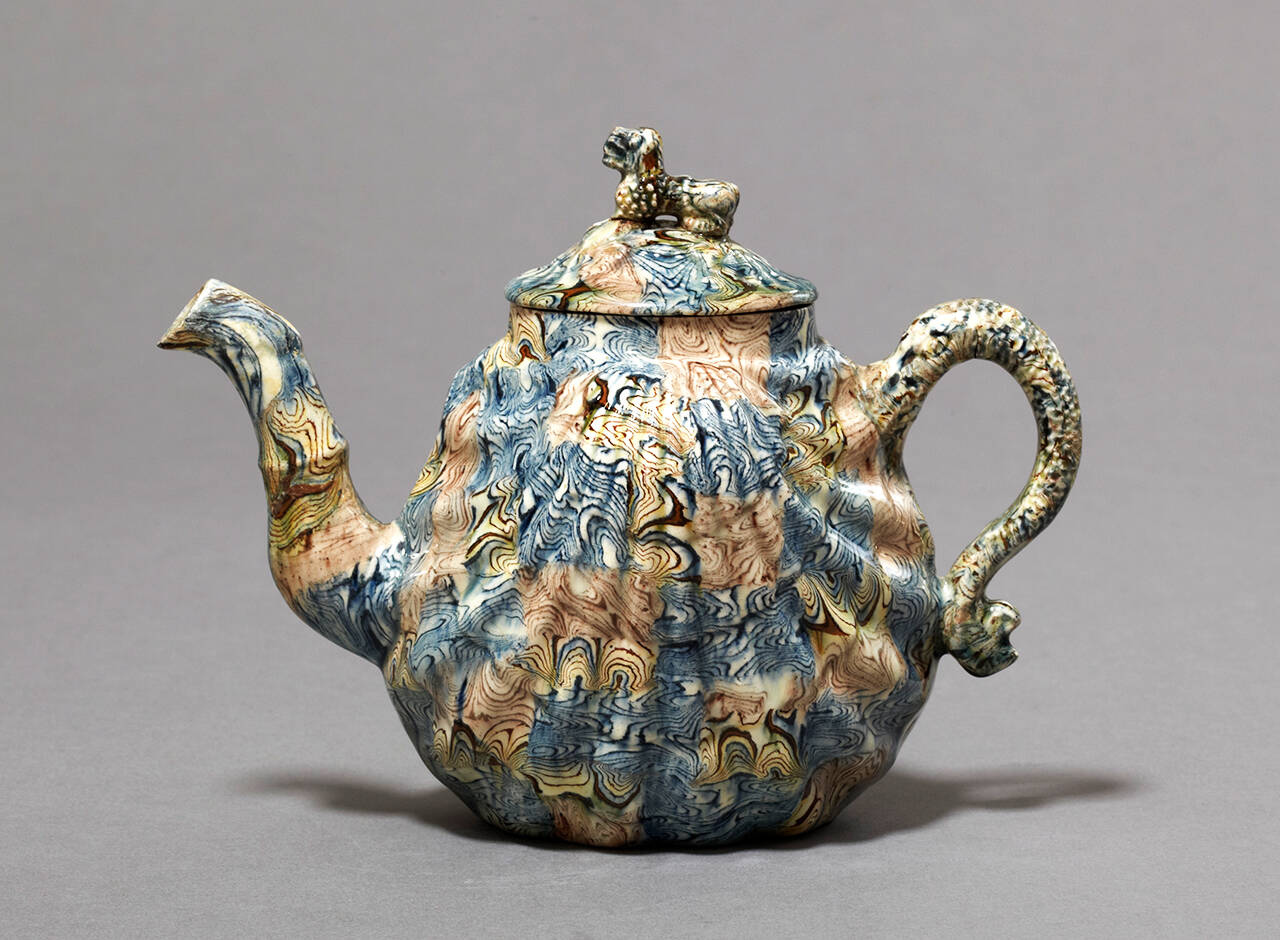
The pot takes its name, agateware, from a stone whose bands emerge when someone cuts it open. A potter working in solid agateware had the unusual pleasure of making the geology too. A stack of thin sheets of contrasting clay will show just one colour on top. Slice across it and the cut face carries a stripe for every layer the blade passed through. Turn that face towards the person who will pour the tea and a decision made deep inside a lump of clay ends up in plain sight. [1][2]
On a surviving diamond-shaped teapot, catalogued by ceramics collector Troy Dawson Chappell, the sequence is particularly legible. Thin layers were cut across, and the resulting strips arranged so the brown lines made little squared turns in the cream. The potter fitted the patterned slabs against the inside of each half of a mould, edge against edge, then joined the two hollow halves. Imagine laying two strips side by side on the workbench. Turn one end for end and the marks meet differently, although the strips still fit the same space. The mould settled the outline of the vessel. It left the maker considerable say over what happened at the meeting of two strips. [2]
A shell complicates the job in a lovely way. Its ribs spread out like an open fan, giving the eye a ready-made set of paths. The veins in the clay have paths of their own. Look just above the foot, to the right of centre. A cream patch holds a pair of little dark arches like upright horseshoes. Immediately to its left, blue lines run almost sideways. From a distance the mottling looks wonderfully unruly. Up close you can pick out the edges of the pieces that compose it. In 2012, when ceramicist Michelle Erickson set out to reproduce this pot at the V&A, she had the original to measure. Measurements could give her the width of the shell. Reconstructing the folds of colour required fresh experiments with layers of clay. [1]
Another shell pot, made in Staffordshire around 1755–60 and now at Colonial Williamsburg, pairs cream clay with teal blue. It too carries a lion on the lid. Put the two descriptions side by side and you could give a potter a fairly precise order for the next one, down to the creature you would grasp to lift the cover. You would still have little idea where any particular blue streak would go. That balance between a familiar shape and a particular piece of clay was available even in objects small enough to pass across a table. [1][3]
At the Nelson-Atkins Museum of Art, the same technique turns up on a pug and a hare. Dark and light clay supply the markings of their coats under a colourless glaze. A vein that reads as mineral grain on the flank of a teapot can read as fur once it runs across an animal's back. Look again at the shell. The sea supplied its ribs, a stone suggested its colours, and the potter found room for both in a handful of earth. [4]
Sources
- Victoria and Albert Museum, “How was it made? An agate teapot.” Museum photograph and Michelle Erickson’s reconstruction.
- Troy Dawson Chappell, An English Pottery Heritage, part 2, entry 215. Construction of the lozenge teapot and lid.
- Colonial Williamsburg, “Teapot,” 1755–1760. Cream and teal shell teapot, object 2005-146,A&B.
- Nelson-Atkins Museum of Art, “Teapot.” Gallery label on agateware glazes and animal figures.