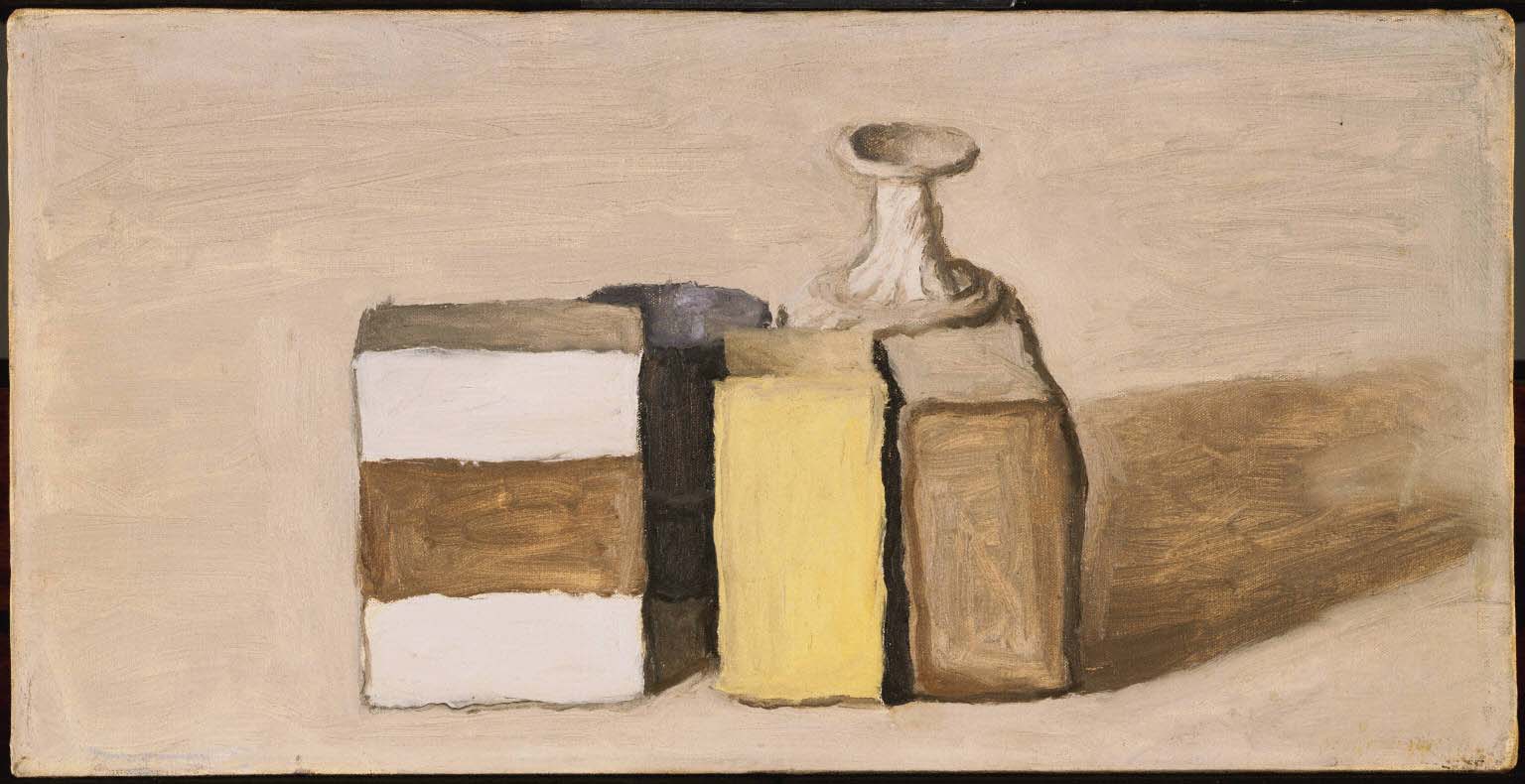
Giorgio Morandi is routinely described as a painter of quiet, and the label is accurate only if quiet is understood as something built under pressure.[1][2] His most famous still lifes do not offer anecdote, luxury, or theatrical symbolism. They offer bottles, boxes, jars, tins, and a table edge. Yet the longer one looks, the less those objects behave like inventory. They begin acting like units in a severe relational system: one pale cylinder thickens the air beside a darker bottle; a striped carton steadies the whole arrangement; a narrow gap between objects becomes as charged as a drawn line.[1][5]
That is the achievement worth naming at the center of Morandi's profile. He did not simply paint humble things with unusual tenderness. He turned repetition into a method for measuring almost imperceptible differences in tone, spacing, and weight. The still lifes matter because they are engines of interval. Their drama lies in the distance between forms that nearly merge, colors that nearly flatten, and compositions that seem stable until one notices how delicately the balance has been won.[1][2][5]
Image context: the cover image from the Phillips Collection is a strong anchor for this argument because the work shows Morandi's mature grammar in compact form. Five ordinary objects sit low and close, with no flamboyant contour and almost no deep space. The force comes from adjacency: striped box against bottle, matte beige against warmer brown, upright form against horizontal lay-down.[1]
Bologna was not a constraint but a discipline
Morandi's biography matters here because it helps explain the unusual rigor of his art.[2][4] Born in Bologna in 1890 and dead there in 1964, he lived a career that looks almost anti-mythic by twentieth-century standards: little glamour, little travel, little appetite for self-dramatization.[2] Britannica's sketch places him briefly among Futurists and, in 1918-19, in the orbit of Metaphysical painting, the de Chirico and Carrà world in which ordinary objects could be made uncanny.[2] But Morandi did not stay inside either program. The speed cult of Futurism and the dreamlike enigmas of Metaphysical painting both moved away from him as he developed a much slower, stricter art of his own.[2][5]
That slowness was not provincial retreat. It was a chosen discipline. The Guggenheim Bilbao dossier describes the way, from around 1920 forward, Morandi devoted himself to objects and landscapes reduced to essential form, returning to bottles, flower vases, boxes, and tins in endlessly adjusted arrangements.[5] The important word there is not only "objects." It is "analysis." Morandi did not use the studio table as a stage for storytelling. He used it as a site for testing what form does when narrative is stripped away and only relation remains.[1][5]
The bottles are really a system of intervals
The Phillips object page for Still Life (1953) gives the clearest factual starting point: Morandi's primary concern was "a measured balance of composition and tone," and throughout his career he repeated the same motif of studio objects.[1] That description is exact because it refuses romance. Measured balance sounds almost dry. In practice it names why the pictures feel so alive. Morandi narrows the field until the eye has nowhere to hide. A few millimeters of spacing, a slight shift in outline, a bottle's bottom turned toward the viewer, or a warmer band of brown against a cooler gray starts to read as a major event.[1][5]
This is why his still lifes can feel close to abstraction without crossing into it. The objects remain identifiable, yet they are never important as consumer goods or domestic props. They become blocks of weight, intervals of light, and containers of tonal pressure. The striped box in the Phillips painting matters not because it is a box, but because its vertical face gives the row an anchor; the horizontal bottles matter because they drag the composition sideways and keep the upright forms from becoming too monumental.[1] Morandi makes still life behave like architecture in miniature.
Britannica is useful here because it emphasizes the tonal limits of the mature work: clay-toned whites, drab greens, umber browns, occasional terracotta highlights.[2] That compressed palette is not an austerity stunt. It is the condition that makes minute differences legible. If the color range were broader, the eye would take easy pleasure in contrast. Morandi wants a more difficult pleasure: the pleasure of noticing that two near-neutrals are not the same, that a contour barely softened can alter the emotional weather of the whole group.[2]
Etching taught him exactness without noise
Morandi's painting becomes sharper when one remembers that he was also a major printmaker.[2][3][4] The Met's 2008 exhibition page frames him as a modern master of copper-plate etching, while Britannica notes that he taught etching at the Academy of Fine Arts in Bologna from 1930 to 1956.[2][4] The Met's object record for Still Life [Bottles and Cans] shows how central the print medium was to his practice, not as a side activity but as one of the places where his sense of form was trained.[3]
That matters because etching disciplines attention differently from oil painting. It asks for decisions about edge, interval, and compression that cannot rely on lush color or painterly improvisation. Morandi's paintings, for all their softness, retain something of that printmaker's economy. They are spare without becoming cold. They know exactly how much contour to keep and exactly how much to let dissolve. The result is an art of exactness that never advertises itself as virtuosity.[3][4]
Old masters stayed inside the room
Morandi's work can look hermetic until one notices how many older pictorial traditions are folded into it.[1][2][5] The Phillips page names Cezanne, Seurat, and early Italian Renaissance painters such as Giotto, Piero della Francesca, and Uccello among the influences he acknowledged.[1] Britannica independently returns to Cezanne and Piero, which is revealing.[2] The connection is not one of subject matter. It is one of structural calm. Morandi admired painters who could make form feel inevitable rather than theatrical.[1][2]
The Guggenheim Bilbao dossier pushes that lineage even further, placing Morandi's still lifes in dialogue with Spanish Golden Age painting, the Bolognese tradition, and especially Chardin.[5] That framing helps because it rescues Morandi from the common idea that he was simply a modern loner repeating his bottles in isolation. He was also a reader of painting history, someone who absorbed old lessons about mass, light, geometry, and intimacy and then compressed them into a modern tabletop scale.[5]
This is why the still lifes never feel cute or merely tasteful. Their smallness is misleading. Morandi uses small formats to intensify authority, not to soften it. A few containers lined up on a table can carry the gravity of a civic wall painting when their internal relations are exact enough. He takes domestic objects and gives them the compositional seriousness of architecture.[1][2][5]
Why Morandi still matters
Morandi keeps returning because he built an answer to a problem that has only become harsher: how to make attention deep without making spectacle louder.[1][2][4] His art does not compete by scale, shock, or narrative surplus. It competes by concentration. The paintings teach the viewer to slow down until tiny differences become legible, and once that happens, the world of ordinary things no longer feels ordinary at all.[1][5]
That is why the familiar summary of Morandi as a poet of bottles is too gentle. He was harsher than that, and more exact. Giorgio Morandi made still life into a laboratory for relation, where tone, spacing, and edge carry more weight than anecdote ever could.[1][2][3] The quiet remains real. It just turns out to be a quiet built like stone.
Sources
- The Phillips Collection, "Still Life" (1953) - object page on Morandi's measured balance of composition and tone, recurring studio objects, and major influences.
- Encyclopaedia Britannica, "Giorgio Morandi" - biography covering Bologna, Futurist and Metaphysical phases, tonal range, and his long teaching career in etching.
- The Metropolitan Museum of Art, "Still Life (Bottles and Cans)" - object record for Morandi's 1933 etching.
- The Metropolitan Museum of Art, "Giorgio Morandi, 1890-1964" - exhibition page framing Morandi's importance as both painter and master etcher.
- Guggenheim Museum Bilbao, Giorgio Morandi exhibition dossier PDF - curatorial framing of Morandi's essentialized objects, old-master lineage, and Chardin connection.