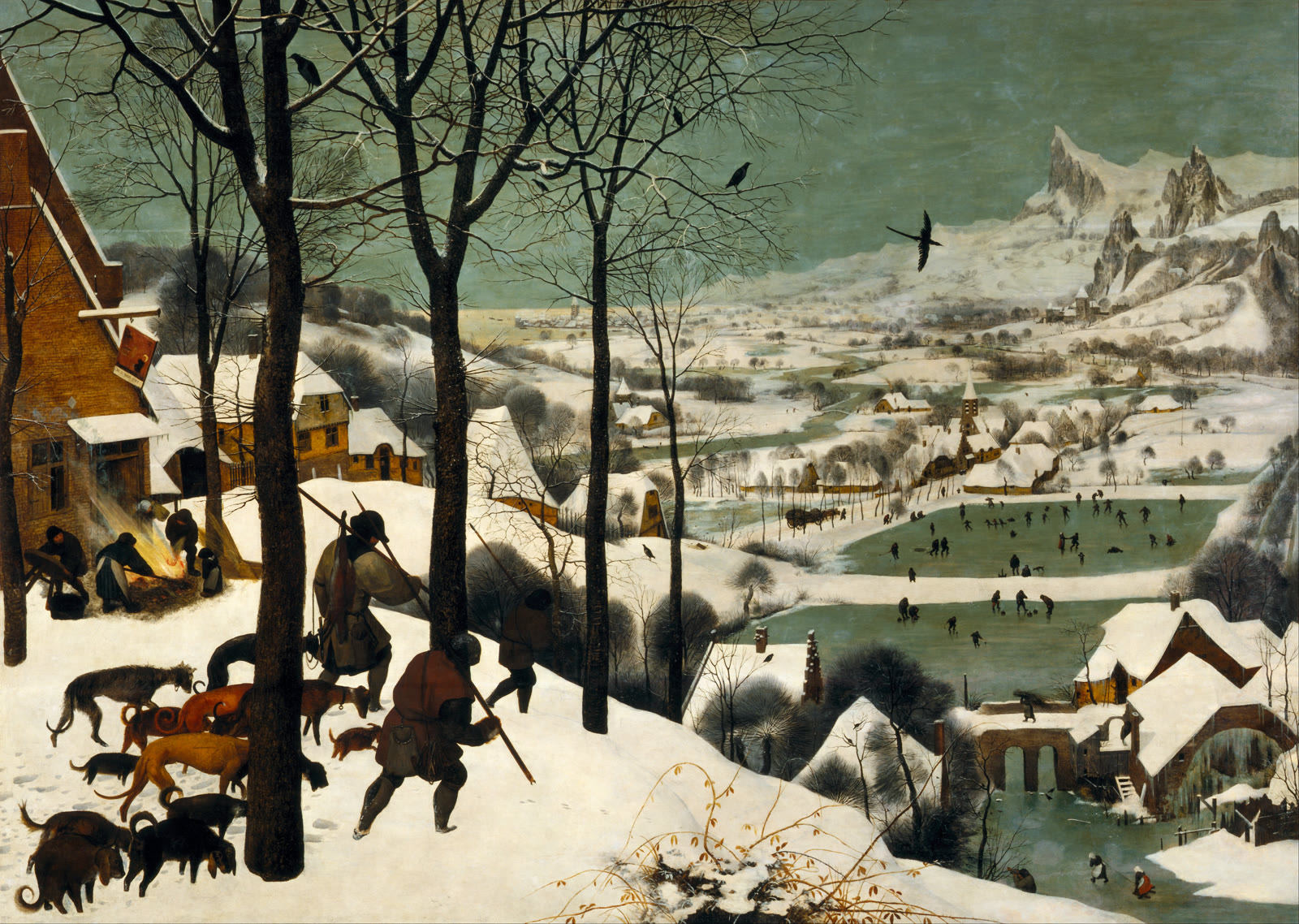
Pieter Bruegel the Elder's Hunters in the Snow (Winter) is one of the most reproduced winter pictures in European art, but reproduction can make it look gentler than it is.[1][2] The image is famous for skaters, snow, and village charm. The painting itself is harsher. Its real subject is not seasonal prettiness but the way winter redistributes effort across a landscape. Bruegel gives us hunters returning with almost nothing, dogs that look as tired as their masters, a brief pocket of warmth at one chimney fire, and a whole valley where labor, travel, and play continue under the same cold pressure.[1][4] What makes the picture last is that winter is not treated as weather alone. It becomes a social field.
That field is built through descent. The eye begins high on the dark hill with the hunters and their dogs, then drops toward the village and frozen ponds below, then moves outward again toward pale distance and hard mountain forms.[1][2] The composition makes winter feel less like one scene than like a sequence of conditions. Bruegel does not ask us to stare at one anecdote. He asks us to travel through a whole environment and feel how every human action inside it has been narrowed by cold.
Image context: the lead image uses the painting itself because the article turns on Bruegel's full distribution of attention. Crop to the hunters and you lose the skating ponds that make winter communal; crop to the valley and you lose the exhausted return that gives the scene its weight. The painting's meaning sits in the long slope between those zones.[1][4]
The descent is the painting's first argument
The first striking fact is that Bruegel does not place us comfortably inside the village. He places us above it, behind the returning men, on a hill that already feels difficult to cross.[1][4] The hunters are not heroic silhouettes against the sky. They are dark, bent figures moving downhill with lowered spears and lowered energy. Their dogs trail with them in a long, drooping line. This opening note matters because it sets the whole emotional key before the eye even reaches the frozen ponds. Winter arrives first as weight.
Khan Academy's close reading notices a detail that sharpens this sense of failure: tracks from a rabbit in the foreground suggest prey recently escaped the hunt.[4] KHM's object page makes the result plainer still. Only a single fox hangs from one of the poles the hunters carry.[1] That is an extraordinary decision. Bruegel could have made the return visibly abundant and then used the valley below as festive contrast. Instead he gives the hunters almost no success to bring home. The painting's first human action is not triumph but insufficiency.
Because the panel measures only about 116.5 by 162 centimeters, Bruegel has to organize this large world with ruthless economy.[1] The dark vertical trees hold the left side like a screen, but they also intensify the sense that the hunters are entering a valley already larger than them. Their bodies are close to us, yet they feel diminished from the start. Scale is doing moral work here. Winter is not merely surrounding the figures. It is reducing them.
The little fire at left is not comfort; it is local resistance
One of the smartest details in the painting sits just left of the hunters: villagers prepare to singe a pig over an open fire.[1] At first glance it looks like a cozy genre touch, the kind of thing that gives the painting its Christmas-card afterlife. In context it does almost the opposite. The fire is tiny. Its warmth does not spread across the panel. It is a local answer to a large condition.
That contrast is one reason the painting feels so modern. Bruegel does not sentimentalize survival. He shows that winter life continues by pockets of managed heat, not by any general victory over the season. The same slope that brings the hunters home also leads past this narrow flame and down toward frozen water where the rest of the village keeps moving.[1][2] Warmth exists, but only as a temporary station inside the cold.
Britannica's work entry and the Met's Bruegel essay both place the painting within the 1565 cycle often called the Labors of the Months or seasonal series, made for the Antwerp merchant Nicolaes Jongelinck.[2][3] That context matters because it explains why Bruegel is so interested in winter as a total condition rather than a picturesque incident. This is not a painting of one lucky view. It belongs to a larger act of seasonal thinking, where weather changes how work, movement, and daily rhythm are distributed.[2][3]
The frozen ponds turn the valley into shared time
Once the eye drops into the middle and lower distance, the picture opens into one of Bruegel's great inventions: a winter world where hardship and activity coexist without being neatly reconciled.[1][4] People skate, walk, play, carry on. The ponds do not offer ease, but they do create a public surface on which the whole village becomes visible at once. What looked, from the hilltop, like a difficult return now unfolds into a social panorama.
This is why the painting should not be read as simple misery. Bruegel is too precise for that. The hunters' scarcity is real, but below them life continues in multiple registers: movement, game, errands, smoke, crossings, and clustered habitation.[1][2] Winter compresses everyone into the same season, but it does not produce one single emotional tone. The painting's depth comes from that mixed social weather. Exhaustion and recreation share the same ice.
KHM's curatorial note says the painting's importance lies not in the sum of delightful details but in its total effect, and that is exactly right.[1] If you isolate the skaters, the scene becomes charming. If you isolate the hunters, it becomes grim. Bruegel's achievement is to force those readings to coexist. The valley is alive, yet the air still feels severe. The village is active, yet the exhausted dogs in the foreground keep sending the eye back to cost.
The mountains make the whole scene stranger and larger
The most destabilizing part of the picture may be the distance. The mountains at right do not belong to an ordinary Netherlandish village view in any literal way.[2][3] The Met's Bruegel essay links such forms to the artist's experience of the Alps during his earlier travels, and the work's afterlife has often depended on that hybrid geography: a lived Flemish village grammar fused with dramatic mountainous distance.[3] The effect is subtle but decisive. Bruegel does not simply document local winter. He enlarges it.
That enlargement keeps the painting from shrinking into anecdote. The village below is specific enough to feel inhabited, yet the mountains give the scene an almost planetary scale. They make the hunters' return look small against a world that is older, colder, and less manageable than any one village economy.[2][3] In compositional terms, the painting keeps moving between the near and the far, the domestic and the exposed. In emotional terms, it says that winter is both communal and inhuman.
This is also why the black birds matter. They cut across the pale valley as moving accents that are lighter than the trees but darker than the snow, giving the whole field a live, unsettled rhythm.[1][4] Bruegel keeps refusing stillness. Even a frozen world is full of motion; the question is what kind of motion cold permits.
Why the painting still holds
Hunters in the Snow survives because it never collapses into one message.[1][2][3][4] It is a landscape, but landscape here is inseparable from labor. It is a winter scene, but winter here is inseparable from social arrangement. It is full of attractive details, but those details keep answering to a larger structure of descent, distance, and managed survival. Bruegel makes cold feel permanent not by painting endless white alone, but by showing how every figure in the panel has to negotiate it differently.
That is the deeper force of the image. The hunters return almost empty. The dogs sag. A pig is singed over a small local fire. Villagers take to the ice. The mountains hold the horizon open beyond all of them. Put together, those facts turn winter into a shared condition without making it equal.[1][4] Some bodies work, some glide, some watch, some simply endure. The painting's greatness lies in letting all of that happen at once.
60-second viewing drill
- Start with the hunters and dogs, and look for how little victory Bruegel gives them.
- Move left to the pig-singeing fire and ask how much warmth it really provides.
- Drop your eye into the skating ponds and notice how winter becomes communal rather than solitary.
- End on the mountains and ask why Bruegel wanted the world to feel larger than the village could ever fully master.[1][3][4]
Sources
- Kunsthistorisches Museum Wien, Hunters in the Snow (Winter) - object page with dimensions, provenance, and curatorial note on the painting's "permanent cold" effect.
- Encyclopaedia Britannica, Hunters in the Snow (Winter) - overview of the 1565 painting, its place in Bruegel's seasonal cycle, and its art-historical significance.
- The Metropolitan Museum of Art, "Pieter Bruegel the Elder (ca. 1525–1569)" - Heilbrunn Timeline essay on Bruegel's patrons, seasonal panels, and Alpine landscape inheritance.
- Khan Academy, "Hunters in the Snow (Winter) by Pieter Bruegel the Elder" - close reading of the hunters, dogs, foreground tracks, and the painting's winter structure.