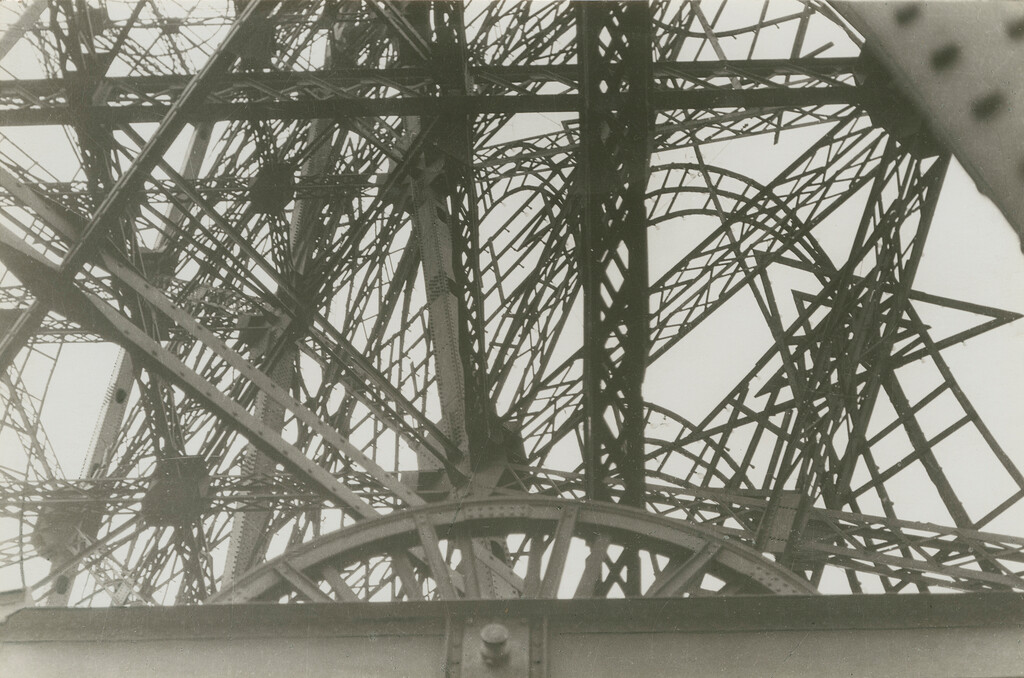
The Eiffel Tower is usually an easy picture to recognize. Germaine Krull made it a place where recognition could lose its footing. In the photograph reproduced here, a curved beam sweeps across the lower frame while diagonal braces crowd the sky. Rivets are easier to find than the monument's familiar outline. The Pinakothek's account of her portfolio Métal places these tower views alongside cranes, bridges, and machines: objects made strange through the photographer's position.[1]
That position was a working choice. Krull's career brought together portrait studios, fashion commissions, illustrated magazines, and photographic books. Her experiments had destinations and readers. To follow her from industrial structures to the printed page is to see an artist developing a visual language while earning a living with it.
Born in Wilda, in present-day Poland, in 1897, Krull began photographic training in Munich in 1915 and opened a portrait studio after graduating. Revolutionary politics carried her into upheavals in Germany and then the Soviet Union, where she was imprisoned. She returned to photography in Berlin; a stay in the Netherlands brought industrial structures into her work. By 1926 she had established a fashion studio in Paris, where she photographed Sonia Delaunay's designs.[2] The eventual reputation for fearless angles rested on practical training and several changes of direction.
An industrial photograph can explain how something is built. Krull also asks how it feels to stand near it. A crane viewed from below makes the viewer's own scale uncertain; a cropped bridge withholds the reassuring beginning and end of a crossing. These are ways of organizing attention. We have to work out where we are before we can settle into naming what we see.
Métal, published in 1928, gave those encounters a portable form. The National Gallery of Victoria describes its sixty-four black-and-white collotype plates, printed on individual sheets and accompanied by a preface by Florent Fels. Its structures came from several cities, including Amsterdam, Rotterdam, Marseille, Saint-Malo, and Paris.[3] Industrial modernity arrives through particular places, even when a close view makes their geography difficult to identify.
The loose sheets matter. As the NGV notes, they can be rearranged by the viewer.[3] A reader can make one skeletal structure answer another, or interrupt a run of monumental forms with a change of scale. This gives the portfolio a peculiar intimacy: immense public objects become images that someone can handle, compare, and put into a different order. The camera's first act of selection is followed by the reader's.
Krull's visual daring also needs a technical distinction. Kim Sichel's study for the Museum of Modern Art explains that multiple exposures and photomontages were comparatively unusual in her work. More often, she achieved disorientation through extreme viewpoints within a single photograph.[4] A bewildering picture does not necessarily show an invented scene. The world can supply enough intersecting structures once the photographer abandons the expected place to stand.
Sichel traces that physical search through Krull's recollection of an Eiffel Tower assignment for Vu. Editor Lucien Vogel wanted a view that escaped the familiar postcard. Krull's account describes finding possibilities as she climbed the stairs and encountered the structure from different positions.[4] It is an appealingly concrete origin for an avant-garde image: an assignment, a dissatisfied first look, then the effort of moving until the subject changes.
The magazine was more than somewhere to sell the result. It provided a setting in which experimental photographs could meet other pictures, captions, and a reader's quick passage across a spread. Sichel describes Vu layouts that overlapped images, extending their visual agitation onto the page.[4] The photograph's edges were therefore only one boundary of the composition. Publication could give its internal movement a continuation.
This is the Krull emphasized by the Jeu de Paume's 2015 retrospective, curated by Michel Frizot. Its account argues for understanding her work through publication and reportage as well as avant-garde exhibitions. It records 280 photographs reproduced in Vu, alongside contributions to numerous other magazines.[5] Such sustained activity changes the proportions of her story. The celebrated portfolio occupies a busy professional life, with editors to satisfy and new subjects to find.
Her books also moved outward from iron structures. 100 x Paris appeared in 1929, La Route Paris-Biarritz in 1931, and Marseille in 1935.[5] The titles suggest different speeds of looking: a city gathered into views, a journey organized by a road, a port explored as a place. Together they make the photographer's mobility feel like a working method. Each publication offers a new container for encounters that would otherwise remain scattered prints.
The later biography extends far beyond interwar Paris. During the Second World War, Krull worked for the Free French photographic service in Africa and subsequently photographed the liberation of Vaihingen camp. After the war she went to Asia, became a hotel co-manager in Bangkok, and later lived in India.[2] These changes deserve more than a romantic shorthand about an adventurous life. They also help explain why a reputation built around a handful of Parisian images can give such an incomplete impression of her work.
Jeu de Paume identifies dispersed prints, incomplete archives, and her long separation from European photographic circles among the obstacles to studying that larger career.[5] The surviving record has its own geography. What becomes easy to exhibit and reproduce may become disproportionately easy to remember.
Return, then, to the tower. Its ironwork can hold the eye without any knowledge of the magazine office, the stairs, or the portfolio sheets. Knowing those things adds another pleasure. The picture becomes evidence of someone going out, finding a position, and making a view that could travel. Krull's modernity lives in that whole passage: from a body moving through the world to a photograph moving among readers.
Sources
- Pinakothek der Moderne, “Germaine Krull: Métal,” 2017–2018 exhibition — industrial subjects, viewpoints, and the reproduced Tour d'Eiffel photograph with collection credit.
- Angelina Meslem, “Krull Germaine,” French Ministry of Culture, July 4, 2019 — photographic education, studios, political upheavals, fashion work, wartime service, and later life in Asia.
- National Gallery of Victoria, “Metal (Métal),” collection record 2023.336 — the 1928 portfolio's materials, individual plates, photographed locations, and rearrangeable presentation.
- Kim Sichel, “Contortions of Technique: Germaine Krull's Experimental Photography,” Museum of Modern Art, Object:Photo, especially pages 1 and 5–6 — camera viewpoints, the Eiffel Tower assignment, and Vu's layouts.
- Jeu de Paume, “Germaine Krull (1897–1985): Un destin de photographe,” 2015 retrospective, curated by Michel Frizot — publication, reportage, photographic books, and the dispersed historical record.