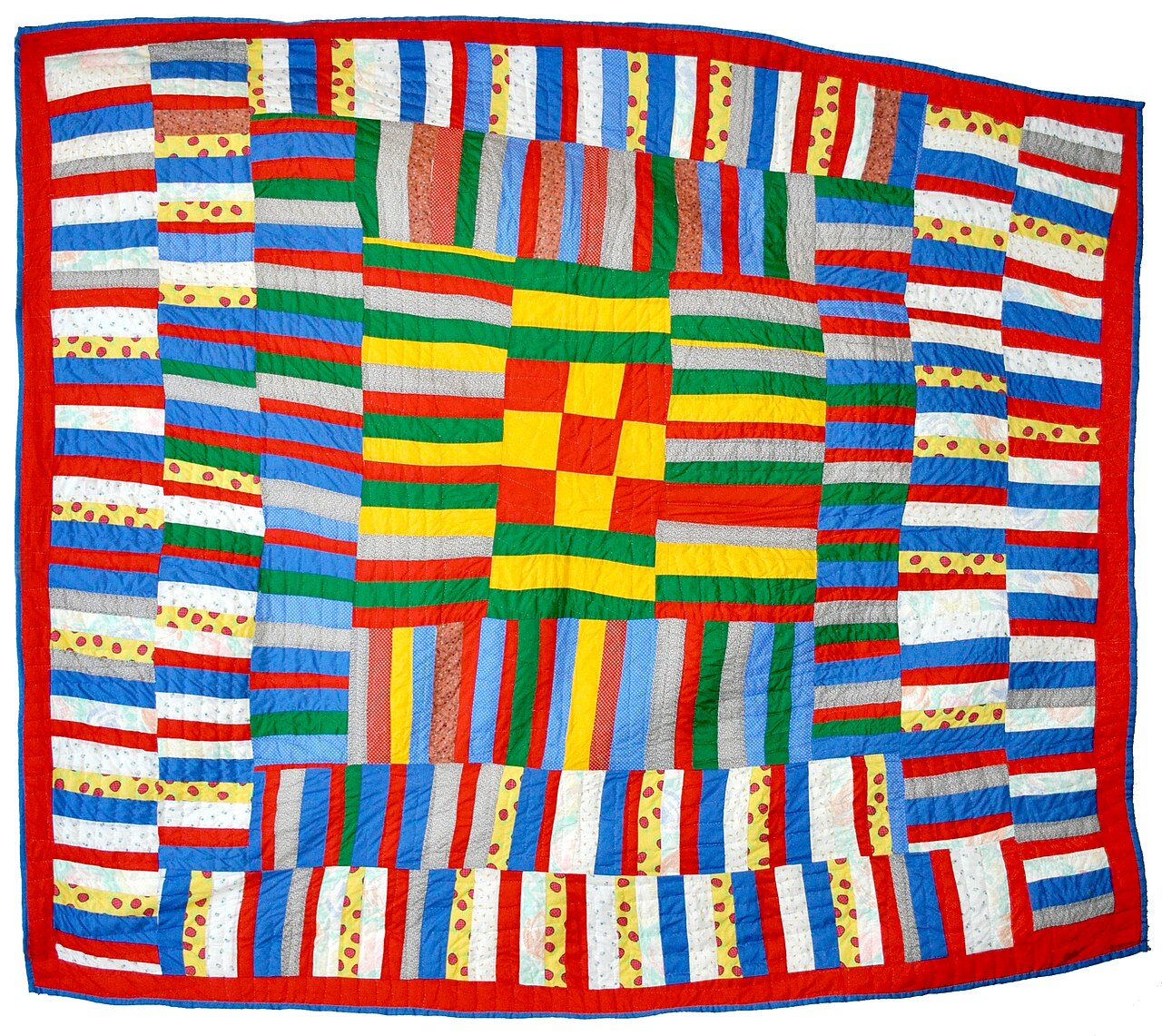
The easiest mistake with Gee's Bend quilts is to praise them as if they had been waiting for museum walls to become art. The better way starts lower and closer: with cloth that had already lived, a bed that needed covering, a pattern remembered by hand, and a maker willing to let the next strip change the whole field. The Housetop mode, one of the best-known Gee's Bend approaches, is not powerful because it resembles modernist abstraction from a distance. It is powerful because its geometry grows out of use.
That distinction matters in a medium-and-technique reading. Souls Grown Deep describes the Gee's Bend quiltmakers as women and ancestors from Alabama's rural Black Belt whose quilting tradition reaches back to the nineteenth century, when quilts were made for warmth in unheated homes and often assembled from old work clothes, fertilizer sacks, flour sacks, corduroy, denim, and other available fabric.[2] The quilts later entered major museum narratives, but their visual intelligence was formed before that recognition. Technique came first.
Image context: this is a real photographic artwork image, not a diagram, chart, or generated visual. Lucy Mingo's c. 1979 quilt shows a nine-patch center held inside strips that do not behave like measured drafting. The result is not casual disorder. It is a built surface where fabric memory, color pressure, and hand decisions stay visible.[1]
A Housetop begins as a build, not a sketch
The Brooklyn Museum's object label for Lucy T. Pettway's Quilt, Housetop Pattern gives a compact technical account: the Housetop pattern is dominated by concentric squares, usually pieced from a starter square, then enlarged by adding strips and additional squares.[4] That process sounds simple until one imagines it happening with imperfect cloth. A strip has a prior thickness. A worn shirt behaves differently from a new cotton length. A seam takes material away. A corner can pull. A rectangle that began as a plan can become a pressure map.
This is why the Housetop is better understood as a construction method than as a fixed design. It gives the maker a generative rule: start, surround, adjust, continue. The rule is stable enough to be passed down, but open enough to absorb shortage, memory, preference, speed, and accident. Souls Grown Deep's category note on patterns and geometry places Housetop configurations among the traditional compositions favored in Gee's Bend, alongside center medallions, lines, stripes, and one-patch formats.[3] The shared vocabulary is real. So is the individual decision-making inside it.
When a Housetop quilt bends away from perfect symmetry, that is not automatically a flaw to be forgiven. Brooklyn's public collection page addresses this directly in a discussion of Pettway's quilt: as more fabric was added, the shape most likely began to warp, and the maker left the irregularity in place; the page also links the right-angle emphasis to call and response in African American musical tradition.[4] That last comparison should be handled carefully, but it helps name something visual: one angle answers another, one fabric interrupts another, and a surface develops rhythm through relation rather than through mechanical sameness.
Reuse changes the color theory
In many painting traditions, color can be selected from a stable commercial range. In Gee's Bend quilts, color often starts as a practical inheritance. The Met's interview with Amelia Peck stresses that Gee's Bend makers were really cutting up old clothes and readily available fabric rather than buying all-new material; Peck also notes that some corduroy quilts used leftovers from a Sears, Roebuck commission organized through the Freedom Quilting Bee.[5] That means color is not only a formal choice. It is also a record of where fabric came from.
This changes the viewer's job. A strip of denim is blue, but it is also workwear. Corduroy is color, but also wale, nap, weight, and commodity history. A patterned scrap may bring scale into the composition because its printed motif refuses to behave like a solid plane. In Lucy Mingo's quilt, the eye keeps moving between blocks, strips, and interruptions because no section is merely a neutral unit.[1] The quilt is built from differences that cannot be fully standardized.
The technique therefore produces a kind of color thinking that is inseparable from material thinking. Red does not simply sit beside black; it arrives through a particular cloth. White does not merely brighten a dark field; it may carry a seam, print, or softness that changes its edge. The formal result can look astonishingly abstract, but abstraction is not the origin story. It is the visible consequence of making a useful object from available materials with an eye alert to balance, surprise, and continuation.[2][5]
Improvisation is discipline under constraint
"Improvisation" can become a lazy word if it is used to mean anything irregular. Gee's Bend quilts deserve better. Souls Grown Deep describes many of the quilts as "my way" works, in which makers began with basic forms and followed individual artistic paths to unexpected patterns, shapes, and colors.[2] The phrase is useful because it does not confuse freedom with randomness. A maker still needs a structure to depart from.
The 2002 exhibition history clarifies the scale of that shared-and-individual balance. Souls Grown Deep's page for The Quilts of Gee's Bend says the exhibition presented more than sixty quilts made between 1930 and 2000, the product of forty-two women, including mothers and daughters; it emphasized both continuity and individuality.[7] Philadelphia Museum of Art's later exhibition page similarly described the quilts as sharing a common visual vocabulary while each remained unique, documenting key patterns such as Housetop, courthouse steps, flying geese, and strip quilting.[6]
That is the technical heart of the matter. The Housetop survives because it is teachable. It stays alive because it is not closed. A quilter can inherit the starter-square logic and still decide that a strip should be wider, that one side can carry more weight, that the border should not rescue the field into neatness, or that a worn fabric's stubbornness is part of the composition. The discipline is in knowing when to keep going and when to stop.
The wall did not erase the bed
Museum recognition changed how Gee's Bend quilts circulated, but it should not make us forget the conditions that shaped them. The Whitney Museum records that The Quilts of Gee's Bend was installed in New York from November 21, 2002, to March 9, 2003, after being organized by the Museum of Fine Arts, Houston and Tinwood Alliance.[8] The Met later framed Gee's Bend quilts within History Refused to Die, its 2018 exhibition of works from the Souls Grown Deep Foundation gift, alongside artists from the southeastern United States using found and repurposed materials.[9]
Those exhibitions mattered. They helped move the quilts into American art history. But Peck's Met interview warns against the easy move of validating the quilts by saying they look like abstract paintings. She argues that this comparison can be superficial because the Gee's Bend women were working from different traditions and did not need male modernist painting as a reference point to make compelling art.[5] That warning should shape how we describe the Housetop. It is not a folk version of something else. It is a technique with its own intelligence.
The bed remains part of that intelligence. A quilt has a front, a back, weight, warmth, seams, repairability, and a relationship to bodies. Even when hung vertically, it carries the logic of a thing made to touch domestic life. That does not make it less artistic. It makes the art harder to separate from survival, family, economy, and memory.[2][7]
Geometry with evidence in it
Look again at the Mingo quilt. Its center block gives the eye a first hold, but the surrounding strips keep refusing a clean reading. They expand, break, tighten, and restart. Some sections feel like borders; others feel like arguments against borders. The surface does not ask whether it is "craft" or "fine art." It asks whether you can see how many decisions are preserved in the seams.[1]
That is why Housetop quilts remain so forceful. They do not turn necessity into a sentimental backstory. They turn necessity into method. Recycled cloth sets the palette. A starter square sets the engine. Strips make growth visible. Warping records the hand, the fabric, and the choice not to over-correct. Repetition gives the work a common language; variation gives it life.
The result is geometry with evidence in it. Gee's Bend Housetop quilts are not famous because museums finally taught them to be modern. They are famous because, once museums caught up, viewers could see what the quilts had already known: a practical structure can hold improvisation, memory, color, labor, and beauty without asking any of them to step aside.
Sources
- Wikimedia Commons, "File:Pieced Quilt, c. 1979 by Lucy Mingo, Gee's Bend, Alabama.JPG" - photographic source for the cover image, with description of Mingo's nine-patch center and surrounding pieced strips.
- Souls Grown Deep, "Gee's Bend" - overview of Gee's Bend quiltmakers, material reuse, improvisational "my way" quilts, and generational transmission.
- Souls Grown Deep, "Patterns & Geometry" - context on Housetop configurations, repeated geometric forms, lines, stripes, and favored Gee's Bend compositions.
- Brooklyn Museum, "Lucy T. Pettway, Quilt, Housetop Pattern" - object label and collection note explaining the starter-square Housetop process, added strips, warping, and call-and-response discussion.
- Rachel High, "Art on Its Own Terms: Author Amelia Peck on Gee's Bend Quilts in My Soul Has Grown Deep," The Metropolitan Museum of Art, July 16, 2018 - interview on material reuse, pattern adaptation, and the limits of comparing Gee's Bend quilts to abstract painting.
- Philadelphia Museum of Art, "Gee's Bend: The Architecture of the Quilt" - exhibition page on the common visual vocabulary and key patterns including Housetop, courthouse steps, flying geese, and strip quilting.
- Souls Grown Deep, "The Quilts of Gee's Bend" - exhibition page covering the 1930-2000 date range, more than sixty quilts, forty-two women, continuity, individuality, and the traveling exhibition history.
- Whitney Museum of American Art, "The Quilts of Gee's Bend" - record for the 2002-2003 Whitney installation organized from the Museum of Fine Arts, Houston and Tinwood Alliance exhibition.
- The Metropolitan Museum of Art, "History Refused to Die: Highlights from the Souls Grown Deep Foundation Gift" - exhibition page placing Gee's Bend quilts within a broader group of southeastern Black artists using found and repurposed materials.