One skeleton has both arms hooked over the lip of the pot. It might be taking a bath. Behind it, a winged pink devil leans over the cooking and a green one raises an arm high enough to touch the masonry. Several of the bathers have turned to face us. Their eyes are the smallest spots of red in the picture, and once you find the first pair, it takes some effort to look anywhere else. [1]
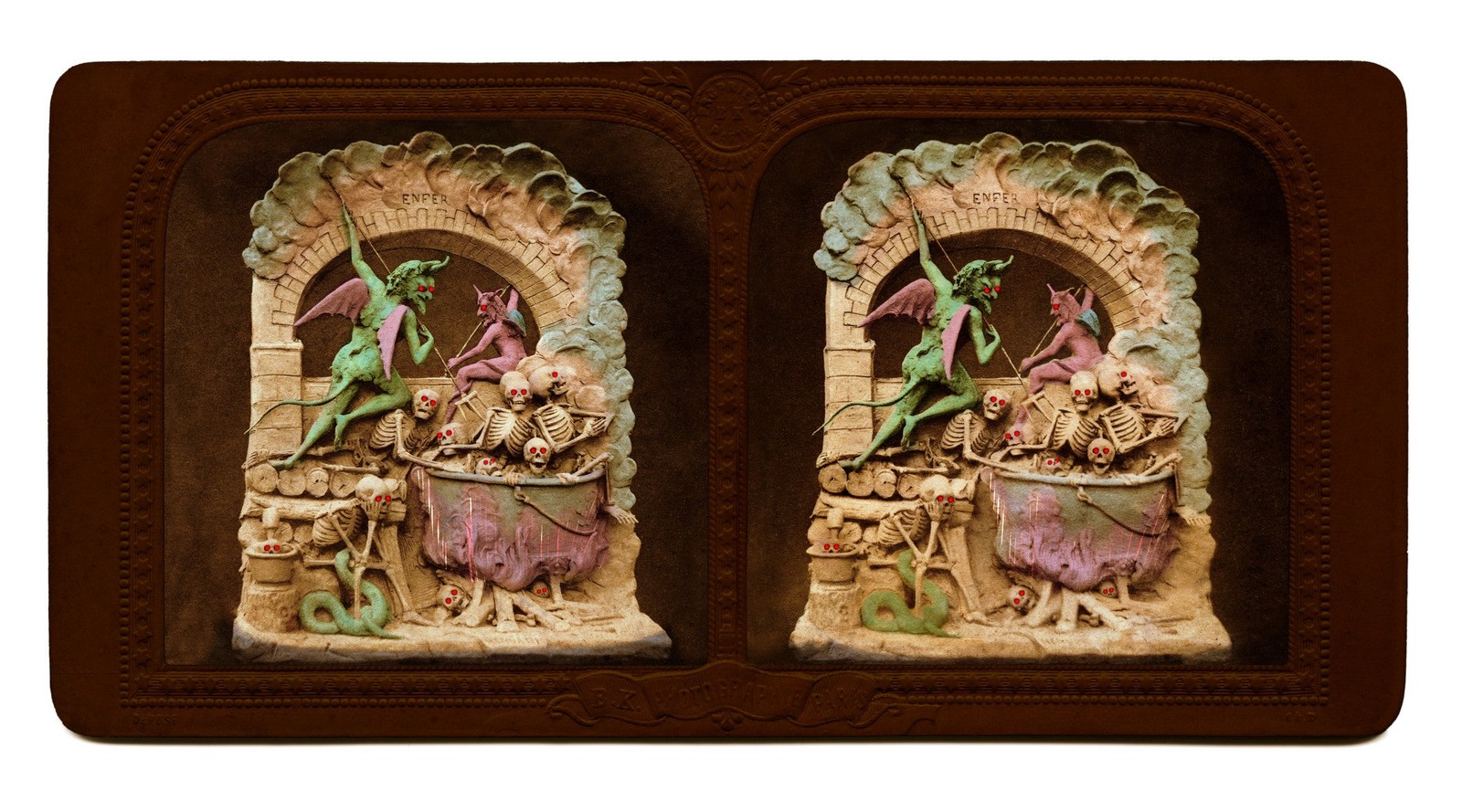
Hennetier built his hell on a tabletop. The figures were modeled in clay and photographed from two slightly different positions. Pick the skull nearest the green devil’s knee and follow it from the left photograph to the right. It is the same skull at the same instant in the story. A stereoscope sends one view to each eye, and the slight shift between them gives the body a place in space. The rim has a near side you could lean on. The arch marked Enfer has room underneath for a devil to stand. [1][2]
When the eyes come on
The colors in the reproduction catch the card in the middle of its performance. Someone examining the original by light falling on its face would first see a monochrome photograph. To bring out the pink of the pot, the viewer had to let light through the back. The photograph was thin enough for hand coloring on its reverse to show through. A sheet of tissue behind it softened the light and concealed the handiwork from anyone who turned the card over to investigate. [1][3]
Look again at the skull in front. Where a sculptor might have left a dark hollow to suggest an empty socket, a pinprick of light comes forward to meet your eye. Conservator Amanda Burr found that the makers of these cards pierced the photographic paper and backed the holes with translucent colored material. In examples she examined at LACMA, some pieces had been cut into tiny rectangles. The person who placed one had to work on the back of a face that the customer would see from the front. [1]
A cauldron sounds like an instrument of perpetual punishment. This one belongs to a series in which the denizens of hell also go to concerts and play billiards. In Block’s catalogue the cauldron has a number, A46. One could visit hell again and find the company otherwise occupied. Here the skeleton with its elbows out makes the punishment look surprisingly sociable. Then the light catches its eyes, and for a moment the little figure seems just as interested in the spectator. [2][4]
A tear near the lower edge of the LACMA photograph posed a peculiar problem. Held to the light, even a small split could shine as insistently as a carefully placed eye. Burr opened the card and mended the damaged paper from within using a strip thin enough to disappear under illumination. The distinction matters down at the foot of the cauldron, where another red-eyed skull peers out between the logs. The maker wanted the viewer to discover that last face. A bright streak in the paper would have given the eye somewhere else to go. [1]
Sources
- Amanda Burr, “Skeleton (or Gelatin?) in the Closet,” LACMA. The cauldron photograph and the conservation treatment.
- Mazie M. Harris, “Skeletons Carousing in Hell,” J. Paul Getty Museum. Viewing the stereo pairs and the entertainments depicted in the series.
- London Stereoscopic Company, “Diableries.” Construction and illumination of French tissue cards.
- London Stereoscopic Company, illustrated catalogue of the Block series, including A46.