
Fog is not the opposite of Ludwig Mies van der Rohe's Neue Nationalgalerie. In Fujiko Nakaya's hands, it is the instrument that tests the building. Mies's museum presents steel, glass, right angles, and a famously open plan as if spatial order could be made lucid. Nakaya's Cult of Mist, installed across the Berlin museum's sculpture garden in 2025, answered that lucidity with pure-water droplets that thickened, drifted, and vanished. The architecture did not disappear permanently. It had to keep becoming visible again.[3][6]
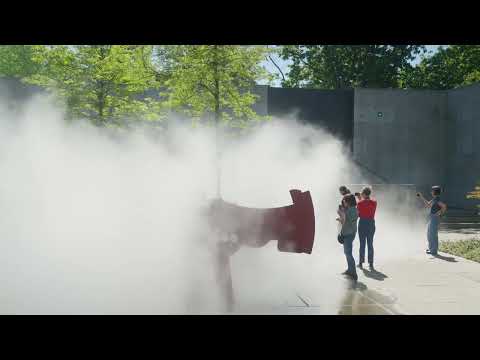
The two short Neue Nationalgalerie videos below are most useful as a pair. The first records the sculpture as an event: fog enters the garden, meets wind and bodies, and refuses a stable outline.[1] The second supplies a curatorial frame for what that event does to Mies's architecture.[2] Together they prevent two common misreadings. This is neither a special-effects cloud dropped into a photogenic site nor a vague celebration of immersion. It is a precisely engineered collaboration whose final form is surrendered to local conditions.
That collaboration has a long history. Nakaya created her first fog sculpture for the Pepsi Pavilion at Expo '70 in Osaka while working with Experiments in Art and Technology and atmospheric physicist Thomas Mee. The high-pressure system developed there, modified over time, established fog as a serious sculptural medium rather than a theatrical accessory.[4] The historical near-coincidence is striking: the Neue Nationalgalerie opened in 1968, only two years before the Osaka work. Mies brought a lifetime's study of open, pillar-free space to a culmination in the museum's glass hall; Nakaya began making a material with no lasting edge occupy similarly ambitious architectural space.[3][6]
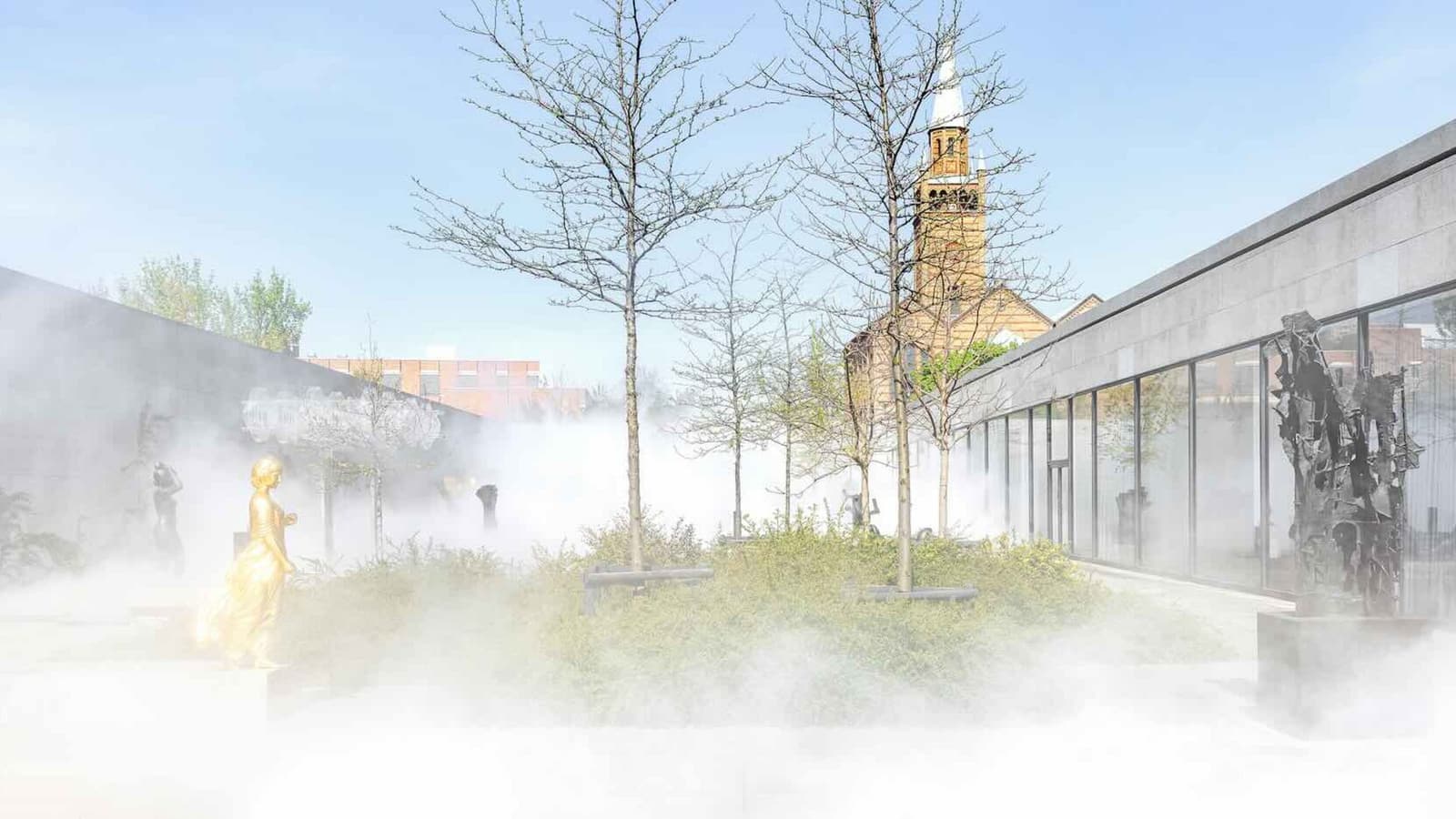
Image context: the cover is David von Becker's official installation photograph, not a generated approximation or an abstract placeholder. Its documentary value lies in the unstable depth it records. Trees and permanent sculptures remain partly legible while the garden walls and glass architecture lose certainty behind the fog. A still cannot preserve the sculpture's movement, but it can show why changing visibility is the work's subject.[3]
Video 1: watch the boundary, not the cloud
The first film is the collection's encounter piece. Before pressing play, resist looking for a single heroic view of Cult of Mist. Watch the edges instead: the places where a person becomes a silhouette, a tree loses contrast, or a hard architectural line returns as the fog thins. Those thresholds are where Nakaya's sculpture takes form.[1][3]
The museum describes the installation as a sequence rather than a fixed mass. At regular intervals, formations emerged from selected sides of the sculpture garden, mixed with trees and permanent works, and dissolved toward the sky near the garden's center. Their density could shift from something that looked almost touchable to a translucent veil.[3] The video makes that variability easier to grasp than a photograph can. Every camera position encounters a different sculpture because every position cuts a different cross-section through wind, moisture, architecture, and time.[1]
This is why the fog's apparent softness should not be confused with formlessness. Haus der Kunst's technical account explains that Nakaya's fog is pure water forced at high pressure through tiny nozzles fitted with microscopic pins, atomizing it into exceptionally fine droplets. Nozzle spacing can be planned, and site data such as humidity, wind direction, wind speed, and temperature can be studied in advance. Yet the result is not fully commandable. The environment acts on every planned release.[5]
That division between preparation and outcome is the sculpture's intelligence. A stone carver removes material until a durable contour remains. Nakaya builds a delivery system that makes contour provisional. The artist decides where water enters, but the site decides how long an edge holds. Wind is not damage to an ideal cloud; it is a co-author that becomes visible by pushing the fog. Sunlight is not neutral illumination; it determines whether droplets look dense, silver, or nearly absent. Visitors do not merely stand before the work; their movement provides scale, opens temporary gaps, and reveals how quickly visibility can change.[1][3][5]
The first film therefore rewards a second viewing focused on disappearance. Instead of asking, "What shape is the sculpture?" ask, "Which relation is changing now?" A body and a tree separate, then merge. The museum and garden read as distinct zones, then the boundary between them weakens. The fog is spectacular, but spectacle is only the invitation. The deeper experience is learning to see space as a set of temporary agreements.
Video 2: the glass wall becomes an active participant
The second film shifts from encounter to interpretation. Curator Lisa Botti places the fog sculpture in relation to the museum, which matters because Mies's building is not a neutral backdrop.[2][3] The Neue Nationalgalerie identifies its glass hall as the culmination of his pursuit of pillar-free open space, held beneath an immense steel roof and expressed through architectural reduction.[6] Nakaya does not cover that achievement with a rival object. She makes its claims about openness, boundary, and transparency physically unstable.
Glass usually promises unobstructed sight while keeping climate on the other side. Cult of Mist makes that contradiction noticeable. The museum's exhibition record emphasizes that the collection level's 90-meter glass facade offered a long interior view of the changing formations, while doors also allowed visitors to step directly into the garden.[3] From behind glass, fog becomes a moving field framed by architecture. Outside, it becomes moisture, reduced visibility, and uncertain distance. The same event is image in one position and environment in another.
This double viewpoint is the crucial annotation for the second video. Mies's glass does not vanish when it becomes hard to see; its boundary becomes more consequential. The visitor can occupy a dry, optically open interior while watching a nearby landscape lose clarity, then cross into that landscape and feel the visual condition become bodily. Nakaya turns transparency from a style into a question: how open is an open space when glass, air, water, and weather distribute experience differently?
The work also edits the sculpture garden's existing collection without pretending to replace it. According to the museum, fog moved among trees and permanent sculptures by Henri Laurens, Wolfgang Mattheuer, and Alicja Kwade.[3] At one moment an object could anchor depth; at another it could be partially erased. That rhythm changes the garden from a stable arrangement of discrete works into a field of appearances. Nakaya adds no permanent pedestal, wall, or monument. She changes the interval through which every existing thing is perceived.
Her earlier Fog Sculpture #08025 (F.O.G.) at the Guggenheim Bilbao clarifies that this is a sustained method, not an effect invented for Berlin. The Guggenheim describes its 1998 installation as a collaboration with water, atmosphere, air currents, and time, produced by a thousand nozzles beside Frank Gehry's riverfront building. There too, fog makes reflective architecture variable and mutable.[4] Berlin presents a different partner: not Gehry's curving titanium, but Mies's glass, steel, and right angles. The medium stays consistent while the architectural argument changes.
What the pair reveals
Placed together, the films show why documentation is necessary and insufficient.[1][2] Video can preserve sequence better than a still image: thickening, passage, dispersal, return. It can also move between the garden and the building, showing that no single viewpoint owns the work. But the camera still selects weather, distance, and duration for us. Nakaya's sculpture ultimately depends on the visitor discovering that those conditions are changing around a body in real time.[3][5]
The lasting lesson of Cult of Mist is therefore not that solid architecture can be made dreamy. That reading would turn fog into decoration and Mies into scenery. Nakaya's sharper achievement is to reveal that the hard-edged museum was never visually self-sufficient. Its famous openness already depended on light, reflection, season, glass, and the viewer's position. Pure-water fog makes those dependencies impossible to ignore.[3][5][6]
This is what the two videos preserve: one artwork taking shape as a system and an encounter at once. Nozzles provide an origin. Wind produces direction. Architecture supplies resistance and scale. Visitors test visibility. Time removes the result. Then the process begins again, and Mies's edges have to earn their certainty one more time.
Sources
- Neue Nationalgalerie, "Fog sculpture by Fujiko Nakaya | Neue Nationalgalerie" — official YouTube encounter film, published May 17, 2025.
- Neue Nationalgalerie, "Fujiko Nakaya. Fog sculpture | Neue Nationalgalerie" — official YouTube curatorial film, published May 19, 2025.
- Staatliche Museen zu Berlin, "Fujiko Nakaya: Fog Sculpture in the Sculpture Garden of the Neue Nationalgalerie" — official exhibition record, installation description, and source page for David von Becker's cover photograph.
- Guggenheim Museum Bilbao, "Fog Sculpture #08025 (F.O.G.)" — collection essay on Nakaya's E.A.T. history, collaboration with Thomas Mee, and site-responsive fog practice.
- Haus der Kunst, "Force of Nature" — technical account of pure-water atomization, nozzle planning, meteorological research, and environmental interaction in Nakaya's fog sculptures.
- Staatliche Museen zu Berlin, "Neue Nationalgalerie Profile" — official architectural history of Mies van der Rohe's glass hall, steel roof, and pursuit of pillar-free open space.