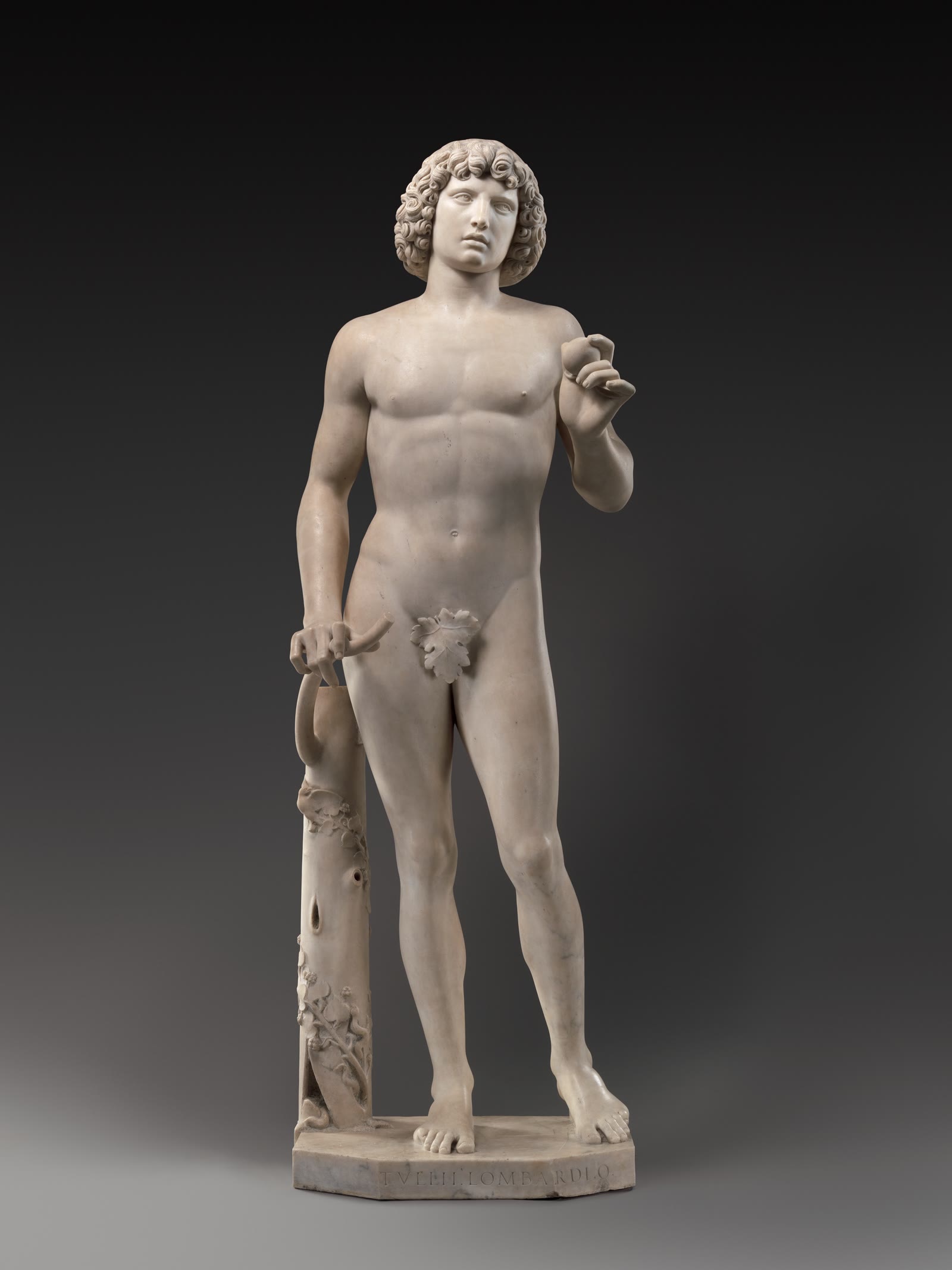

The marble figure in the cover photograph looks continuous: a calm, nearly life-size man holds an apple while his weight settles into a classical contrapposto. That visual calm is an achievement, but it is not the beginning of this story. On the evening of October 6, 2002, the plywood pedestal beneath Tullio Lombardo's Adam buckled at the Metropolitan Museum of Art. The sculpture struck the stone floor and broke into 28 large fragments and hundreds of smaller ones. The Met initially estimated a repair of one or two years. Adam returned to view in 2014, after almost twelve.[3][4]
The delay is what makes the Met's eight-minute film worth close attention. It does not present conservation as virtuoso gluing, and it does not use technology as a magical shortcut. Instead, it records a museum learning to pause after its own failure. Documentation came before handling; digital models came before drilling; tests came before adhesives touched the original marble. The apparent wholeness in the final image rests on a long sequence of decisions designed to preserve future choices.[1][4]
That principle matters especially for this sculpture. Carved around 1490–95 for the tomb of Doge Andrea Vendramin, Adam joined antique bodily ideals to a Christian subject. The Met describes it as the first life-size nude marble statue carved since antiquity. Its smooth surface, relaxed pose, heavenward gaze, apple, serpent, and grapevine make the figure at once ideal and newly vulnerable: the first man at the threshold of the Fall.[2] The 2002 accident gave that old subject an unwanted material echo. The restoration's task was not merely to recover a silhouette, but to return weight, gesture, and surface without sacrificing more Renaissance stone than the fall already had.
0:10–1:58 — Treat the floor as evidence
The film opens with conservator Carolyn Riccardelli recalling the Monday-morning call that brought her to the fragments. Watch what follows as a procedure rather than a disaster montage. The team imposed a coordinate grid on the gallery floor, photographed every square, and only then lifted the pieces. Even tiny chips were saved. Their positions stayed attached to them as evidence, so location itself became conservation data.[1]
This is the first important annotation. A shattered sculpture creates pressure to act, especially when the institution responsible is also accountable to the public. Yet immediate assembly would have destroyed information and narrowed the repair to familiar habits. The grid converted shock into a record. It also separated two questions that museums too easily collapse: Can this object be put upright again? and What intervention should the original material be asked to endure?
The Met's 2002 statement now reads as a measure of that changed tempo. It called the object repairable and forecast a relatively quick return while the cause of the pedestal collapse was still under investigation.[3] The eventual twelve-year project was not twelve years of continuous gluing. It was time spent defining the problem well enough that urgency would not dictate the method.
2:03–4:26 — Make the repair fail before the marble does
Around 2:03, the film turns from recovery to modeling. The fragments were laser-scanned, virtually reassembled, and subjected to finite-element analysis so engineers could estimate how stress would move through the repaired body. The colored stress maps on screen are not a replacement for connoisseurship. They answer a physical question that looking alone cannot: once every joined fragment begins carrying the weight of the whole, where will force concentrate?[1][4]
The team's answer overturned the default repair. A conventional reconstruction would have drilled each major joint for long stainless-steel pins and relied on very strong adhesives. That approach could make the statue stand, but it would remove original marble and introduce rigid elements whose failure might damage the sculpture again. Tests showed that reversible acrylic adhesives could carry many joints without pins. Where reinforcement remained necessary—at the load-bearing ankles and one unstable knee area—the team chose relatively modest fiberglass pins.[1][4]
At about 3:43, listen for the crucial design criterion: under extreme stress, the fiberglass should fail without taking the surrounding stone with it. This is conservation understood as a hierarchy of losses. Adhesive and pin are replaceable; fifteenth-century marble is not. A good repair therefore need not be the strongest possible structure. It should be strong enough in use, removable where feasible, and sacrificial if another catastrophe forces something to break.[4][5]
That logic gives reversibility more substance than a slogan. No restoration can literally reverse time. Cleaning changes a surface, drilling removes material, and reassembly changes how fragments bear weight. Here, reversibility means limiting those irreversible acts and placing modern materials in a subordinate role. The treatment succeeds not because it denies the accident, but because it refuses to make the next conservator pay for an unnecessarily aggressive solution.
4:26–6:35 — Rehearse the body before touching it
The middle of the film contains its most revealing practical sequence. Fresh fracture edges were delicate, so repeated trial fittings of the real fragments carried their own risk. The conservators first broke a commercially available marble David along analogous lines to plan an external armature. They then used CNC-milled replicas of Adam's scanned fragments to refine carbon-fiber straps that could support each piece during assembly. Only after rehearsing on substitutes did those supports move to the original.[1][4]
This is not simply a charming behind-the-scenes detour. The copies changed the kind of knowledge the team could acquire. A digital model could predict stress, but it could not teach hands how adhesive makes a precise stone joint slide, or how two rigid leg fragments must align with the torso at once. A sacrificial David could absorb mistakes. The milled fragments could test sequence and armature. The original could remain still until the operation had become repeatable.
At 5:25, reassembly begins at the ankles and rises slowly. The method makes visible what the finished statue conceals: Adam is not balanced by one heroic join but by a choreography of alignment, curing time, straps, wedges, and paired attention. When the head is set around 6:25, the emotional release is earned, yet the film immediately returns to damaged hands, small losses, cleaning, and fills. Structural completion is not aesthetic completion.
6:38–7:36 — Wholeness is a judgment, not a reset
The closing minute shifts from large engineering decisions to the surface. Dirt is removed before losses are filled; small gaps are brought into visual continuity; fills and retouching use materials intended to remain reversible.[1][4] The result does not advertise every fracture from across the gallery. Nor does it claim that the sculpture is untouched. Its seams are held within a documented material history that scholars and future conservators can retrieve even when an ordinary visitor first encounters a whole body.
This balance avoids a false choice between a visibly shattered ruin and a deceptive reset. Adam's artistic force depends on continuous posture: the gentle shift of weight, the turn of the head, the relationship between hand, apple, trunk, and serpent. Leaving all 28 major pieces apart would preserve evidence of the accident by withholding the sculpture Lombardo made. Hiding the treatment record would do the opposite, sacrificing history to illusion. The Met chose physical reintegration with intellectual transparency.[2][4]
The film's deepest contribution is therefore institutional, not technological. Laser scans, stress models, acrylics, fiberglass, and CNC replicas matter because they allowed the museum to intervene less in an object it had already failed to protect. The same accident also prompted an immediate inspection and reinforcement of other sculpture pedestals.[3] Conservation here extends beyond the repaired marble to the conditions around it: mounts, galleries, documentation, testing, and the willingness to let a public mistake slow the timetable.
Look once more at the cover photograph after the video. The unbroken contour no longer reads as evidence that nothing happened. It reads as the visible outcome of restraint. Adam stands because the repair was engineered to support Lombardo's sculpture, not to compete with it—and because a twelve-year pause became part of what responsible looking required.
Sources
- The Metropolitan Museum of Art, "After the Fall: The Conservation of Tullio Lombardo's 'Adam'" — official Conservation Stories video, 2014.
- The Metropolitan Museum of Art Libraries, Tullio Lombardo's Adam: A Masterpiece Restored — official 2014 digital press kit with the exhibition release, historical text panel, and object label.
- The Metropolitan Museum of Art Libraries, "Statement by Metropolitan Museum of Art on Damage to Tullio Lombardo's Adam" — archived contemporaneous account of the October 2002 collapse and initial response.
- American Institute for Conservation, "After the Fall: The Treatment of Tullio Lombardo's 'Adam'" — conference report on laser scanning, finite-element analysis, materials testing, and the external armature.
- Bard Graduate Center, "After the Fall: The Treatment of Tullio Lombardo's Adam" — institutional summary of Riccardelli's lecture on the structural research, reversible adhesive, and pinning strategy.
- The Metropolitan Museum of Art Open Access API, "Adam" by Tullio Lombardo — institutional object metadata and source record for the public-domain cover photograph.