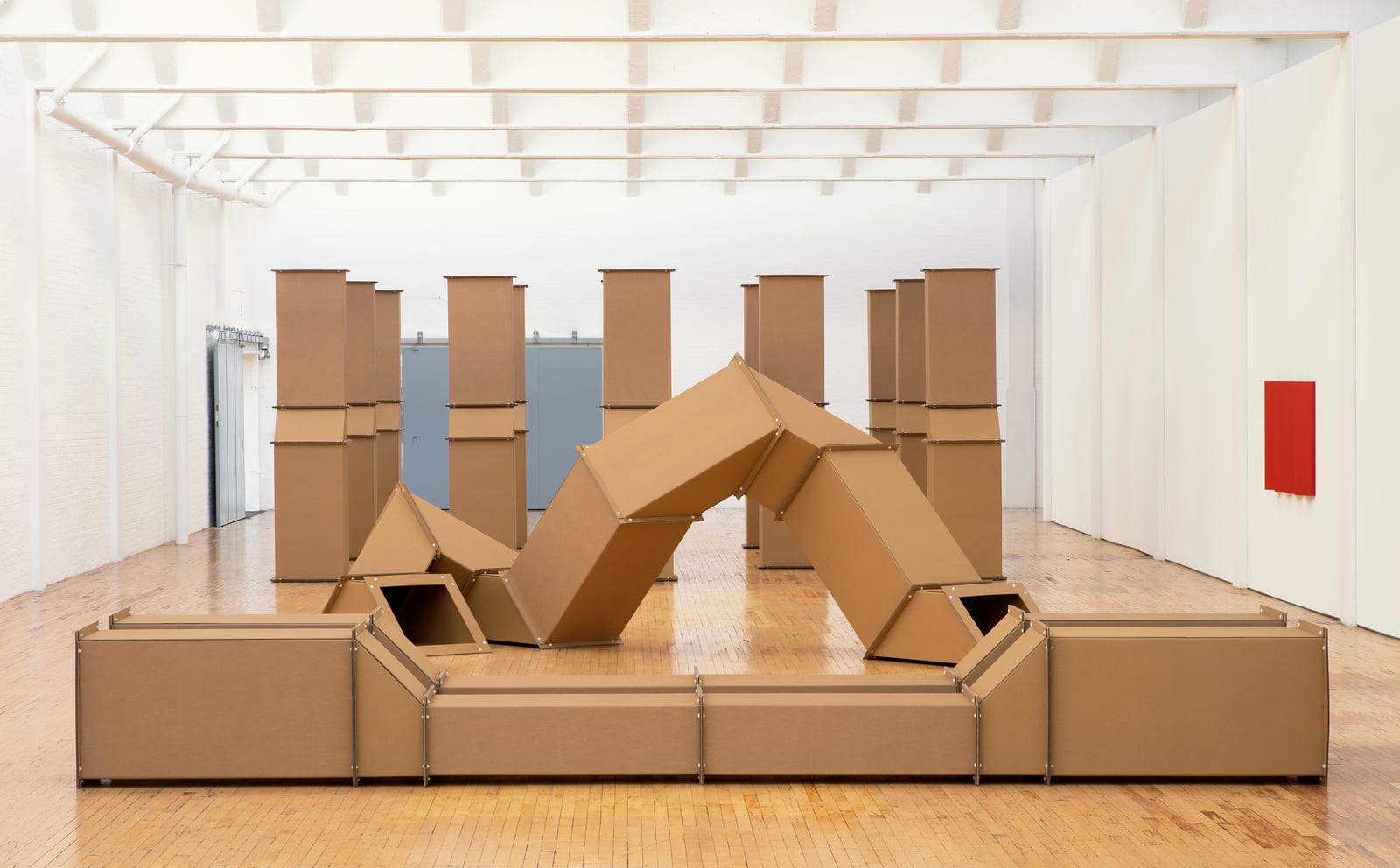
Image context: this post uses one real photographic installation image from the 2019 Dia Beacon retrospective, not a diagram, chart, generated image, or abstract placeholder. The image shows Charlotte Posenenske's modular square-tube work as it must be understood: in a room, in relation to bodies, walls, floor, and the possibility of rearrangement.[1][6]
Charlotte Posenenske's late sculpture looks, at first, almost too plain to carry the weight placed on it: galvanized sheet steel, corrugated cardboard, screws, square tubes, angled sections, industrial color, and open ends. The forms resemble ventilation ducts or building components that have wandered into the gallery. That resemblance is not a joke at art's expense. It is the core of the work. Posenenske made sculpture behave less like a treasured object and more like a public system: repeatable, movable, inexpensive, unfinished, and available to other people's decisions.[1][2][3]
The profile is unusually compressed. Posenenske was born in Wiesbaden in 1930 and died in Frankfurt in 1985, but the artistic turn for which she is now best known happened in a narrow late-1960s window. VIA Art Fund's account of the Dia retrospective frames her as an artist who rejected the prestige of the unique art object and the supreme authority of the artist, developing modular structures whose plans could be fabricated and disseminated.[1] Artists Space, which presented her first institutional solo exhibition in the United States in 2010, records the crucial ending: in 1968 she left contemporary art to study sociology.[2] The exit can seem like a biographical footnote. In fact, it is one of the cleanest ways to understand the work.
A Profile Built Around Refusal
Posenenske's importance does not come from making Minimalism friendlier. It comes from making Minimalist form answer to a social question. What if a sculpture were not a final composition guarded by the artist's hand? What if it were a set of components, available in series, that could be recombined by owners, curators, viewers, or collaborators? What if the work's beauty lay partly in refusing to become rare?
That refusal sits at the center of her 1968 statement, reproduced by Artists Space. Posenenske describes her works as variable, simple, reproducible, and rearrangeable; she also ties serial production to economy and to the wish not to make single pieces for individuals.[2] The point is not only formal. The object is being moved out of the old triangle of artist, masterpiece, collector. A Posenenske work is still authored, but it is not sealed. It asks someone else to complete, move, and test it.
This is why the square-tube works feel more radical than their calm geometry first suggests. They are not only austere shapes. They are instructions for a different art economy. VIA notes that Posenenske's modular structures could be produced from blueprints and that Dia's retrospective included new fabrications generated from those blueprints and verified by the estate.[1] The later fabrication is not a copy in the ordinary sense. It belongs to the work's logic. Posenenske wanted series, not aura as scarcity.
Square Tubes As A Public Grammar
The Series D and Series DW works clarify the grammar. NGV's collection record for Square tubes series D, Square tube identifies the material as galvanized steel and screws, and explains that Posenenske turned to prefabricated building materials resembling ventilation pipe systems in 1967.[5] The same record stresses that the owner or curator may assemble and reconfigure the work in different shapes each time it is shown.[5] That sentence changes the medium. The sculpture is not one pose. It is a permission structure.
The Posenenske archive's D/DW account gives the mechanic in sharper detail. Series D is made from six galvanized-sheet-steel element types: square tube, semi-square rectangular tube, cubic tube, angle section, transition section, and T-section.[3] Series DW translates the square-tube idea into corrugated cardboard, with four basic element types: square tube, rectangular tube, angle section, and transition section.[3] These pieces can be screwed together into different configurations, including large architectural arrangements.[3]
The effect is a kind of industrial alphabet. A tube is a word. An angle is a verb. A transition changes the sentence's scale. A T-section branches the syntax. The resulting installation can sprawl, stand, hang, interrupt a room, imitate infrastructure, or expose its own awkwardness. Nothing in the grammar promises a perfect sculpture. It promises that sculpture can be built as a repeatable language.
The Viewer Becomes A User
The word "viewer" is almost too passive for Posenenske. Her work does not need a viewer who merely recognizes good composition. It needs a user who understands that the arrangement could be otherwise. Artists Space made that explicit in 2010 by inviting different artists and staff to reconfigure her Square Tubes Series D on successive weekends.[2] M+ later described a related exhibition format in Hong Kong, where Posenenske's Series D and DW works were reconfigured across the run of Five Artists: Sites Encountered so audiences could see multiple responses to the same modular system.[4]
Those curatorial choices are not gimmicks. They reveal the work's time signature. A conventional sculpture may change meaning as a viewer moves around it, but the object itself remains fixed. A Posenenske square-tube work can change because a new arrangement has been made. M+ describes the practice as combining sameness and variability: the same elements, different configurations, different responses to space.[4] That is the work's social intelligence. It keeps authorship visible while refusing to let authorship end the conversation.
There is also a politics of scale here. When the pieces resemble ducts, they bring the gallery close to offices, factories, airports, distribution systems, and the built environment. The archive notes that Posenenske saw social spaces outside the gallery, including an airport, as meaningful contexts for the square tubes because such spaces belonged to networks of people and goods.[3] The sculpture does not represent logistics. It borrows logistics' forms to ask who gets to arrange space and who has to move through arrangements made by others.
Why Cardboard Matters
The cardboard Series DW is especially important because it drains monumentality without sacrificing presence. Cardboard is not noble in the old sculptural sense. It is light, cheap, consumable, and vulnerable. Yet in the Dia installation photograph, the brown modules still occupy the room decisively: standing in ranks, turning across the floor, opening into dark mouths, and making the white gallery read like an industrial passage.[1][6]
The archive's account says the works never bear a signature and may differ because of production runs, weathering, fingerprints, numbers, graffiti, or other marks of use; those surface changes counted as a historical level and a critique of art's claim to eternity.[3] That is a severe idea made from modest stuff. Wear is not failure. Use is not contamination. The work is allowed to show that it has been handled.
This is where Posenenske's position parts company with a narrow reading of Minimalism as pristine industrial cool. Her forms are simple, but the social life around them is not. The object may look objective; the arrangement is contingent. The fabrication may suppress the expressive brushstroke; the work then returns expressiveness to decision, handling, cost, circulation, and context.[2][3][5]
The Exit Was Not Silence
Posenenske's 1968 departure from art is often narrated as renunciation, and that is partly right. But it is more useful to see the exit as continuous with the sculpture's pressure. Artists Space records the problem in her own terms: art's formal development had accelerated while its social function had regressed, and the market remained small while prestige and price rose as supply became less topical.[2] Her withdrawal was not a sudden loss of interest in form. It was a judgment about what form could and could not do.
That judgment gives the square tubes their afterlife. They do not solve the social problems Posenenske cared about. They do something narrower and still forceful: they make the limits of the art object impossible to ignore. The work can be purchased, fabricated, installed, reinstalled, and exhibited. Yet every time it appears, it points away from singular possession and toward use, repetition, and collaborative arrangement.[1][2][4]
Seen this way, Posenenske's profile is not the story of a Minimalist who stopped too soon. It is the story of an artist who pushed Minimalist means until they exposed a harder question. If an artwork can be industrial, reproducible, cheap, unsigned, variable, and dependent on other people's choices, what exactly remains of the old masterpiece model?
Her answer was not a slogan. It was a room full of components. The sculpture waits for assembly, then refuses to become final. It behaves like a building system, a public grammar, and a critique of rarity all at once. Posenenske made the artwork answer to use - and in doing so, made use itself visible as a form of authorship.
Sources
- VIA Art Fund, "Charlotte Posenenske: Work in Progress" - Dia Beacon retrospective support page covering dates, modular structures, blueprints, estate-verified fabrications, and image captions.
- Artists Space, "Charlotte Posenenske" - 2010 exhibition page reproducing Posenenske's 1968 statement and giving biography and reconfiguration-program context.
- Archiv Charlotte Posenenske / Mehdi Chouakri, "D/DW SCHONE NEUE PLASTIK" - archive page detailing Series D and Series DW materials, elements, assembly, use, weathering, and social-space context.
- M+ Museum, "Four Configurations of Charlotte Posenenske's Sculptures" - museum article on Series D and Series DW, reconfiguration, curatorial participation, and variable display.
- National Gallery of Victoria, "Square tubes series D, Square tube, Charlotte POSENENSKE" - collection record with medium, measurements, date, and curatorial note on prefabricated materials and reconfiguration.
- VIA Art Fund hosted JPEG, "POSinstallation-view2019_1.jpg" - real installation photograph of Charlotte Posenenske: Work in Progress at Dia Beacon used as the article image.