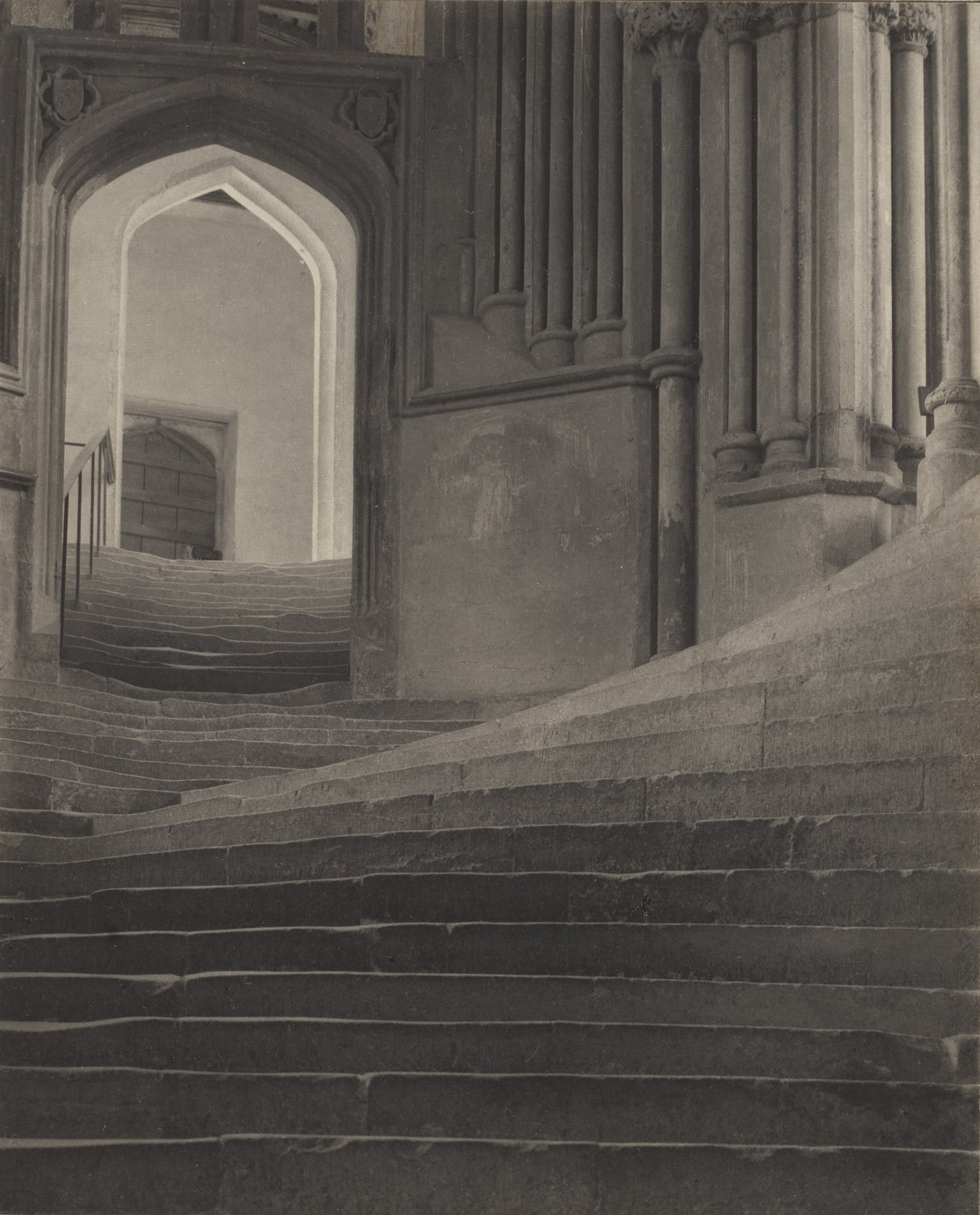
The staircase offers two ways onward. At the right, a broad flight curves upward and leaves the picture. Ahead, narrower steps continue through a pointed arch toward a farther doorway. Frederick H. Evans places us below their separation, where the routes still share the same worn treads. Before we can imagine arriving anywhere, we have to decide how to look.
His 1903 photograph, “A Sea of Steps,” Wells Cathedral, makes that hesitation absorbing. The MoMA print reproduced here measures just 23.6 by 19.1 centimeters.[1] Within this small rectangle, a passage between rooms becomes a place with its own weather: pale stone, deep recesses, and edges that seem to gather and break.
A staircase with business to do
The architecture has practical reasons for its unusual shape. Wells Cathedral dates the staircase to 1265–1280 and the Chapter House to 1286–1306. The meeting room stands above an undercroft used as a strong room. Canons assembled upstairs to discuss cathedral affairs and conduct legal proceedings; witnesses could wait on seats beside the steps.[2]
The routes also matter to the photograph. The rising curve at right leads toward the Chapter House floor, while the passage ahead connects toward Vicars’ Close.[3] The composition holds both directions together without showing either destination fully. The room that would ordinarily justify the climb remains outside our view.
That omission gives the staircase an independence it lacks in a visitor’s itinerary. A person hurrying to a meeting would treat each tread as a means of getting somewhere. Evans makes the intermediate space sufficient. We stay where a walker would normally move on.
The historical function also complicates the photograph’s hush. These stones belonged to an institution that met, managed, and heard testimony. Their unevenness invites us to imagine repeated use, although the image cannot identify whose feet made a particular hollow. Its emptiness leaves room for human presence without supplying a picturesque figure to represent it.
How the wave is made
Begin at the lower edge. The broad steps lie close to the picture’s surface, their shallow depressions interrupting what might otherwise look like tidy horizontal bands. Farther up, those bands gather more tightly. On the right they bend around the clustered columns; on the left they narrow into the opening. The eye receives several instructions at once: rise, turn, continue.
The columns keep the movement intelligible. Their upright lines offer a firm measure against which the curving stair can appear to swell. Cover that side of the picture mentally and the sequence becomes flatter, more simply a series of steps leading away. Restore the column bases and the staircase seems to press around something that resists it.
Evans’s title directs this sensation. In his own account, quoted by the National Gallery of Canada, he likened the right-hand curve to a large wave and the worn upper steps to smaller waves approaching shore.[3] The sea is his interpretation of the stone. Once he gives us the comparison, the eye can move between two readings of the same edge: a surface that supports a foot and a crest that appears ready to fall.
Light sustains that doubleness. Bright rims pick out the treads, while darker risers give them thickness. The photograph lets the stair feel mobile without making its material disappear. Stone continues to look heavy even as its outline begins to flow.
A viewpoint reached slowly
This encounter took work. Anne M. Lyden’s Getty study describes the 1903 image as the outcome of attempts made over several years. She contrasts it with Evans’s 1900 photograph from another perspective, finding a stronger rhythm in the later view.[4] The staircase had offered him a subject before he found the arrangement that satisfied him.
Lyden also describes his broader working practice: studying cathedral interiors over extended visits and recording viewpoints, light, exposures, and lenses in notebooks.[4] Those observations do not give us a stopwatch reading for this exposure. They establish that waiting and comparison belonged to his method.
There is a useful distinction here between finding a building and finding a photograph. The camera can register what stands before it; the photographer must decide which relationships will survive inside the frame. In this case, shifting position changes the balance between the sweep at right and the smaller ascent ahead. A familiar staircase can become a different visual proposition without any stone moving.
Getty’s exhibition account emphasizes Evans’s wish to convey an emotional experience of architecture.[5] In A Sea of Steps, that ambition is available in ordinary particulars. We can see the worn surface, follow the bend, and feel the pull of the opening. A spiritual reading is possible, but the photograph gives it something solid to rest on.
Look once more at the place where the routes divide. The right-hand ascent promises a room beyond the edge; the left-hand passage promises another stretch of building. Evans leaves both promises open. The lasting pleasure lies here, before arrival, where a staircase built to carry people onward persuades us to remain.
Sources
- The Museum of Modern Art, Frederick H. Evans, “A Sea of Steps,” Wells Cathedral, 1903 — object record, dimensions, medium, credit, and source of the reproduced print; object 457.1966.
- Wells Cathedral, “Wells Cathedral Timeline,” especially “A Masterful Meeting Place” and “Accommodation for the Ages” — construction, Chapter House functions, witnesses, and the passage to Vicars’ Close.
- National Gallery of Canada, “Your Collection: Wells Cathedral: A Sea of Steps by Frederick H. Evans,” May 25, 2015 — the two routes and Evans’s description of the steps as waves.
- Anne M. Lyden, The Photographs of Frederick H. Evans, J. Paul Getty Museum, 2010, printed pp. 3, 11, and 15–16 — working notebooks, prolonged observation, and comparison of the 1900 and 1903 Wells views.
- J. Paul Getty Museum, “A Record of Emotion: The Photographs of Frederick H. Evans,” 2010 exhibition essay — Evans’s emotional approach to architecture and photographic presentation.