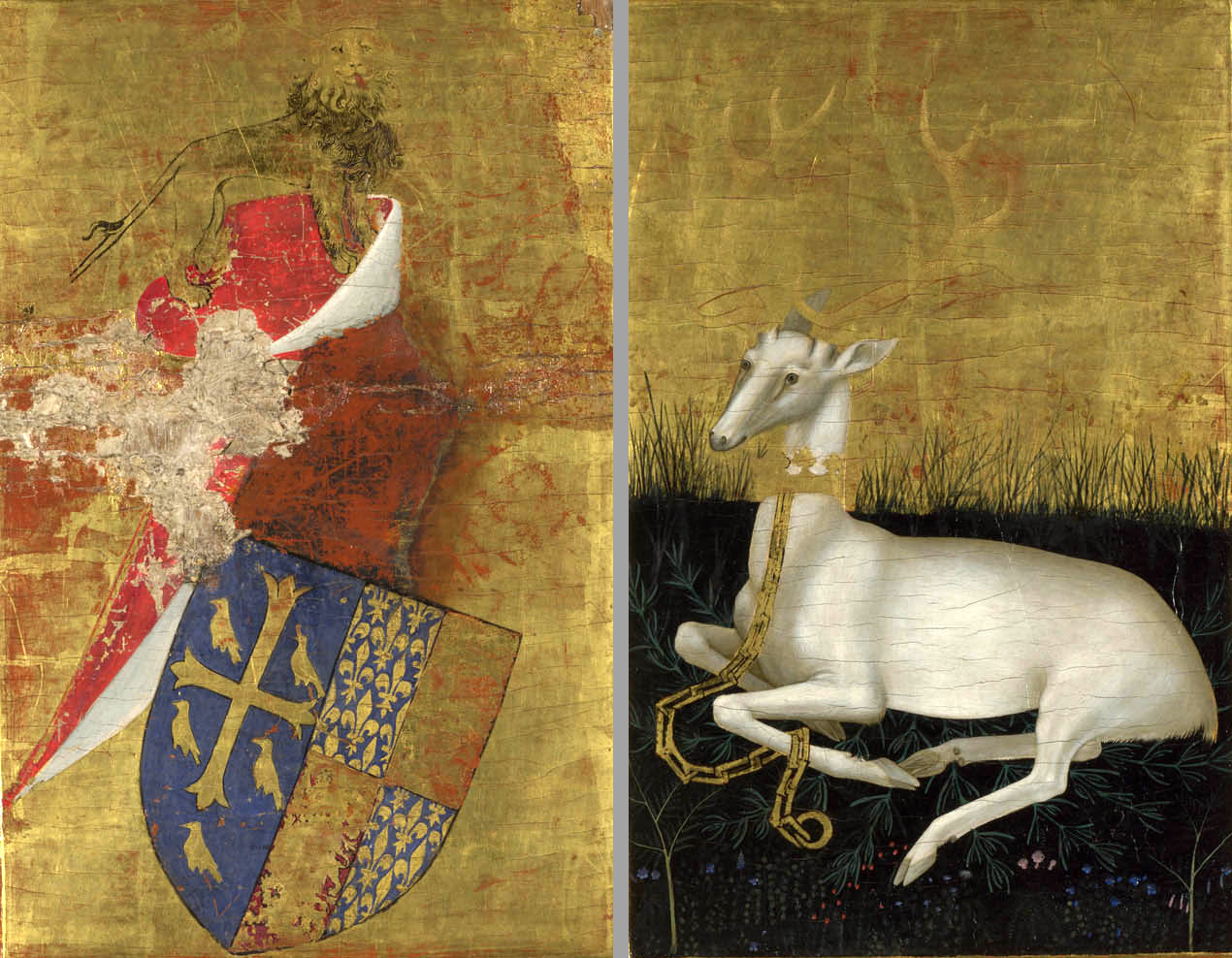
The Wilton Diptych is small enough to be held in the imagination like a book, but it behaves like a kingdom compressed into two hinged panels. Open, it stages King Richard II kneeling on the left while the Virgin and Child appear on the right among a company of angels in saturated blue. Closed, it becomes heraldry and emblem: arms on one side, a white hart on the other. The work does not separate private prayer from public rule. It makes each condition explain the other.[1][2]
That is why the painting feels stranger than a royal donor portrait should. Richard kneels, but the scene is not modest. Gold leaf floods the background. The Virgin's court is dressed in the king's own white-hart badge. One angel holds a white pennon marked with a red cross, while the Christ Child reaches toward the kneeling king. The picture turns devotion into a ceremony of recognition: Richard lowers himself before heaven, and heaven appears already wearing his sign.[1][2]
Image context: this post uses an immersive museum-viewing scene rather than a flat artwork reproduction, diagram, chart, or analytical graphic. The choice keeps attention on the diptych as a small, hinged, devotional object whose royal meaning depends partly on scale, proximity, and viewing conditions.
The Hinge Makes the Argument Portable
The National Gallery describes the Wilton Diptych as a late fourteenth-century folding altarpiece made for Richard II, painted in egg tempera on oak, covered with gold leaf, and joined by central hinges so that it could open and close like a book.[1] That physical fact is not incidental. A diptych is an image with a threshold built into it. It can conceal and reveal. It can travel. It can stand open for prayer, then shut into a compact object of custody.
The Institute of Historical Research's Richard II project notes that the two Baltic oak panels had carved gilded frames from the same wood and originally gilded iron hinges; it also stresses the prepared gold ground and egg tempera, a technique that allowed the deep ultramarine to keep unusual purity.[3] The object therefore asks to be read not only as image but as equipment. It is a royal devotional instrument, scaled for movement, close looking, and guarded handling.
That portability changes the meaning of the king's body. Richard is not shown enthroned in a public hall. He kneels inside an object that could accompany him through residences, campaigns, and private oratories. Lisa Monnas's study of Richard II's devotional settings argues that the Wilton Diptych survives almost alone in England from a normal class of portable devotional paintings used within royal worship, and that the accepted view links it to Richard's personal devotions in private oratories.[4] The work's intimacy, then, is not retreat from power. It is power carried into prayer.
Blue Is Where the Painting Turns
The most immediate drama is chromatic. Richard's side is rich but earthbound: bare ground under his knees, fur and gold around his mantle, saints arranged as a court of intercessors. The Virgin's side is cooler, denser, and less earthly. The angels' blue robes gather around Mary and the Child like a single field of celestial allegiance. The National Gallery's catalogue identifies the right wing as the Virgin and Child with eleven angels, one holding the swallow-tailed white pennon with a red cross.[2]
Blue does more than decorate heaven. It concentrates attention. Against the gold ground, the blue robes make Mary's court feel both precious and coordinated. In the open diptych, the eye moves from Richard's patterned robe to the blue choir, from royal textile to heavenly textile. The painting makes color carry hierarchy: the king has splendor, but the Virgin's side has atmosphere.
That matters because the angels wear Richard's white-hart badge. The sign that would normally belong to a king's earthly affinity has migrated into heaven. This is not a neutral compliment. It imagines Richard's rule as already acknowledged by a celestial household. The badge does not make the angels servants in a crude political poster. It makes the boundary between devotion and royal self-image almost impossible to cleanly separate.
The Saints Make a Lineage, Not a Crowd
Richard does not face the Virgin alone. He is presented by Saint John the Baptist, Saint Edward the Confessor, and Saint Edmund, king and martyr.[1][2] The grouping is precise. John the Baptist points toward the Lamb and toward recognition; Edward and Edmund bring English royal sanctity into the scene. The painting gives Richard a devotional escort made of witness, dynasty, and martyrdom.
This is where the left panel becomes more than a kneeling portrait. The saints do not simply decorate Richard's prayer. They authorize its route. Edward the Confessor and Edmund carry royal holiness backward into English history, while John the Baptist connects that royal line to a biblical language of announcement and mediation. The king is small in posture but not unsupported. His humility is staged within a powerful network of intercession.
The National Gallery catalogue also notes that the composition has been compared to the Adoration of the Magi.[2] That resemblance helps explain the diptych's tension. Richard kneels like an offering king, but he is also the one being offered. His person, his realm, and his emblematic identity are moved across the hinge toward the Virgin and Child. The painting transforms a royal portrait into a devotional presentation ceremony.
The Banner Is a Small Political Machine
One of the most charged details is the angel's swallow-tailed white pennon with a red cross. The National Gallery catalogue records the argument that this banner can be read with a dual function, as both the banner of Christ and of Saint George.[2] The point is not that a single flag solves the painting. The point is that the flag gathers several claims into one delicate object: crusading color, English sanctity, Marian presentation, and royal petition.
The banner's position matters. It is held on the Virgin's side, not Richard's. The emblem that might serve royal ambition is already in heavenly hands. The Christ Child reaches toward Richard near this field of signs, so the scene feels like a transfer without requiring a literal document. The king is not crowned in the picture. He is received, interpreted, and folded into a sacred order.
That is the painting's political subtlety. It does not shout dominion. It stages dependency. Richard's authority appears strongest when it is shown as something he must ask heaven to confirm. The white hart, the saints, the banner, and the gold ground all help make that request look visually inevitable.
The Outside Remembers the Inside
The outer panels matter because the diptych was made to close. The National Gallery's object description emphasizes the back as well as the front: when shut, the work presents exterior imagery, including the hart panel and the armorial panel.[1][2] The closed object therefore does not become blank storage. It keeps speaking in a more compressed language.
This is one of the diptych's finest inventions. Open, it narrates an encounter: Richard, saints, Virgin, Child, angels, banner. Closed, it distills the same world into signs of identity and possession. Devotion turns into emblem; image turns into object; prayer turns into heraldic memory. A portable altarpiece has to survive both states, and the Wilton Diptych uses both.
That double life also explains why the painting remains so difficult to reduce to either art history or political history alone. The artist is unknown, and even the place of production remains debated, with the National Gallery and IHR both describing it as English or French and made around the late 1390s.[1][3] But uncertainty about authorship does not weaken the work's force. If anything, it sharpens attention on the object itself: hinged oak, egg tempera, gold, blue, badges, saints, exterior emblems, and the choreography of opening.
The result is a painting about rule under pressure. Richard II's reign ended in deposition in 1399, but the diptych does not need hindsight to feel tense. Its tension is already in the image. A king kneels. Heaven wears his badge. A banner hovers between Christ, Saint George, and English claims. The object can close like a book, hiding the encounter inside a shell of heraldry.
The Wilton Diptych makes kingship beautiful by making it conditional. Richard's grandeur depends on kneeling, on being presented, on being seen by the Virgin and Child, on having his emblems translated into heavenly company. The gold ground makes the scene timeless; the hinge makes it practical; the blue makes it unforgettable. In this small folding object, royal power becomes most extravagant at the moment it admits that it needs an audience beyond the court.[1][2][4]
Sources
- The National Gallery, London, "English or French (?) | The Wilton Diptych | NG4451" - object page with late-fourteenth-century dating, Richard II context, folding altarpiece format, egg tempera on oak, gold leaf, hinged construction, portability, and private devotion.
- Dillian Gordon et al., "The Wilton Diptych," National Gallery Catalogues: Online Entries for Individual Paintings, 2024 - detailed catalogue entry covering the interior panels, saints, Virgin and Child, eleven angels, white-hart imagery, pennon, exterior panels, technique, support, provenance, and interpretation.
- Institute of Historical Research and Royal Holloway, "The Wilton Diptych (portrait of Richard II)" - Richard II's Treasure project page on Wilton House provenance, unknown artist/place, likely English or northern French production, Baltic oak panels, gilded hinges, gold ground, egg tempera, and ultramarine.
- Lisa Monnas, "The Furnishing of Royal Closets and the Use of Small Devotional Images in the Reign of Richard II: The Setting of the Wilton Diptych Reconsidered," Fourteenth Century England III, Cambridge Core - chapter summary on portable devotional paintings, royal travel, private oratories, and the likely personal devotional use of the diptych.
- Wikimedia Commons, "File:Wilton diptych2.jpg" - public-domain photographic reproduction used as the article image, showing the open two-panel diptych.
Editor’s Pick Review
This piece earns the editor’s pick because it treats the Wilton Diptych as a working object rather than a famous surface. The argument keeps returning to physical evidence — hinge, oak panels, gold ground, ultramarine, white-hart badges, saints, banner, and exterior panels — so the close reading feels anchored in the artwork itself instead of floating above it.
Its strongest editorial quality is balance: devotional intimacy, royal theater, portable format, and political pressure all remain visible at once. The selected image is equally disciplined, using a direct reproduction of the object under discussion, which gives the reader the exact visual field the essay is asking them to read.