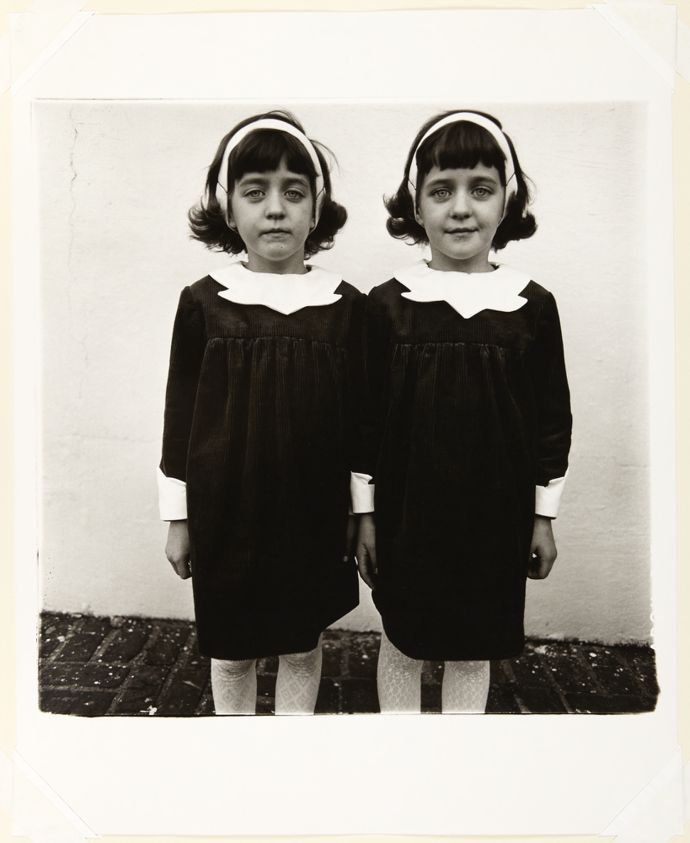
Image context: this post uses a real museum object image of Diane Arbus's Identical Twins, Roselle, New Jersey from Princeton University Art Museum, not a generated visual, diagram, or abstract placeholder. The photographed print is the evidence: two matching figures, a wall, pavement, paper edge, and the uneasy difference that appears only because the image first insists on sameness.[1]
Diane Arbus's Identical twins, Roselle, N.J. is often remembered as an uncanny photograph, but that word can flatten the picture too quickly. The work is not powerful because two children in matching dresses seem strange. It is powerful because the photograph makes matching itself unstable. The longer you look, the less the twins behave like a single doubled sign. Their clothes align, their pose aligns, their hair and headbands align, and then their faces quietly refuse the bargain.[1][2]
That is the work's exact pressure. Arbus does not dissolve individuality into sameness. She uses sameness as a measuring device for difference. One mouth softens while the other holds back. One expression seems closer to a smile, the other more watchful. The bodies stand almost as a unit, but the eyes do not deliver the same temperature. The photograph therefore turns comparison into the subject. The viewer is not simply looking at twins. The viewer is caught in the act of testing how much likeness can hide before difference leaks through.
The object records already hint at the photograph's complicated afterlife. Princeton University Art Museum titles its print Identical Twins, Roselle, New Jersey and dates it 1967; MoMA and the Metropolitan Museum of Art list closely related records under Identical twins, Roselle, N.J. with a 1966 date.[1][2][3] That variance is not a problem for this reading. It is a reminder that the picture exists both as a specific encounter and as a print history that museums have repeatedly stabilized, catalogued, and recirculated.
The uniform is not neutral
The matching dresses do the first work. Dark fabric makes the two bodies read as a pair before either child reads as a separate person. White collars and cuffs repeat. White headbands repeat. The girls stand upright in nearly the same frontal posture, close enough that their shoulders form a shared block against the wall. A less rigorous photograph might have used matching clothes as a cute fact. Arbus makes them into a visual contract.[1]
That contract says: begin by assuming likeness. The photograph then spends the rest of its energy breaking that assumption without breaking the pose. The dresses are not decoration; they are the control condition. Because clothing, stance, age, scale, and background are so tightly aligned, every small deviation becomes louder. The tilt of hair, the set of a lip, the degree of tension around the eyes, the slight difference in how each girl meets the camera: these are no longer minor portrait details. They become the whole drama.
This is why the picture is more severe than sentimental. Childhood portraiture often invites softness, family resemblance, or charm. Arbus removes most of that cushioning. The wall is plain. The pavement is ordinary. The girls are neither playing nor being folded into domestic warmth. They are presented in the open, almost like a demonstration. But what is being demonstrated is not a type. It is the failure of type to contain two people.
The square makes looking unavoidable
The square format matters because it holds comparison in place. Princeton's record gives the image dimensions as a square, and MoMA's object page similarly records a nearly square gelatin silver print.[1][2] That format denies the eye an easy escape route. There is no dramatic landscape, no deep street, no narrative path leading away from the figures. The twins occupy the center, and the format keeps returning us to their relation.
The wall behind them also matters. It is not blank in the sense of empty; it is blank in the sense of withholding. Its pale surface strips away the clutter that could explain or soften the scene. Without toys, parents, party decorations, or a larger room, the photograph offers only pose, dress, face, edge, and ground. That spareness can make the picture feel cold, but it also gives the image its analytic force. The viewer has to make sense of the difference that remains.
Arbus's mature square photographs often feel less like captured moments than staged confrontations with presence. Recent criticism of the 2025 Constellation exhibition notes how her move toward waist-level, wide-format cameras created a different kind of encounter from faster 35 mm street work: more intention, more connection, more pressure on the subject's directness.[7] Identical twins belongs to that pressure. The girls' frontal stance is not casual in effect. It is a meeting.
The meeting is uncomfortable partly because the children do not perform one emotional script. If both smiled, the picture might become charming. If both glowered, it might become theatrical. Instead, the expressions diverge just enough to interrupt the viewer's hunger for a simple reading. One face seems to open; the other seems to reserve. The difference is slight, but the photograph has built a room in which slightness becomes decisive.
New Documents gave the image a public frame
The photograph's historical frame sharpened that effect. MoMA's New Documents exhibition ran from February 28 to May 7, 1967, bringing together Diane Arbus, Lee Friedlander, and Garry Winogrand in a show that the museum now describes as highly influential for modern photography.[4] John Szarkowski's framing shifted documentary photography away from social reform alone and toward a more personal kind of knowing. MoMA's archived press release placed Identical Twins, Roselle, N.J. 1966 directly on the Arbus checklist.[5]
That context matters because it keeps the photograph from being read as a private oddity. The image is a documentary photograph, but not because it explains twins, childhood, New Jersey, or a social condition in the older reformist sense. Its documentary force lies in what happens when ordinary appearance is held still long enough to become strange. The picture looks at a commonplace ritual, two children dressed alike for an event, and finds an identity problem inside it.[4][5]
Phillips's account of an important lifetime print emphasizes how quickly Arbus recognized the photograph as a definitive work, noting its inclusion in New Documents, its use as a postcard connected to that exhibition, and its later place in A box of ten photographs.[6] That early circulation is not secondary gossip. It shows that the photograph's authority depended on print, exhibition, postcard, portfolio, and repetition. The work became famous because it could keep reproducing the same unstable comparison.
The irony is perfect. A photograph about sameness and difference became an image repeatedly printed, collected, catalogued, and reproduced, yet each record carries its own version: 1966 or 1967, Roselle N.J. or Roselle, New Jersey, lifetime print or later print, museum object or auction history.[1][2][3][6] The work's afterlife repeats its central problem. How can one thing remain itself when every act of presentation makes it slightly different?
The ethics sit in the viewer's stare
Writing about Arbus always risks turning into a trial. Her work has been praised for attention and accused of cruelty, defended as radical openness and criticized as voyeurism. The recent New Yorker review of Constellation usefully restates that dispute: Arbus's photographs have long posed questions of consent and agency, and her critics have often argued over whether the camera exposes people or exposes the viewer.[7]
Identical twins does not let that question settle cleanly. The girls are children, and the photograph's fame has turned their childhood image into an art-historical emblem. That fact should keep the viewer alert. But the picture itself is not a simple act of mockery. The twins stand with composure. They do not appear tricked into chaos, nor are they turned into caricature by an intrusive background. The photograph's discomfort comes from a more exact place: it makes the viewer's comparative impulse visible.
You look from one face to the other. You test the smile against the unsmiling mouth. You compare collars, cuffs, headbands, hands, knees, shoes, and hair. The picture asks for that work and then makes that work feel morally exposed. Why do we need the two children to resolve into a pattern? Why is likeness comforting until difference appears? Why does difference feel so intense when nothing dramatic has happened?
That is Arbus's hard achievement here. She does not simply photograph people who look unusual. She photographs a situation that reveals how quickly normal looking becomes classificatory. The twins are not abnormal. Matching children at a gathering is almost aggressively ordinary. Yet under the camera's square pressure, ordinariness becomes theatrical. The viewer discovers that the act of looking is already loaded.
The print edge keeps the icon material
The Princeton image is useful because it shows the photograph as an object, not just as a floating internet icon. The paper, margin, and mounted edge remain visible.[1] That matters for a close reading because Arbus's work can become too easily absorbed into cultural shorthand: "the creepy twins," "the famous Arbus," "the image that influenced later horror." The object view pulls the work back toward photographic material: gelatin silver print, square image, paper surface, museum accession, physical dimensions.[1][2][3]
That materiality also returns us to the photograph's discipline. The picture is not a loose anecdote about a strange encounter. It is a carefully held arrangement in which surface and subject collaborate. The pale wall makes the dresses darken. The dresses make the collars flash. The collars push the faces forward. The square frame keeps the pair locked in relation. The print edge reminds us that all of this is made, selected, printed, and preserved.
The final force of Identical twins is therefore not shock. Shock fades too quickly. The stronger force is a durable visual trap: the photograph gives us sameness as the easiest first reading, then makes that reading fail in front of us. It teaches the eye that comparison is never innocent, that identity is not cancelled by uniform, and that a small difference can become enormous when a picture has stripped away every excuse not to see it.[1][4][7]
Arbus made a photograph in which two children stand side by side and nothing much happens. That is why everything happens. The image does not need narrative movement because the movement is already inside the viewer's attention, shifting back and forth, trying to decide whether likeness has won, and learning that it never does.
Sources
- Princeton University Art Museum, "Identical Twins, Roselle, New Jersey" - object record for Diane Arbus's 1967 gelatin silver print and source for the article image.
- The Museum of Modern Art, "Diane Arbus. Identical twins, Roselle, N.J., 1966" - collection page with medium, dimensions, object number, and department record.
- The Metropolitan Museum of Art, "Diane Arbus, Identical twins, Roselle, N.J." - collection record for the 1966 gelatin silver print.
- The Museum of Modern Art, "New Documents" - exhibition archive for the 1967 show featuring Diane Arbus, Lee Friedlander, and Garry Winogrand.
- The Museum of Modern Art, "New Documents" 1967 press release PDF - archived checklist and Szarkowski exhibition framing.
- Phillips, "In Focus: Diane Arbus's 'Identical twins, Roselle, N.J., 1967'" - provenance and print-history essay on the photograph, New Documents, and A box of ten photographs.
- Max Norman, "Diane Arbus and the Too-Revealing Detail," The New Yorker - 2025 critical context on Arbus's camera practice, legacy, and the ethics of looking.