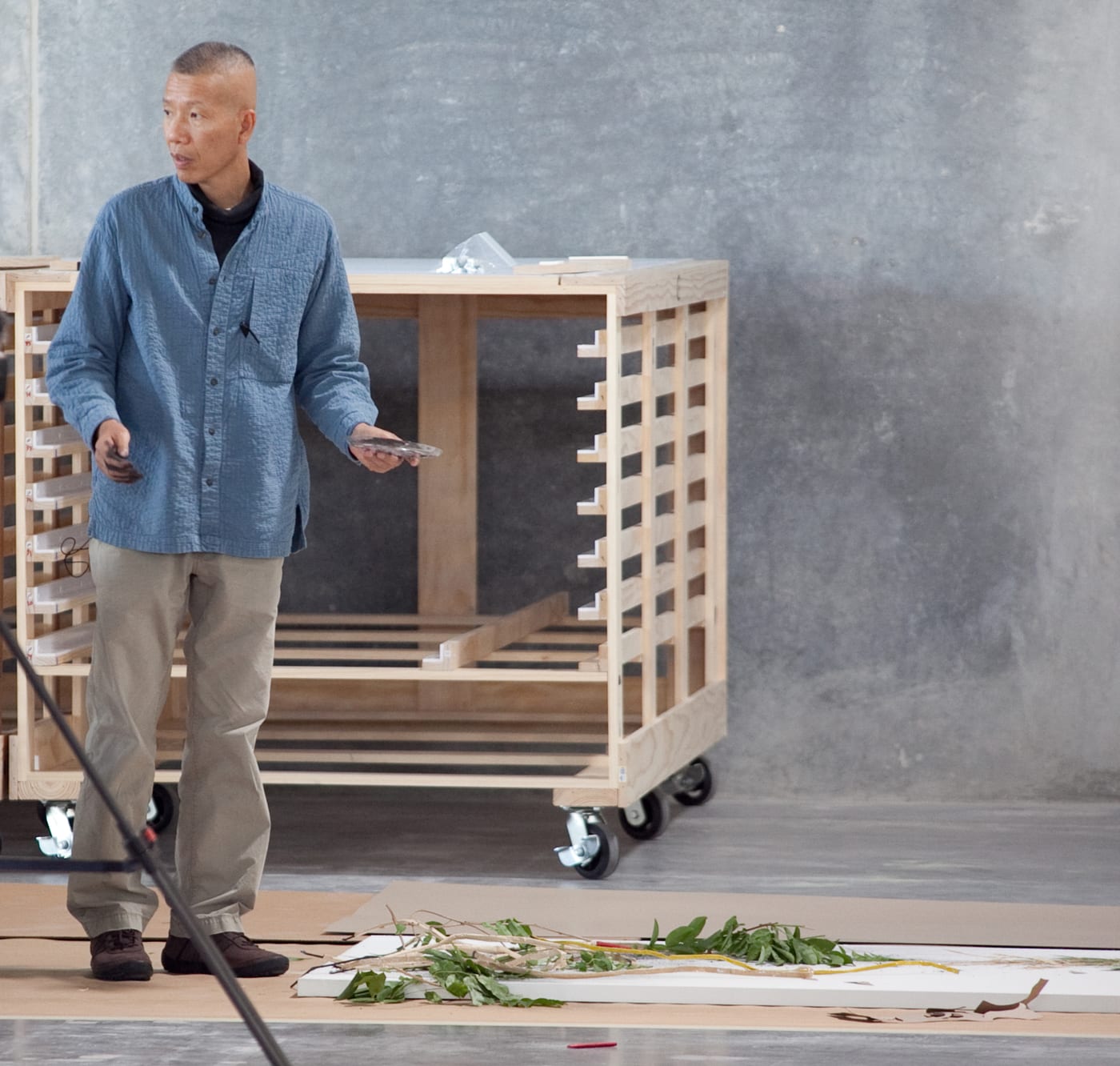
Image context: this post uses a real documentary photograph of Cai Guo-Qiang preparing a gunpowder drawing at the Museum of Fine Arts, Houston on October 5, 2010. It is not a generated visual, diagram, chart, or detached portrait. The image matters because Cai's medium is visible before it becomes spectacle: paper on the floor, arranged organic material, studio scaffolding, and a working body poised around a controlled accident.[5][7]
Cai Guo-Qiang's gunpowder drawings are often remembered through the instant of ignition: flash, smoke, audible charge, the theatrical risk of fire entering the studio. That memory is accurate, but it can make the medium sound like a stunt with residue. The stronger reading is more disciplined. In Cai's work, gunpowder is not paint with a louder entrance. It is a drawing material whose behavior has to be composed before it is released.
That distinction changes how the works should be seen. The finished surface carries scorch, bloom, dark powder, broken edge, and smoky diffusion, but those marks are not simply the aftermath of an event. They are the record of a process in which planning and volatility have been forced into the same pictorial field. Cai's achievement is to make an image that remains legible after a material has partly refused to obey him.[2][3]
The result is a controlled accident, but the phrase should be taken seriously. Control comes through supports, stencils, weights, pressure, sequence, and an artist's accumulated knowledge of how powder behaves. Accident comes through flame speed, smoke movement, particulate drift, heat, uneven contact, and the small ways matter answers back. The drawing happens where those two systems meet.
Powder Is A Line With Weather Inside It
Gunpowder gives Cai a line that cannot stay clean. The Ashmolean exhibition record makes the range visible: early small gunpowder drawings on paper from 1988, a 1994 gunpowder-and-arrow work, later gunpowder on porcelain, canvas, silk, plaster, marble, glass, ceramics, brick, and concrete.[1] The point is not simply that Cai uses many surfaces. It is that gunpowder behaves differently depending on what receives it.
On paper, the mark can feel like charred ink remembering heat. On canvas, it can spread into bruised atmosphere. On porcelain or glass, combustion meets a harder, colder support. On silk, the image has to negotiate fiber, delicacy, and scorch. Gunpowder is therefore a medium with a built-in argument against neutrality. It never arrives as pure color. It arrives with chemistry, force, risk, and cultural memory already attached.[1][2]
That is why the drawings do not need to imitate fireworks in order to matter. A firework spends itself in public air. A gunpowder drawing asks the spent force to remain on a surface. It turns the vanishing event into a fixed field without fully domesticating it. Look closely at the medium and the image is always double: a composition you can inspect and an event you know you missed.
Composition Happens Before The Flame
The mistake is to imagine ignition as the beginning. In practice, ignition is closer to the middle. White Cube's 2025 account of Cai's recent gunpowder works describes a procedure in which the composition is first mapped with sprinkled powder, then covered and weighted before ignition, so that the blast disperses, recomposes, and fuses matter into an image.[3] That summary is useful because it restores the slow work before the flash.
Mapping matters. Cai has to decide where powder accumulates and where it thins, where the image should hold an edge and where it should feather, where a stencil should resist fire and where a support should accept stain. Covering and weighting matter too. They do not merely protect the studio. They shape how pressure travels, how flame breathes, and how residue gets trapped or released. A drawing made this way is not drawn by the hand alone. It is drawn by a prepared environment.
The Houston installation record gives a more concrete view of what happens after that preparation. CultureMap's October 2010 report describes the 42 panels of Odyssey being installed in sequence at the Museum of Fine Arts, Houston after the warehouse ignition had fixed the gunpowder image, with the smell of fresh powder still present in the gallery.[5] That detail is important. It keeps the gunpowder from swallowing the method. Cai's fire depends on ordinary craft and logistical decisions: sequencing, mounting, spacing, ventilation, and the conversion of a floor-born event into a wall-length viewing condition.
This is where the technique becomes richer than the spectacle. The blast can feel sudden to an audience, but the image has already been negotiated through paper, pattern, labor, and sequence. The ignition is decisive because so much has been set up to be decided in one irreversible moment.
Odyssey Turns Process Into Architecture
Odyssey is a useful scale test because it proves that the method can exceed the studio sheet without turning into mere theatricality. Cai Studio identifies the work as a 2010 gunpowder-on-paper piece mounted on wood as a 42-panel screen, measuring 3.15 by 49.38 meters overall, commissioned by the Museum of Fine Arts, Houston for the Ting Tsung and Wei Fong Chao Arts of China Gallery.[4] Those numbers matter. They move the medium from object scale to architectural encounter.
At that scale, gunpowder does not just make marks. It makes a room-length atmospheric system. The viewer cannot take in the whole work as one neat image from a single standing position. The body has to move along the screen, letting dark passages, open intervals, blown edges, and residual fields accumulate over time. Cai's technique becomes spatial because the mark no longer sits in front of the viewer as a bounded picture. It lines the viewer's path.
The Houston process photograph used for this post catches the right phase of that transformation.[7] Cai stands beside a work still in preparation, before fire has converted arrangement into image. That matters because a finished gunpowder drawing can look almost inevitable. The photograph restores contingency. It shows the drawing as a set of decisions still waiting for ignition to approve, distort, or betray them.[5][7]
The same tension sits in the finished Odyssey. A permanent museum installation gives the work institutional stability, yet its surface keeps the memory of instability. The image is fixed, but its marks still imply the violence of their making. The work belongs to a gallery and to the moment that nearly escaped the gallery.
Chance Is Not The Opposite Of Skill
Cai's art is often described through chance, but chance here is not laziness disguised as philosophy. The Pacific Asia Museum's 2024-2025 exhibition page, based on Getty research, frames gunpowder as the material that has come to define Cai's work and emphasizes that its unpredictable nature helps determine the outcome.[2] The useful word is "determine." Unpredictability is not a decorative afterthought. It is one of the image's active agents.
Art21's profile gives the biographical and artistic bridge: while Cai lived in Japan from 1986 to 1995, he explored gunpowder in drawings, work that led toward his signature explosion events.[6] It also notes that he used the material to foster spontaneity and confront controlled artistic traditions and social conditions.[6] That history helps explain why the drawings should not be separated too sharply from performance. They are not performances only, but they preserve performance inside a material record.
Skill, then, lies in knowing how much to let the material decide. Too little release and the work becomes an illustration of danger. Too much release and it becomes only damage. Cai's strongest gunpowder drawings stay between those failures. They let combustion leave evidence of autonomy without abandoning composition.
This is why the medium can hold both violence and elegance. Gunpowder is a historical material of war, celebration, signal, state ceremony, and festival. Cai does not erase those associations. He reroutes them into picture-making. The same material that can announce power or destruction becomes a means of staining paper, shaping flowers, making landscapes, or turning abstraction into residue.[1][3][6]
The Afterimage Is The Work
The most interesting thing about a gunpowder drawing is that it is not the explosion. It is what remains after the explosion has done its work and vanished. That remaining surface is not quiet exactly. It is quieter than the event, but it keeps pressure in the marks. A dark burst can read as flower, bruise, smoke cloud, cosmic field, battlefield trace, or ink wash depending on how the support and composition behave.[1][3]
That instability explains why Cai's gunpowder practice continues to move across formats. The recent White Cube exhibition described a decade of gunpowder experimentation from 2015 to 2025, including shifts between figuration and abstraction, black powder and colored pyrotechnic powders, natural motifs and cosmic registers.[3] The medium remains productive because it has not been reduced to one look. Its grammar is procedural rather than stylistic: prepare, charge, cover, ignite, reveal, assess.
The reveal is crucial. Many artists make process visible by showing the hand. Cai makes process visible by showing what the hand could not completely govern. The finished drawing asks the viewer to read residue as evidence of negotiation. It says that an image can be authored without every mark being personally controlled, and that chance can become precise when the conditions around it are made exact.
That is the core technical lesson. Cai Guo-Qiang does not make fire replace drawing. He makes drawing survive fire. Powder becomes line, ignition becomes pressure, smoke becomes edge, accident becomes composition, and the surface that remains is not a souvenir of spectacle. It is the place where spectacle has been forced to become form.[2][3][5]
Sources
- Cai Guo-Qiang Studio, "Cai Guo-Qiang: Gunpowder Art" - project page for the Ashmolean exhibition, with work metadata across paper, canvas, porcelain, silk, and other gunpowder supports.
- USC Pacific Asia Museum, "Cai Guo-Qiang: A Material Odyssey" - exhibition page on decades of gunpowder drawings, paintings, pyrotechnics, Getty research, and the material's unpredictable role in the work.
- White Cube, "Cai Guo-Qiang: Gunpowder and Abstraction 2015-2025" - 2025 exhibition page describing mapped powder, covering, weighting, ignition, color powders, and control-versus-chance tensions.
- Cai Guo-Qiang Studio, "Odyssey" - official project page for the 2010 MFAH commission, including 42-panel format, dimensions, medium, and installation context.
- CultureMap Houston, "Explosive aftermath art: Cai's gunpowder mountains are mounted at MFAH" - October 2010 report on Odyssey after ignition, including the 42-panel installation, gallery sequence, fresh gunpowder smell, and visual description.
- Art21, "Cai Guo-Qiang in Power" - artist segment page on gunpowder, spontaneity, Japan-period drawings, explosion events, and performance context.
- Wikimedia Commons, "File:CaiGuoQiangArtworkOct10.jpg" - Ed Schipul's October 5, 2010 documentary photograph of Cai preparing a gunpowder drawing for the Arts of China Gallery at the Museum of Fine Arts, Houston.