At the bottom edge of Carleton Watkins’s Yosemite photograph, just left of center, a crack runs into the granite. It would be easy to miss on the way to Half Dome, the great upright mass on the right. Start at the crack instead. The stone is pale enough to show grit in its creases. A little way uphill two small rocks cast dark marks. Beyond them the ground drops out of sight, and the tips of firs stand up against the sheer face across the valley. By the time you reach Half Dome this way, you have some idea how far away it is. [1]
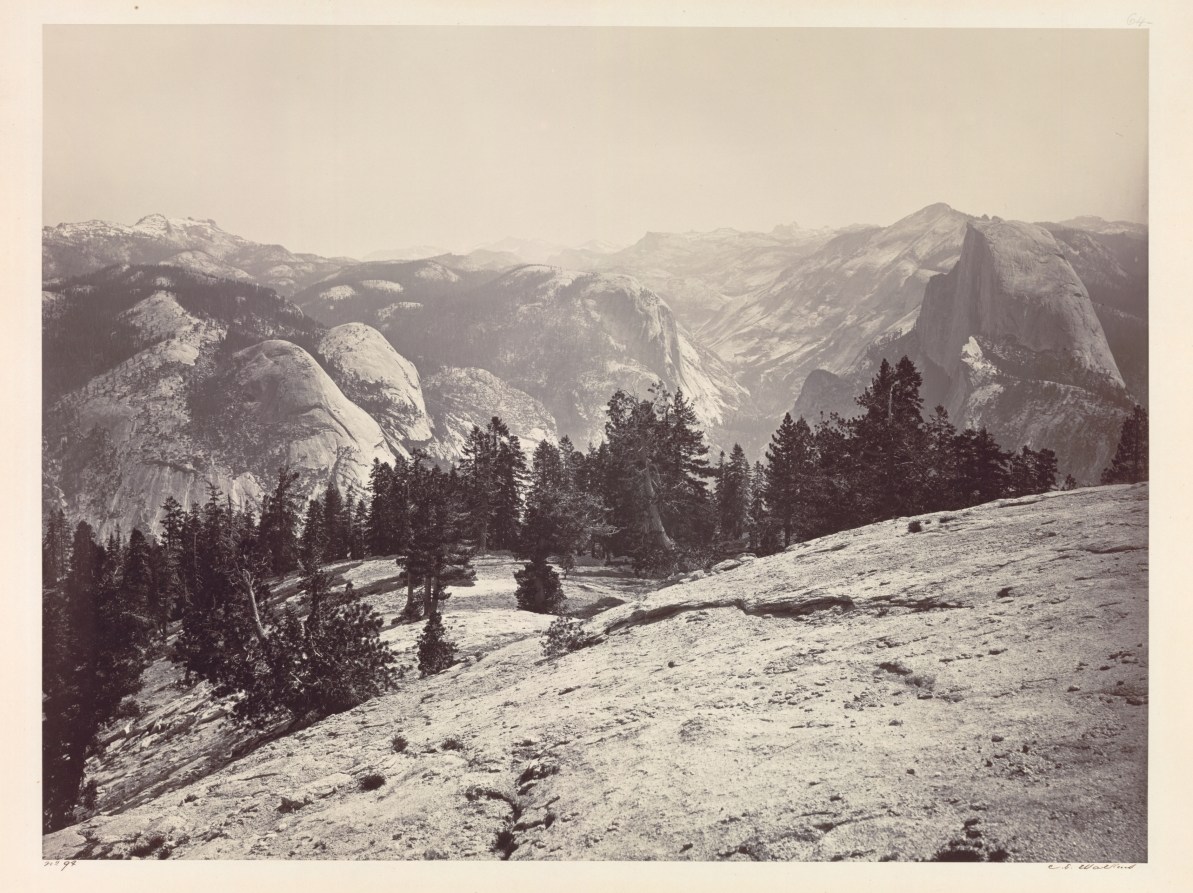
The image in Cleveland measures a little over half a meter across. That measurement tells us something about the journey to the overlook. Watkins made his mammoth prints by contact. In printing, the light-sensitive paper lay against the glass negative, so a fissure half an inch long on the print occupied half an inch on the glass. The dimensions of the finished photograph had consequences even before Watkins left for the mountains. A picture this size required a camera that could hold a window-sized sheet of glass. [1][2]
A darkroom within walking distance
For his first Yosemite expedition in 1861, several years before he made this view, Watkins took a specially built camera for plates roughly eighteen by twenty-two inches. He also needed chemicals and a tent he could use as a darkroom. Mules carried the equipment along mountain tracks. Glass was an awkward cargo twice over. Each fresh view called for another clean plate on the way up. Coming back, the fragile sheet held the exposure itself. From one intact negative Watkins could make many prints. [2][3]
There was a reason to carry the tent so far. Watkins had to coat the plate, expose it in the camera and develop it while the coating was still wet. A photograph taken below Yosemite’s Upper Falls even catches the tent at the edge of the scene, with a seated figure among the equipment. Imagine choosing where to put a tripod under those conditions. The view might be best from one ledge, the footing for a tray better a little farther back. The photographer had to be able to get from one to the other with a wet plate in hand. [3][4]
How much ground fits on the paper?
Watkins also carried a stereoscopic camera. A stereograph gives each eye a slightly different view through a viewer. The two images fuse, making the intervening space seem almost palpable. The Cleveland print gives both eyes the same picture. You can see how much work the trees do in it by covering the dark band across the middle with a finger. The foreground slab and the distant domes start to look curiously alike. Each presents a pale, sloping surface to the light. Uncover the trees and the slab comes forward again. [1][2][3]
The large contact print rewards two quite different distances from the paper. From a few paces away the foreground reads as a single diagonal, rising from the lower left toward Half Dome. Up close it breaks into patches of rough stone and shallow seams. Try the same shift with the pale ridge at the upper center. Its folds stay faint even as the foreground yields more detail. Watkins gave the viewer enough stone to examine at arm’s length that the point where such examination fails, miles away across the valley, becomes visible too. [1]
Sources
- Cleveland Museum of Art, The Domes, from the Sentinel Domes, Yosemite, collection record and open-access photograph.
- The Photographs of Carleton Watkins, user guide to mammoth plates, contact prints and stereographs.
- National Park Service, Explorers and Recorders, on Watkins’s cameras, mules and field darkroom.
- Carleton Watkins Image Gallery, archival view of the dark tent below Upper Falls and notes on wet-plate fieldwork.