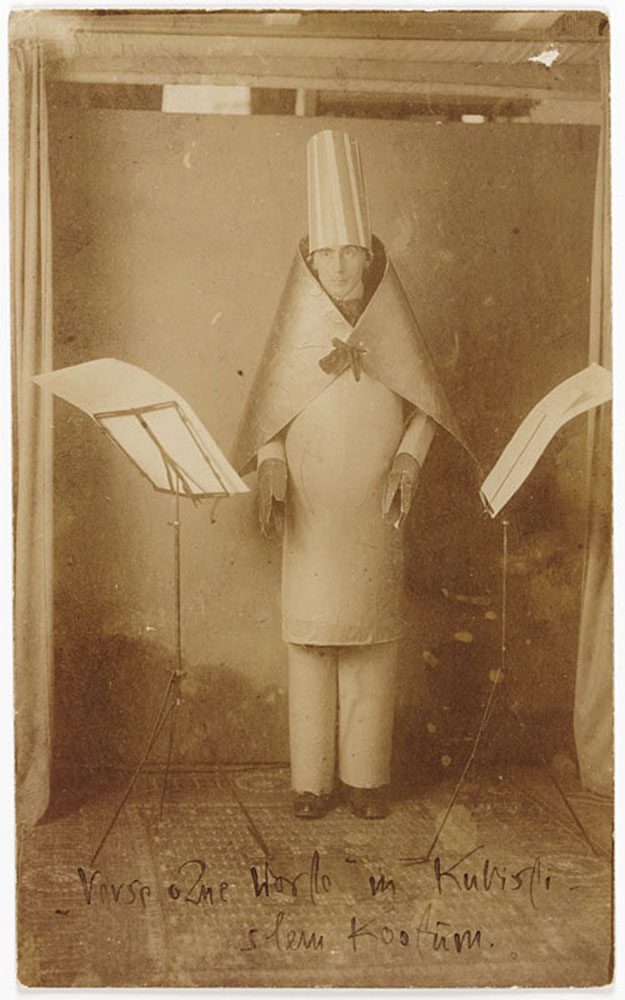
Image context: this post uses a real archival photograph of Hugo Ball onstage in a cubist costume in Zurich, not a generated image, diagram, chart, or symbolic placeholder. The photograph matters because Dada is often flattened into a word, a joke, or a list of scandalous objects. Ball's body inside a stiff paper costume shows the movement closer to its original pressure point: art as an event that made ordinary sense feel newly suspect.[1][2]
Dada is tempting to describe as a tantrum, then leave there. It had the noise, the mockery, the childish syllable, the anti-art posture, and the taste for objects and performances that seemed designed to annoy anyone still asking whether art was noble. But the tantrum label makes the movement too easy. Dada's nonsense was not a refusal to think. It was a way of making thought pass through failure, interruption, repetition, chance, and public embarrassment.
The setting matters. Hugo Ball and Emmy Hennings opened the Cabaret Voltaire in Zurich in 1916, during World War I, as a gathering place for artists and writers who were trying to work outside the culture that had marched Europe into catastrophe.[2] Smithsonian's account is useful because it keeps the origin physical: Ball reciting sound poetry onstage, Hennings present as co-founder, and a public being shocked in a room rather than persuaded by a tidy doctrine.[2] Dada began less as a style than as a room where styles were forced to misbehave together.
That is the movement's real method. Dada did not replace painting with performance, or poetry with noise, or sculpture with readymades. It made every medium vulnerable to another medium. A poem could become a throat exercise. A costume could become a manifesto. A printed page could behave like a stage. A found object could make the museum explain itself. A photograph could become evidence, self-portrait, joke, and circulation device at the same time.[2][3][5]
The Cabaret Was A Machine For Disagreement
Cabaret Voltaire's value was not longevity but format. Ball and Hennings's Zurich nightspot made poetry, performance, costume, music, provocation, and anti-war refusal share the same public air.[2] That collision was not decorative variety. It was a test of hierarchy.
In a conventional gallery, the viewer knows where to stand, when to be quiet, and what kind of attention the object expects. The cabaret scrambled those agreements. There were performances, readings, stage personas, noise, and deliberate embarrassment. The audience did not just look. It had to endure, laugh, resist, misunderstand, or participate.[2]
That is why the photograph of Ball in costume is more than a mascot. The body is present, but almost trapped inside an abstract construction. The costume looks like armor made from paper geometry. It turns the performer into a temporary object, and the object into a problem of speech. Dada's early power came from that kind of exchange: the person becomes form, the form becomes voice, and voice becomes a way to attack the old confidence of language.[1][2]
Nonsense Was A Diagnosis
If Dada sounds unserious, that is partly because it understood seriousness as compromised. MoMA frames the movement as a response to the disasters of World War I and to modern media and machine culture, with artists creating a revolution that shaped later art.[3] The point was not simply that war was bad, then artists made nonsense. The harsher claim was that too much respectable language had already failed. Reason, progress, patriotism, aesthetic refinement, and institutional taste had not prevented mass violence. They had often dressed it up.
Dada's nonsense was therefore diagnostic. It made broken speech audible. It forced the polite viewer to hear the absurdity that civilized rhetoric had hidden. A sound poem did not explain the war; it refused the assumption that explanation could remain clean. A costume did not illustrate protest; it made a human speaker look synthetic, constrained, and alien. A collage did not merely arrange scraps; it showed a world already cut by newspapers, advertising, propaganda, and mechanical reproduction.[3][4]
This is why the familiar phrase "anti-art" needs careful handling. Dada did not simply decide that art should end. It attacked the rulebook that made art seem safely separate from money, publicity, nationalism, machinery, and bourgeois good taste. Its negation was productive because it kept asking what counted as art, who got to decide, and what happened when the materials of ordinary modern life entered the room before aesthetic permission was granted.[3][4]
The Movement Spread By Changing Shape
One reason Dada still feels unstable is that it was not one city with one doctrine. MoMA calls it a defiantly international movement, born in neutral Zurich and New York and spreading to Berlin, Cologne, Hannover, Paris, and beyond.[3] MoMA's 2006 exhibition materials likewise treat the movement through six principal cities: Berlin, Cologne, Hannover, New York, Paris, and Zurich.[4]
Those centers were not interchangeable branches of a franchise. They were different answers to the same crisis. Zurich emphasized performance, poetry, masks, and collective experiment around the cabaret. New York made irreverence feel cooler and more object-based, especially through readymades and machine-age wit. Berlin sharpened photomontage into a political weapon. Hannover made Kurt Schwitters's Merz logic out of fragments and urban residue. Cologne and Paris added their own mixtures of hallucination, provocation, publishing, and attack on painterly manners.[3][4]
This city-to-city drift is crucial. Dada did not survive by preserving a pure origin. It survived by letting the method mutate. MoMA's press materials list strategies and media that included chance procedures, collage, photomontage, readymades, performances, media pranks, films, paintings, photographs, printed matter, sound recordings, and objects.[4] That inventory reads like a refusal of purity. Dada's consistency lay in its pressure on categories, not in a recognizable surface.
Print Made The Disorder Portable
Performance created the heat, but print carried the infection. Ball's edited anthology Cabaret Voltaire helped introduce the nightclub's output to wider audiences, and later Dada publishing made the movement travel as text, image, layout, invitation, manifesto, and rumor.[2] This is where Dada becomes especially modern. It understood that an avant-garde was not only made in studios and rooms. It was made in reproducible formats.
MoMA's Dadaglobe Reconstructed page gives a late, revealing example. Tristan Tzara planned Dadaglobe as an anthology to document Dada's international activity, originally slated for publication in 1921. He invited about 50 artists from 10 countries to submit photographic self-portraits, photographs of artworks, original drawings, and layouts for book pages.[5] The project was never published, but its failure is almost too perfect: Dada tried to become a portable international file before the organization and financing could hold it together.
The categories Tzara requested are telling. He did not ask only for finished masterpieces. He asked for images of artists, images of works, drawings, and page layouts.[5] That is Dada thinking in networks. The artist's face, the artwork's reproduction, the original mark, and the designed page all become units in a circulating system. The movement's medium was not just collage or performance. It was distribution.
Why The Joke Still Has Teeth
Dada's legacy is easy to overgeneralize. Every meme, prank, conceptual gesture, institutional critique, absurd performance, recycled object, or anti-branding tactic can be made to look vaguely Dada if the comparison is loose enough. But the stronger inheritance is narrower and sharper. Dada matters when nonsense exposes the rules that normally stay hidden.
That is why it still feels different from ordinary satire. Satire usually depends on a stable outside position: the satirist knows what is foolish and points at it. Dada often removes that comfort. The viewer, performer, page, object, institution, and language all become implicated. The joke does not simply land on someone else. It asks why the room was arranged this way in the first place.
The Ball photograph keeps that problem visible. It is funny, stiff, strange, and theatrical, but it is not casual. The performer appears both ridiculous and ritualized, as if the old humanist speaker had to be rebuilt from cardboard before he could speak after the war.[1][2] That is Dada's method in one image: take a damaged world, refuse to smooth it into taste, and make its disorder perform.
The movement's achievement was not that it made nonsense meaningful in the sentimental sense. It made nonsense operational. It turned absurdity into a pressure test for art's borders, language's credibility, the museum's authority, the printed page's power, and modern culture's appetite for spectacle. Dada did not escape the world by becoming irrational. It used irrational form to show that the world had already become irrational, then asked art to stop pretending otherwise.
Sources
- HelveticArchives, "SLA-HEN-C-04-a-OP-02-03 Ball, Hugo (1886-1927) in kubistischem Kostum, 1916-1917" - Swiss Literary Archives record for the archival photograph used as the article image.
- Smithsonian Magazine, Paul Trachtman, "A Brief History of Dada" - historical survey on Ball, Hennings, Cabaret Voltaire, sound poetry, World War I, city centers, readymades, photomontage, and Dada's later influence.
- The Museum of Modern Art, "Dada" - exhibition page on Dada as an international movement responding to World War I, modern media, and machine culture across Zurich, New York, Berlin, Cologne, Hannover, and Paris.
- The Museum of Modern Art, "DADA Comes to The Museum of Modern Art" - press release on Dada's six principal cities, media range, chance procedures, collage, photomontage, readymades, performances, and media pranks.
- The Museum of Modern Art, "Dadaglobe Reconstructed" - exhibition page on Tristan Tzara's planned 1921 Dada anthology, international invitations, submission categories, and reproducibility concerns.