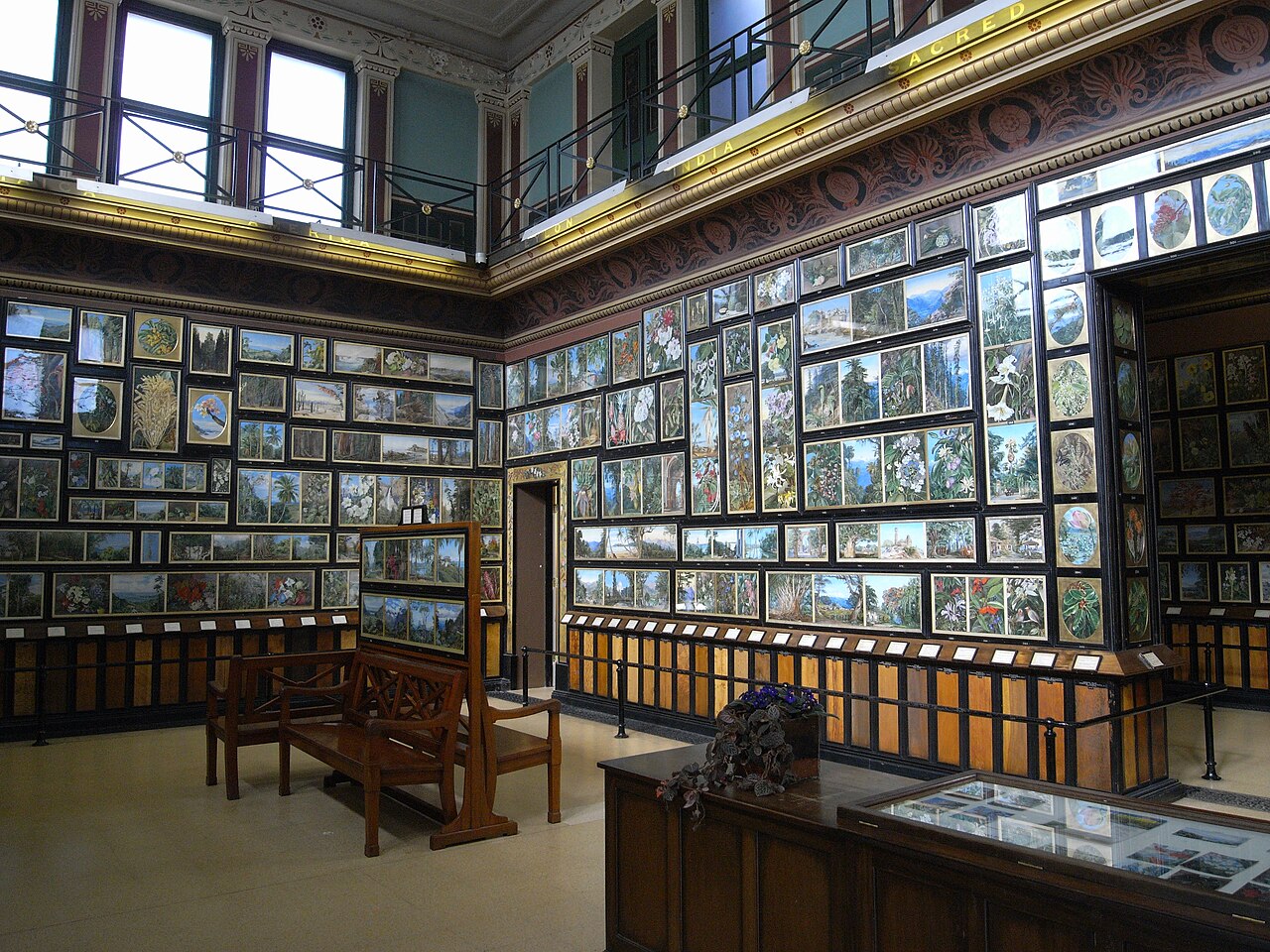
Image context: this post uses a real archival photograph of the Marianne North Gallery at Kew Gardens, not a generated visual, diagram, chart, or symbolic placeholder. The image matters because North's art is inseparable from the display system she built: walls covered with botanical paintings, arranged as a world tour rather than as a neutral specimen drawer.[1][4]
Marianne North's botanical paintings are easy to underestimate if they are filed under "flowers." They do not behave like polite Victorian flower studies. They make plants carry weather, slope, distance, architecture, animal life, travel routes, and the pressure of being seen in place. Kew's Google Arts & Culture story gets close to the turn: North challenged the tradition of Victorian flower painting by choosing to paint plants in their natural settings, years before color photography could perform that public documentary job at scale.[1]
That shift is the core of her profile. North did not simply paint many plants. She built a way of looking in which the plant remained attached to its world. A redwood is not just a specimen. A pitcher plant is not just a form. A branch, a blossom, a tree, or a fruit appears with the place that gives it force: humid light, distant mountains, temple walls, insects, water, soil, travel, and sometimes the people or animals who share the scene.[1][3]
This is why the Marianne North Gallery at Kew feels less like an archive than like an argument. More than 800 paintings cover the walls, and Kew presents the collection as a vivid 19th-century record arranged geographically so visitors can follow North's travels through pictures.[1] The hanging is dense, almost overwhelming, but that density is part of the meaning. North wanted viewers to encounter biodiversity as abundance, not as a row of isolated labels.
The plant stays in the weather
The easiest way to see North's originality is to compare her with the habits she resisted. Botanical illustration often needed clean isolation: the plant extracted, clarified, diagrammed, made useful for identification. North's paintings can be scientifically valuable, but they do not give up atmosphere to achieve usefulness. They preserve the shock of location.
Google Arts & Culture's Kew story notes that North used oil paint rather than the more conventional watercolor, giving her pictures greater vibrancy and impact.[1] That choice matters formally. Oil lets the world thicken around the plant. Leaves can become glossy, cliffs can hold shadow, water can sit heavy, and a tropical sky can feel like a medium rather than a backdrop. North's color is not decorative frosting over data. It is a record of how a plant enters sight under real conditions.
JSTOR's Global Plants collection describes the Marianne North archive as botanical and landscape paintings whose records include scientific names and geographic locations, spanning expeditions to places including Brazil, the Seychelles, Chile, South Africa, Natal, Colombia, Jamaica, India, and Madagascar.[3] That cataloging detail helps explain why her work sits between art and science. The painting gives the visual encounter; the metadata keeps the encounter accountable to place and species.
North's genius was not to choose between those functions. She made them interfere productively. The scientific name says, "identify this." The painted setting says, "do not pretend identification is the whole encounter." A plant is a taxonomic fact, but it is also a body in a landscape.
Travel became method
North was born in 1830 and died in 1890, but the decisive public arc of the work begins after the death of her father in 1869, when travel became her method rather than a family accompaniment. The Darwin Correspondence Project describes her as a painter and traveler who, in the 1870s, visited Canada, the United States, Jamaica, Brazil, California, Japan, Borneo, Java, Ceylon, and India, then later Australia, New Zealand, South Africa, the Seychelles, and Chile.[2]
The route list can sound like romance, and the gallery certainly invites a kind of wonder. But the work is stronger if we keep its conditions visible. Kew's Google Arts & Culture story says North traveled extensively between 1871 and 1885, almost always on her own, visiting 15 countries through routes made possible by the British Empire.[1] That matters. Her art enlarged European viewers' sense of plant life, but it did so through imperial transport, colonial access, and the uneven mobility available to a wealthy British woman.
The tension does not cancel the paintings. It gives them their historical weight. North's rooms at Kew are not innocent windows onto the world. They are a Victorian world-picture assembled through courage, privilege, appetite, observation, scientific friendship, and imperial infrastructure. The profile becomes more interesting when all of those forces stay in the frame.
Darwin admired the seeing, not just the travel
North's connection to Charles Darwin is often mentioned as prestige decoration, but it is more useful as evidence of the kind of looking her work performed. The Darwin Correspondence Project notes that Darwin wrote to North on 2 August 1881, thanking her for the shrub "Australian Sheep" and saying he was pleased to have seen her Australian pictures, which recalled scenes from various countries vividly.[2]
That response is revealing. Darwin did not need North to tell him that plants existed abroad. What mattered was the force of visual recollection: the way her pictures could carry scenes, not just specimens. In that sense, North's paintings worked like portable habitat memory. They brought together observation, color, locality, and the emotional charge of having been there.
The Kew story also notes that North had no formal training, yet gained the admiration of scientists including Darwin.[1] The absence of formal training should not be romanticized into a myth of pure instinct. Her art is disciplined. But it does help explain why the paintings refuse some of the polite boundaries of academic flower painting. North worked as if the subject demanded movement, color, scale, and compression more urgently than institutional permission.
She built the room that would explain the work
The most radical part of North's career may be architectural. In 1879 she offered her collection to the Royal Botanic Gardens, Kew, and proposed a gallery to hold it; the gallery opened in 1882.[1] The Darwin Correspondence Project is even more pointed: North presented the collection to Kew for display in a gallery designed, furnished, and financed by herself.[2]
That self-curation changes the status of the paintings. North was not only producing images for later institutional arrangement. She was designing the conditions under which they should be read. The dense gallery wall, the geographic order, the feeling of compression, and the decorative interior all belong to the artwork's afterlife.
The phrase "Kew Collection" can sound tidy, but the actual effect is more restless. The gallery asks the visitor to move by looking: from one region to another, from plant to plant, from natural setting to painted surface, from science into travel narrative and back again. Its density is not a storage solution. It is a viewing method.
This is why a single North painting can feel vivid but the gallery feels decisive. One picture says: this plant was seen here. The gallery says: the world can be organized as a chain of such encounters, and painting can hold that chain in color.
The profile is bigger than bravery
North's life lends itself to the story of the exceptional Victorian woman: unmarried, wealthy, mobile, persistent, out where convention said she should not be. That story is true enough, but it is too small if it ends at personality. Her achievement is not merely that she traveled. It is that she turned travel into a pictorial system.
She changed the unit of botanical art. Instead of treating the plant as a detachable object, she made the unit "plant-in-world." That unit could include a mountain, a monkey, a temple, a forest edge, a road, or a river. It could include the facts that taxonomy needs and the sensory pressure that taxonomy alone cannot carry.[1][3]
The result is a body of work that still feels unusually alive inside an institution. The gallery walls are crowded, but they are not confused. They make a claim about abundance: biodiversity cannot be understood only by naming separate things. It must also be seen as relation, habitat, geography, and encounter.
North made fieldwork into a gallery, and the gallery keeps returning the favor. It prevents the paintings from becoming pretty botanical souvenirs. It lets them remain what they were at their strongest: colored evidence from a moving eye, gathered into a room where plants keep their weather.[1][3][4]
Sources
- Royal Botanic Gardens, Kew via Google Arts & Culture, "Marianne North: an unsung pioneer of botanical art" - institutional story on North's travel, oil-paint technique, natural settings, imperial routes, 1879 commission, and 1882 gallery opening.
- Darwin Correspondence Project, "Marianne North" - related-person record summarizing North's travels, self-financed Kew gallery, and Darwin's 1881 letter about her Australian pictures.
- JSTOR Global Plants, "Royal Botanic Gardens, Kew: Archives: Marianne North Images" - collection record for 383 North objects, with scope notes on botanical and landscape paintings, scientific names, locations, and expedition geographies.
- Wikimedia Commons, "File:Marianne North Gallery 821.JPG" - source page for the real 2008 photograph of the Marianne North Gallery interior used as this article's image.