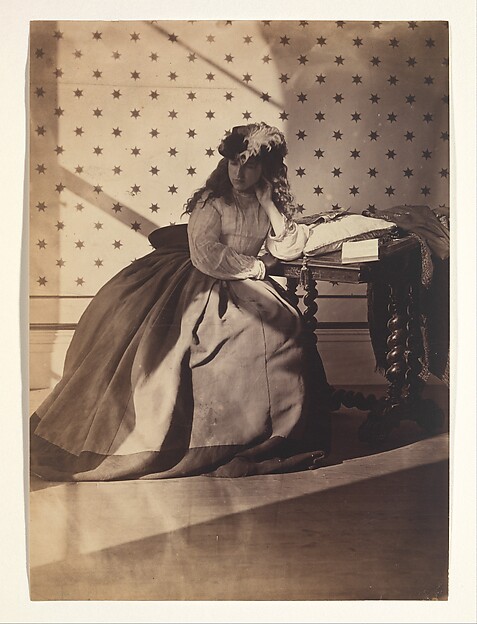
Clementina Hawarden's photographs can look deceptively private. The sitters are often her daughters. The rooms are domestic. The props are curtains, mirrors, shawls, dresses, balcony doors, patterned walls, and whatever the light of a South Kensington house could be made to do. Yet that privacy is not the same thing as smallness. Hawarden turned the middle-class Victorian interior into a field of experiment, using family life not as retreat from art but as the material from which art photography could be built.[2]
That is the first reason she matters. In a period when many male photographers could define photographic seriousness through travel, monument, science, war, or public portraiture, Hawarden worked with the space available to her and made its limits productive. The V&A describes how she used natural light in her studio at 5 Princes Gardens, arranged mirrors, fabrics, costumes, and posture, and often placed her figures before the balcony with the city beyond dissolving in the background.[2] The result is not merely a record of domestic leisure. It is a controlled theater of looking.
Image context: the cover is not a generic portrait of the artist. It is one of Hawarden's own photographic artworks. The Met collection record identifies it as an early 1860s albumen silver print from a glass negative, measuring 20.1 by 14.4 centimeters.[1] The visible shawl, table, loose hair, wallpaper, light, and shadow create a sparse but charged room. That exact image belongs here because this profile turns on Hawarden's ability to make ordinary interior materials feel composed rather than incidental.
A Short Career With A Concentrated Method
Hawarden took up photography in 1857 and died in January 1865, leaving a career of roughly seven or eight years depending on how one counts the first experiments.[1][2][4] That compressed span matters. There is no long late style to explain her reputation. Instead, there is intensity: a rapid movement from domestic practice into a body of work that nineteenth-century viewers already recognized as unusually strong.
The V&A notes that she exhibited with the Photographic Society of London in 1863 and 1864 under titles such as "Studies from Life" and "Photographic Studies," and that she received the Society's silver medal in both years.[2] Those titles sound modest, almost anti-literary, especially beside the theatrical naming habits of some Victorian photography. But the modesty is strategic. "Study" lets the photograph be exploratory without making it casual. It says: watch what light, pose, costume, and room can do when the camera is treated as an artistic instrument.
Her historical afterlife was also unusually dependent on an act of family preservation. In 1939, Hawarden's granddaughter Clementina Tottenham donated 775 photographs to the V&A after visiting an exhibition on the centenary of photography and finding her grandmother's work absent.[2][4] The V&A estimates that this donation represented about 90 percent of Hawarden's life's work.[2] The episode has a useful irony. Photographs made in private rooms became visible as an artistic corpus only when another family member pushed them into institutional memory.
The Room Is Not Background
The Met's Photographic Study shows why Hawarden should not be reduced to biography. A young woman sits beside a table; her hair falls loose; the table is draped; the wallpaper is crisp enough to make the wall active without becoming busy.[1] The composition avoids the overstuffed clutter often associated with Victorian interiors. That spareness is not empty. It lets each object perform.
The table leg curves like a drawn line. The shawl falls with enough weight to make the surface tactile. The star-patterned wall turns flat backdrop into a measured field. The sitter's pose is neither formal portrait stillness nor narrative action. She is held inside a pause. The room seems airy, but it is highly organized.[1]
This is where Hawarden's domestic restriction becomes an aesthetic choice. She does not need the world outside the house to supply importance. The image's drama comes from threshold and suspension: body beside furniture, hair against patterned wall, softness against crisp detail, young womanhood staged between self-possession and performance. The V&A's account stresses that Hawarden used surroundings, backdrops, fabrics, clothing, mirrors, and posture as compositional elements rather than treating the face alone as the photograph's center.[2] That is the heart of her difference from Julia Margaret Cameron, whose close heads often make the face a visionary site. Hawarden lets the room think with the figure.
Costume Without Simple Make-Believe
From around 1862, Hawarden concentrated on photographing her daughters in costume tableaux, mixing dressing-up clothes with fashionable contemporary dresses.[2] This detail is easy to flatten into a story about charming family play. The pictures are more unsettled than that. Costume lets Hawarden move between social reality and fiction without choosing either one. A daughter remains a daughter. A dress becomes a role. A room becomes a studio. A balcony becomes a stage edge.
The V&A is careful about this point, noting that much has been written about the provocative poses of Hawarden's daughters while also stating that there is no evidence she deliberately set out to explore Victorian anxieties around sexuality and adolescence.[2] That boundary is important. The photographs do not need a sensational explanation to be complex. Their complexity comes from how they manage visibility. They show young women looking, leaning, turning, pausing, and arranging themselves in ways that feel neither fully candid nor fully theatrical.
That ambiguity is one reason the work still feels modern. Hawarden's figures do not simply submit to the camera as subjects to be cataloged. They inhabit the scene. Their poses often suggest collaboration within a family studio, even when the power of authorship remains Hawarden's. The photograph becomes a place where dress, posture, and light test how a person can be seen without becoming fully explained.
Light As Structure
Hawarden's most rigorous tool was light. The V&A says she liked natural light in the South Kensington studio and used mirrors to reflect it while exploring ideas of doubleness.[2] A Journal of Victorian Culture essay by Rose Teanby sharpens that observation by focusing on Hawarden's silhouette motif: profiles, reflected figures, and semi-silhouetted forms that reveal and conceal at once.[3]
That language of partial visibility fits the broader body of work. Hawarden's light does not simply illuminate a subject. It sorts the image into zones of knowledge and opacity. A face may be legible while a reflected profile slips away. A dress may carry bright surface detail while a figure's inwardness remains withheld. A balcony may promise open air while the photograph keeps us inside.
This is a photographic intelligence, not a painterly imitation. The wet collodion process and albumen printing required chemical timing, glass negatives, and careful handling; Hawarden's interior pictures make those constraints feel like artistic structure.[1][3] Natural daylight was necessary, but she turned necessity into grammar. Window light becomes stage light. Reflection becomes a second image. Shadow becomes a way to keep the sitter from hardening into mere inventory.
Why The Private Work Became Public Art
Hawarden's class position complicates the story. The V&A notes that, as a woman of her social standing, selling photographs would not have been considered appropriate.[2] That meant her art could be publicly exhibited but not easily absorbed into ordinary professional commerce. Her work therefore sits in a strange zone: publicly praised, privately held, technically sophisticated, and long under-recognized as a coherent achievement.
Hundred Heroines frames her as one of the significant historical women in photography, emphasizing both the family donation and the belated recognition of work that had remained largely hidden.[4] The point is not just recovery for recovery's sake. Hawarden changes the map of early photography because she shows that an interior practice can be experimental without being amateurish in the dismissive sense. She did not need a public commission, a battlefield, a travel route, or a famous sitter to make photographs with authority.
The Met's Photographic Study makes that authority visible at small scale.[1] Nothing dramatic happens. A young woman sits in a room. Yet the photograph refuses to behave like a casual family keepsake. The composition is too spare, the light too exact, the pause too deliberate. Hawarden's achievement is to make that threshold hold: between home and studio, daughter and model, costume and self, record and art.
That is why her photographs should not be treated merely as charming Victorian survivals. They are early arguments about what photography can do when the artist takes the available room seriously. Hawarden found a way to make domestic space carry formal pressure. She made window light behave like a collaborator. She made the private stage public without stripping it of intimacy. In doing so, she gave early art photography one of its quietest and most precise languages.[1][2][3]
Sources
- The Metropolitan Museum of Art, public collection API record for "Photographic Study" - object data for Hawarden's early 1860s albumen silver print, including image URL, medium, dimensions, accession data, and repository.
- Victoria and Albert Museum, "Lady Clementina Hawarden - an introduction" - institutional overview of Hawarden's working methods, South Kensington studio, exhibitions, medals, and V&A donation history.
- Rose Teanby, "Lady Clementina Hawarden: the silhouette motif in photographic art," Journal of Victorian Culture Online, 2022 - essay on Hawarden's silhouette, reflection, light, and shadow motifs.
- Hundred Heroines, "Clementina Hawarden" - biographical profile summarizing Hawarden's short career, family context, and posthumous recognition.