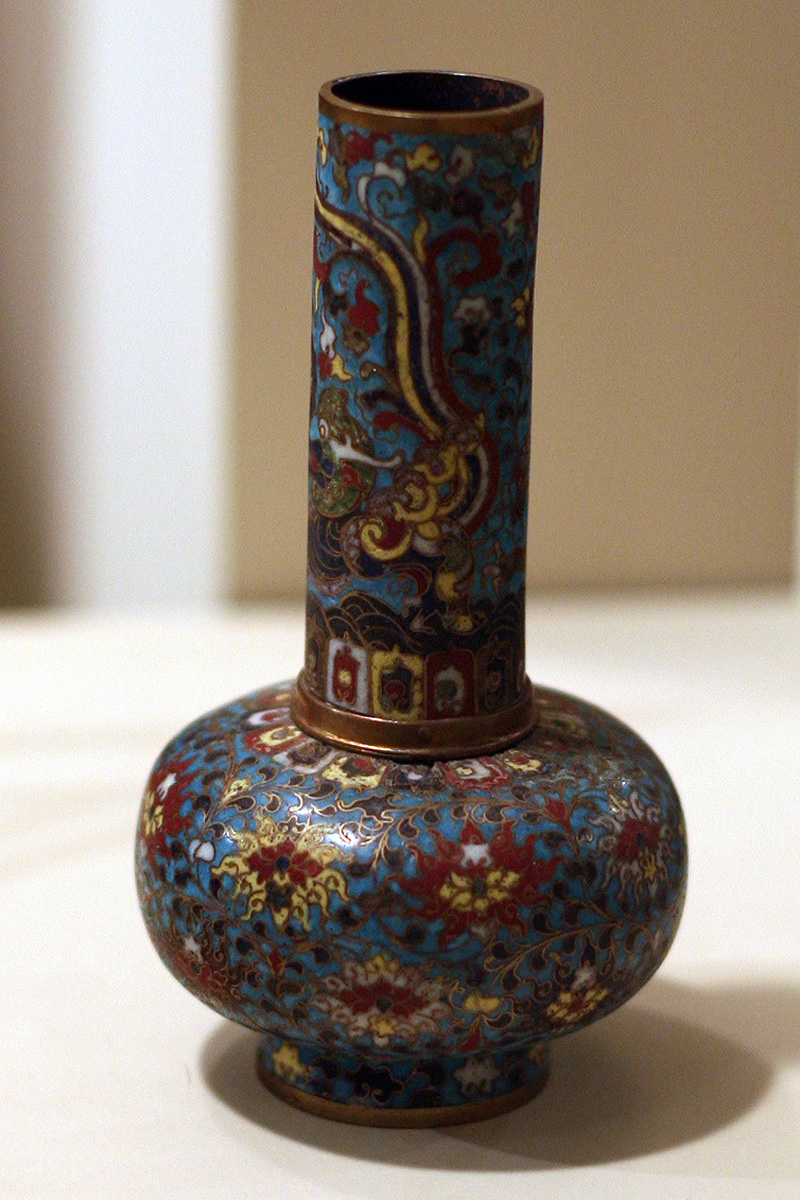
Cloisonne enamel can look, at first, like color has simply conquered metal. Blue, red, green, yellow, and white crowd the surface until the vessel seems almost textile-like. But the medium works in the opposite direction. Color arrives late. The first discipline is line: thin metal strips bent into a pattern, fixed to a metal body, and used to make tiny walls that decide where molten glass is allowed to go.[3][4]
That is why cloisonne deserves a technique reading rather than a quick appreciation of ornament. Its visual richness is not loose exuberance. It is color forced to behave inside a constructed architecture. Every field of enamel sits in a cell. Every cell depends on wire. Every wire has to survive heat, shrinkage, grinding, and polish without losing the pattern it was asked to hold.[3][4]
The Brooklyn Museum vase used here as the cover image is a useful compact object for slowing the eye. The museum identifies it as an early sixteenth-century Ming-dynasty Chinese vase, made of cloisonne enamel on copper alloy and measuring only 6 5/8 by 3 5/8 inches.[2] Wikimedia Commons preserves the photograph used for this post and notes the same object, accession number, medium, and Brooklyn Museum source context.[1] The object is small, but its surface is not minor. It compresses an entire metal-and-glass grammar into something that can be held in the imagination at hand scale.
Image context: this post uses one real photographic image of an actual museum object, not a generated visual, diagram, chart, or reconstruction. It belongs here because the article is about visible technique: wire partitions, colored enamel cells, copper-alloy support, and the way a fired surface becomes both pattern and object.[1][2]
Wire Is The Drawing
The clearest technical account begins with the word "partition." Britannica describes cloisonne as a technique in which thin metal strips are bent and curved to follow a decorative outline, then attached to the metal object so they form miniature walls and cells.[4] The Metropolitan Museum of Art's essay on Chinese cloisonne gives the Chinese vessel version of the same operation: colored-glass paste is placed inside enclosures made of copper or bronze wires, which have been bent or hammered into the desired pattern.[3]
That means the drawing is not merely preparatory. It remains physically present in the finished object. In painting, a drawn outline may disappear under pigment. In cloisonne, the outline becomes structure. The lines are not just visual borders; they are load-bearing boundaries for powdered glass and heat.
This changes how ornament should be read. A scrolling vine, cloud, lotus, or archaistic motif is not painted freehand across a passive surface. It is first translated into a metal route. The artisan must decide how tight a curve can be, where a cell can close cleanly, how much area can hold enamel without becoming visually dull, and how the pattern will wrap around a three-dimensional body. On a vessel, drawing has to turn corners. It has to survive shoulders, necks, feet, and rims.
The Brooklyn vase makes that pressure visible. Its color fields feel packed, but they do not bleed into one another. The decorative density stays legible because wire has already converted image into compartments.[1][2] The viewer sees brightness; the object has been built from boundaries.
Glass Becomes Color By Being Contained
Once the cells exist, the medium changes from metalwork to controlled glasswork. The V&A's general enamel collection page gives the basic material fact: enamels are made by fusing finely ground glass to metal.[5] The Met adds the Chinese cloisonne detail that the glass paste, or enamel, is colored with metallic oxide and painted into the contained areas of the design.[3]
That sentence explains the special saturation of the medium. Cloisonne color is not ink staining a surface. It is glass fused onto metal. The color has body. It is granular before firing, then vitreous after heat. It can look jewel-like because it belongs to glass as much as to pigment.
The containment is crucial. Without the wire cells, colors would lose the sharpness that makes cloisonne read as both image and object. The walls permit strong adjacency: blue against yellow, red against green, white against dark outlines. The technique does not ask color to blend softly. It asks color to sit beside other colors with clear borders, like a disciplined mosaic whose tesserae have been melted into place.
This is why cloisonne often feels more architectural than painterly. The surface is not one continuous skin of brushed color. It is a field of compartments, each one filled, fired, lowered, refilled, and finally leveled into relation with its neighbors.[3][4] The result can be lavish, but it is lavishness made by sequence.
Fire Does Not Finish The Surface Once
The most important hidden step is repetition. The Met notes that enamels commonly shrink after firing, so the process is repeated several times to fill in the designs.[3] That shrinkage matters aesthetically because it prevents the surface from being understood as simple application. A cell is not complete when color first enters it. Heat changes the fill. The glass settles, contracts, and reveals the need for more work.
This gives cloisonne a rhythm closer to construction than to finishing. Fill, fire, inspect, refill, fire again. Each pass has to respect what the previous pass has done. Too little enamel leaves a sunken cell. Too much risks distortion, unevenness, or later grinding problems. The artisan is not merely choosing colors; the artisan is managing volume.
Britannica's account continues the sequence after fusion: when the enamel cools, the surface can be polished to remove imperfections and increase brilliance.[4] The Met likewise describes rubbing the completed surface until the edges of the cloisons are visible, followed by gilding often on edges, interiors, and bases.[3] This is the moment when the surface becomes publicly coherent. Before polishing, the object may have the right materials but not yet the right face.
Polishing is not cosmetic in a trivial sense. It decides how glass, wire, and light meet. The wires reappear as crisp outlines. The enamel gains evenness and shine. The vessel's decorative map returns to legibility after the disorder of filling and firing. A finished cloisonne surface therefore carries a paradox: it looks smooth because it has survived a process full of interruptions.
Chinese Cloisonne Was Also A Court Language
Technique alone does not explain why Chinese cloisonne became such a powerful court and temple medium. The Met's Chinese cloisonne essay places the earliest securely dated Chinese examples in the Xuande reign of the Ming dynasty, 1426-35, while noting that the technique was recorded earlier and may have come into China through routes shaped by Yuan-period contact and Islamic influence.[3] The Brooklyn Museum's public object page makes the cross-cultural point in gallery language, describing cloisonne as a technique first developed in the Mediterranean basin, highly developed in Byzantium, and transmitted to China through maritime and overland Silk Routes, appearing there by the early fifteenth century.[2]
That history matters because it keeps the medium from being reduced to a single national essence. Cloisonne is a traveling technology. Its Chinese flowering depended on foreign technique, court taste, local metalworking, ceramic and bronze precedents, and the appetite for brilliant surfaces that could hold power in rooms built for ceremony.
The Met is especially useful on that last point. It says cloisonne objects were intended primarily for temples and palaces because their flamboyant splendor suited those settings, even though an influential late fourteenth-century antiquarian text dismissed the ware as too showy for the restrained atmosphere of a scholar's home.[3] By the Xuande period, however, the ware was greatly prized at court.[3] The tension is revealing. Cloisonne could be criticized as excessive and prized for exactly the same reason: it knew how to make authority visible.
The Met's seventeenth-century fangzun object page shows how that authority could also become historical theater. The vase adopts the form of an archaic wine vessel, using bronze-age shape memory while replacing old bronze gravity with brilliant enamel color.[6] Late Ming and early Qing makers could borrow ancient ritual forms, then make them blaze in a way earlier bronzes never did.[6] Cloisonne was therefore not only decorative technique. It was a way to stage continuity and transformation on the same surface.
The Medium's Argument
Seen up close, cloisonne refuses a lazy split between craft and image. The image depends on craft so completely that the two cannot be separated. Wire is drawing. Glass is color. Firing is revision. Shrinkage is a design problem. Polishing is revelation. Gilding returns metal to the surface after glass has done its work.[3][4]
That is why the Brooklyn vase holds attention beyond its size. It does not ask to be admired only as a pretty blue object. It asks the eye to move from color to cell, from cell to wire, from wire to body, from body to kiln, and from kiln back to the gleaming finished surface.[1][2] The pleasure is real, but it is not weightless.
Good cloisonne makes color look inevitable only after making it obey a demanding set of constraints. The medium's brilliance comes from that obedience. It turns metal into a map, glass into contained light, and fire into a collaborator that must be answered more than once. What looks like ornament is really a compact engineering of brightness.
Sources
- Wikimedia Commons, "File:WLA brooklynmuseum Vase Cloisonne enamel.jpg" - source page for the real photographic image used as the cover, including Brooklyn Museum object identification, accession number 09.553, photo provenance, dimensions, and file metadata.
- Brooklyn Museum, "Vase" - object record for the early sixteenth-century Ming-dynasty Chinese cloisonne enamel on copper-alloy vase, including dimensions, accession number, gallery context, and cross-cultural cloisonne note.
- The Metropolitan Museum of Art, "Chinese Cloisonne" - essay on Chinese cloisonne technique, early Ming dating, colored glass paste, wire enclosures, repeated firing, polishing, gilding, and temple/palace use.
- Encyclopaedia Britannica, "Enamelwork: Cloisonne" - technical overview of bent metal strips, soldered cells, powdered enamel, fusion, cooling, and polishing.
- Victoria and Albert Museum, "Enamels" - collection overview defining enamel as finely ground glass fused to metal and situating the medium across regions and techniques.
- The Metropolitan Museum of Art, "Vase in the form of an archaic wine vessel (fangzun)" - object record for a seventeenth-century Chinese cloisonne vessel showing late Ming and early Qing archaistic forms translated into brilliant enamel color.