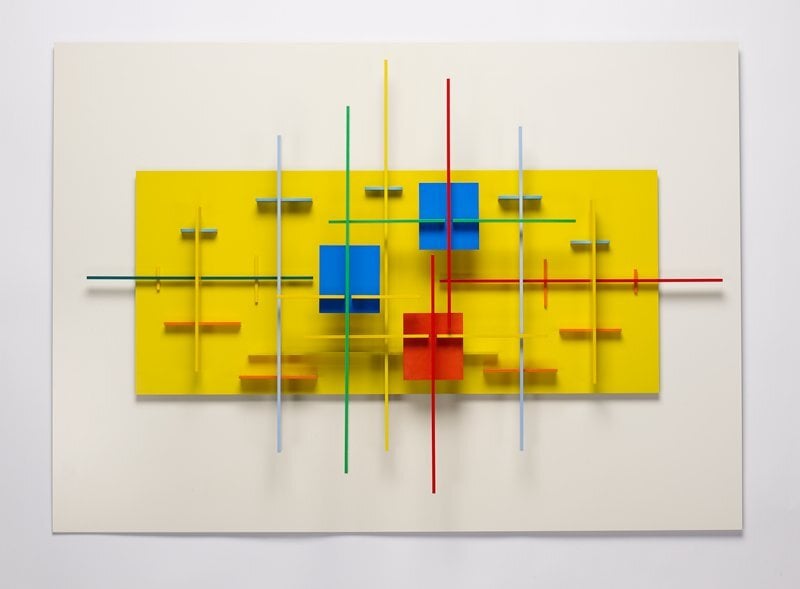
A colored rectangle can do two jobs in a Charles Biederman relief. It can establish a patch of color, as it would in a painting. It can also stand out from its backing and cast a shadow. That second job changes the first: the rectangle now belongs to the light in the room, and its visible proportions depend on where you stand.
Biederman's #26, Red Wing, 1956–68, in the Minneapolis Institute of Art, makes that double life tangible. Its painted metal construction occupies only five and a half inches of depth, yet that shallow interval gives color an actual place to sit, overlap, and interrupt the light.[1] A photograph records one encounter with those relationships. The object permits others.
Look at the broad yellow rectangle in the photograph. Blue and red planes punctuate it, while thin colored bars extend beyond its edges. Underneath the crisp geometry, the shadows form a softer, displaced arrangement. The relief offers both at once: bright declarations of color and their dimmer consequences.
Biederman spent much of his long career investigating that difference. Born in 1906, trained in Cleveland and Chicago, and established for a time in New York and Paris, he eventually settled in Minnesota.[2] There he pursued a demanding proposition: an artwork made from strict geometry could remain closely attached to the experience of nature.
The move out from the surface
The change began before the move to Minnesota. Biederman was making reliefs and collages by 1935; a solo exhibition at New York's Pierre Matisse Gallery followed in 1936. After visiting Paris in 1936–37, he increasingly made constructed relief his central medium, experimenting with materials that included metal, plastic, and glass.[3]
The early objects reveal an artist testing what a picture could be made from. MoMA's Relief, New York of 1936 combines casein paint on wood with metal, nails, and string.[4] The material list matters: a stretched line and a painted line may both organize a composition, but only one physically crosses the space before it. Construction allows a relationship that painting can depict to become a fact of the object.
In #3 Paris, made the following year and now at the Lowe Art Museum, painted wooden planes meet at right angles. The museum identifies Mondrian's influence while acknowledging Biederman's resistance to that association. It also traces his developing Structurist philosophy to Cézanne's abstraction of nature.[5] His independence was an ambition worked out through encounters with other artists, with all the friction that implies.
That tension makes the career more interesting than a clean story of invention. Biederman could reject a label and still carry forward a problem someone else had opened. What would happen if a composition's advancing and receding planes acquired physical thickness? How much could color do once it occupied several orientations at once?
A hill behind the house
Charles and Mary Biederman settled in Red Wing in 1942. His substantial theoretical book, Art as the Evolution of Visual Knowledge, appeared in 1948. In 1954 the couple bought a farmhouse in a wooded valley nearby. According to the Minnesota Historical Society's biography, he regularly climbed the hill behind the house to study nature. The same account records his recognition of Mary's importance to both his art and his writing.[2]
Those details complicate the appealing picture of the lone modernist who leaves the city and discovers an entirely private language. The work continued within a marriage, through books, and in sustained attention to a particular place. A wooded hillside supplied an encounter that could be repeated without ever being quite identical.
The resulting reliefs offer few conventional landscape cues. The connection becomes clearer through the way they behave. Near and far, brightness and shade, the concealment of one surface by another: these are experiences available among trees, but also among projecting pieces of painted metal. Reading the reliefs through those relationships lets their geometry remain exact without requiring a tree to be hidden inside every upright.
Precision that admits change
For his mature reliefs, Biederman developed a vocabulary of industrial aluminum strips, spray-painted in a range of colors.[5] The material choice gave him crisp edges and sharply differentiated planes. Yet the visual result need not feel settled. A firmly fixed component can have a shifting appearance.
Art historian Roald Nasgaard, discussing the Structurist practice Biederman shared with the younger artist Eli Bornstein, emphasizes its grounding in observation of the natural world. He explains how the viewer's position changes the relationships among a relief's colors and forms, while ambient light activates the construction.[6] This is a useful distinction: the parts can remain still while the encounter develops.
It also changes how much authority to give a reproduction. The photograph here clearly records an arrangement, but it fixes the lighting and viewpoint together. A dark area may be the shadow of an element rather than a painted shape. An edge that seems to be a thin line may belong to a plane seen almost side-on. Looking carefully means keeping those possibilities open.
The relief asks for a small bodily adjustment. Move sideways, and a surface begins to offer more of itself; another grows narrower. The colored object is constant enough to recognize, but its parts keep renegotiating their visual weight. Biederman's precision makes those changes legible.
An argument that traveled
The Minnesota years also produced exchanges with artists elsewhere. Bornstein read Biederman's book in 1954 and began corresponding with him in 1956. Nasgaard describes how seeing the reliefs in person altered Bornstein's understanding of them.[6] The distinction between a pictured construction and an encountered one was consequential for another artist's work.
Institutional recognition followed through major exhibitions, including the Walker Art Center's 1965 retrospective and the Minneapolis Institute of Art's 1976 retrospective. Biederman also arranged a substantial gift of works and archival material to the University of Minnesota.[3] The career had become both a body of objects and a continuing argument about seeing.
That argument is still available in the narrow space between a relief and its backing. Follow a painted edge until it becomes a side; follow the side until it throws a shadow. Biederman gives the eye something measured and definite, then allows the room to participate. The longer you look, the less those inches of depth feel like a minor extension of a painting.
Sources
- Minneapolis Institute of Art, “#26, Red Wing, 1956–68” — object record, medium, dimensions, collection credit, and artwork identification.
- Frederick L. Johnson, “Biederman, Charles Joseph (1906–2004),” MNopedia, Minnesota Historical Society — biography, Mary Biederman, the Red Wing years, and the museum photograph reproduced here.
- Tweed Museum of Art, “Collection Spotlight: Charles Biederman” — early exhibitions, development of relief construction, later retrospectives, and the University of Minnesota gift.
- Museum of Modern Art, “Charles Biederman. Relief, New York. 1936” — official record of the early work and its materials.
- Lowe Art Museum, “#3 Paris,” 1937 — the early wooden relief, European influences, Structurist ideas, and the later use of painted aluminum.
- Roald Nasgaard, Eli Bornstein: Life & Work, Art Canada Institute, “Biography” — Bornstein's reading, correspondence, and encounters with Biederman; “Style & Technique” — their shared attention to nature and the behavior of constructed relief.