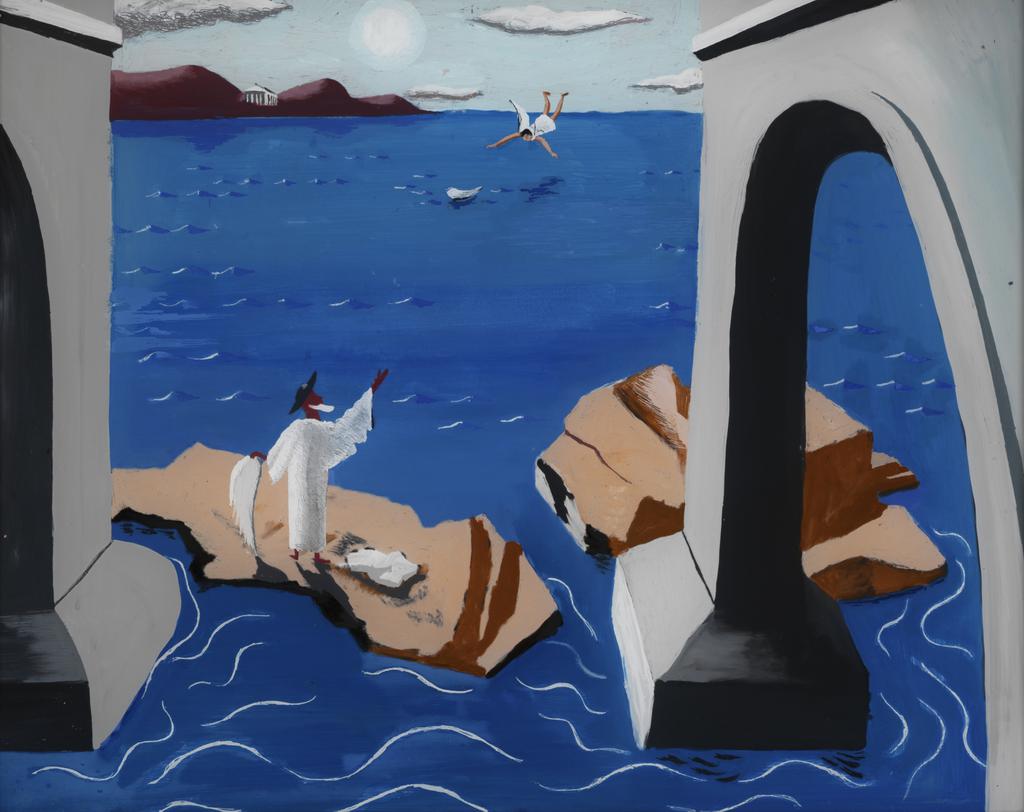
The falling boy is almost the smallest thing in the picture. Between two immense gray architectural supports, above an expanse of blue water, his body tips headfirst toward the sea. Below him, a white-robed figure on a rocky ledge raises one hand. The distance between that hand and the tumbling body is the emotional center of Angelo Pinto's Icarus.
The Barnes Foundation dates the work to around 1944 and identifies the foreground figure as Daedalus, pleading with his son about the danger of flying too close to the sun. The feathers of Icarus's wings were held with beeswax, which the heat melted.[1] The museum's account supplies the story. Pinto's arrangement makes us feel the difficulty of reaching someone inside it.
The visible image measures only 19.7 by 25.1 centimeters. Its medium is reverse painting on glass: the picture is painted on one side of the support and seen through the other.[1][2] A huge sea occupies a small object, and the catastrophe remains close enough for us to examine.
A father inside the story
The title gives the son possession of the picture. The foreground gives the father a competing claim on our attention. Daedalus stands upright while Icarus is inverted. His raised arm carries our eye upward and to the right, toward the small body with its feet in the air. Their gestures belong to the same diagonal, yet a broad stretch of water separates them.
That separation changes the emotional question. Knowing the myth, we can explain what Icarus did wrong; looking at Daedalus, we have to consider what it means to recognize danger without being able to prevent it. The Barnes describes the warning as already too late.[1] The father's gesture persists inside a scene that has passed beyond his control.
The architecture makes this helplessness stranger. The right-hand arch rises beyond the upper edge, its interior almost black; a second support cuts off the view at the left. These heavy forms dominate the foreground without helping either figure. They provide the scene with enormous apparent stability while a human body loses its footing in the air.
My reading is that these supports also give the viewer an uneasy position. We look out from among solid structures toward an exposed patch of rock and open water. The picture offers us a kind of shelter while leaving father and son stranded in the action. Our proximity to the foreground does not bring us any closer to intervening.
The first marks stay nearest
Reverse painting makes that closeness materially unusual. On a conventional painted surface, a later stroke can sit in front of an earlier one. When the picture is viewed through glass, the layer touching the glass remains nearest to the viewer. The V&A explains the resulting sequence: highlights and details go down before the background.[2]
Imagine a small bright mark within a larger colored shape. Applied first against the glass, it remains visible when the larger shape is painted behind it. What appears to be a finishing touch may therefore belong to the beginning of the work. The visible order and the working order run in opposite directions.
Corning Museum of Glass describes another consequence: the underside of the paint becomes its intended viewing surface, and direct contact with the glass gives the image its shine.[3] The glass is part of how the picture appears. It brings differently colored passages under one continuous surface, even when those passages describe incompatible movements or sharply separated forms.
For Icarus, I read that smoothness as a source of unease. The event is disastrous, yet the object remains composed and available to the eye. Knowing the technique does not supply a hidden moral. It helps explain how the work can make an unstable moment feel so firmly held.
There is a limit to what the medium tells us. The V&A distinguishes this process from enameling: the pigments are unfired and can remain vulnerable to damage.[2] A glossy face does not guarantee an invulnerable object. Nor does a general description of reverse painting establish Pinto's exact pigments or every step of his procedure; the Barnes record identifies the medium without supplying that technical analysis.[1]
A practiced simplicity
Pinto's compactness belongs to an experienced artist's work. Woodmere records that he and his brothers Salvatore and Biagio studied with Albert C. Barnes in the late 1920s. Barnes supported their study in Europe, collected their paintings and employed them as teachers. Angelo taught at the foundation for nearly six decades.[4]
That background gives the picture's apparent directness a useful context. Look at the water: large, relatively quiet areas of blue carry scattered white strokes, with longer curling lines near the bottom. Those marks suggest movement without breaking the sea into a continuous spectacle of waves. Icarus has room to remain legible against it, despite his size.
The pale sun is similarly restrained. It sits high above the dark reddish coast, a softly bounded disc that scarcely announces the destructive role it plays in the story. The cause of the disaster, the falling body and the father are dispersed across the image. We have to connect them through looking.
Return to the relation between title and foreground. Icarus owns the famous name; Daedalus gives the catastrophe a witness with something at stake. The glass holds them at the same unreachable distance from our hands. Pinto's little painting makes room for both the fall and the terrible persistence of a warning that can no longer help.
Sources
- Barnes Foundation, “Angelo Pinto: Icarus,” c. 1944, BF744 — artwork reproduction, dimensions, medium and interpretation of Daedalus's warning.
- Victoria and Albert Museum, “An A–Z of glass,” “R is for reverse painting” — paint-layer sequence, viewing through the glass and the distinction from fired enamels.
- Corning Museum of Glass, “Reverse Painting on Glass: The Ryser Collection,” 1992 — museum description of the technique and the relationship between paint, glass and viewing surface.
- Woodmere, “Pinto, Angelo” — studies with Albert C. Barnes, European travel and Pinto's long teaching career.