Sarah Taintor Bulkeley Waterman has dressed for her photograph in a gown with a close-fitting bodice and sleeves wide enough to show the pattern along their edges. There is quite a lot to look at before you reach her face. The gold-colored surround curls inward at the corners. A dark ribbon draws the eye to one wrist. Then the straight part in her hair, bright against two dark wings, leads you back to her eyes. Augustus Washington made this daguerreotype around 1850 in Hartford, Connecticut. A customer who bought one of his “Miniatures,” as an advertisement called them, took home the whole little object, frame and all.[1][2]
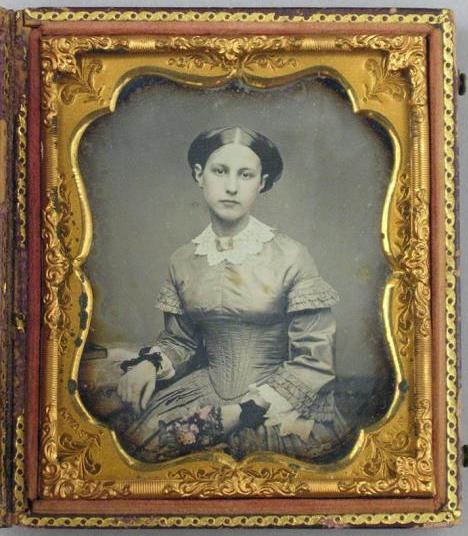
Washington had learned photography to pay for something else. Born free in Trenton, New Jersey, he entered Dartmouth College in 1843 and took up daguerreotypy to meet his expenses. Even with the work, he could afford only a year. In Hartford he found a teaching post at the North African School, run by the Talcott Street Congregational Church, a center of local abolitionist activity. In 1846 he left the classroom and opened his own studio on Main Street.[2]
It was a fairly crowded street to enter, commercially speaking. Some twenty daguerreotype studios opened in Hartford between 1840 and 1855. Many folded quickly. Washington advertised likenesses that were both “beautiful and correct” and made a point of his prices. Waterman’s portrait gives those two adjectives some substance. You can pick out the seam down the middle of her bodice. You can also see how its line continues the part in her hair, holding the figure steady amid all that ornament. A customer could recognize the dress down to its stitching and still find something new in how she looked wearing it.[1][2]
One of Washington’s customers was John Brown. In the portrait now at the National Portrait Gallery, Brown raises a hand as though taking an oath. The Smithsonian dates it to about 1846 or 1847, long before the raid on Harpers Ferry would make Brown a household name. Set beside Waterman’s resting hands, the gesture shows how much room Washington could give a sitter within the narrow compass of a plate. Brown looks ready to speak. Waterman could hold your gaze all afternoon.[1][3]
In 1853 Washington left for Liberia with his family. Business in Hartford had gone well enough to finance a studio in Monrovia. Its success also sharpened a question he had been considering in public. A Black man could own a thriving business in Connecticut. What prospect did that give his children of living as equals there? In an 1851 letter to the New York Tribune, Washington had argued for the opportunities Black Americans might find in Liberia. He now put the proceeds of those Hartford sittings behind his answer.[2][4]
Among his Liberian sitters was Chancy Brown, sergeant at arms of the Senate. Another was a woman the Library of Congress associates with the McGill family. She sits with a daguerreotype case in her lap. Imagine holding Waterman’s portrait in your hands and looking down at it. Washington’s Liberian sitter holds just such an object, while looking straight out at the person who will hold hers. The case offers a glimpse of what happened to a portrait once the customer left the studio.[1][4]
Washington eventually took a seat in the legislature himself, serving as speaker of the House and later as a senator. There is another, smaller place to find his name. Among thirty Liberian daguerreotypes in the American Colonization Society collection at the Library of Congress, five carry his stamp on their brass mats. Matching mounts help the Library attribute eleven more to him, with a degree of uncertainty. After so much looking at the faces, it is worth letting the eye travel outward again. There at the edge, on the piece a customer might have chosen for its handsome finish, the photographer signed his work.[4][5]
Sources
- Connecticut Historical Society, Black and Latino History primary sources, pp. 11–12. Portrait of Sarah Taintor Bulkeley Waterman, accession 1995.203.0.
- Connecticut History, “Augustus Washington (1820–1875), African American Daguerreotypist.” Hartford schools, studios, and advertising.
- Smithsonian Institution, “John Brown.” Augustus Washington’s daguerreotype in the National Portrait Gallery.
- Library of Congress, “Augustus Washington, Daguerreotypist.” Washington’s letter, Monrovia studio, sitters, and political career.
- Library of Congress, “Bach to Baseball Cards,” photograph conservation highlights. Brass mats and attributions in the American Colonization Society collection.