Gustave Caillebotte's The Floor Scrapers is often introduced as an early modern image of labor, and that description is correct as far as it goes.[1][2] What it misses is where the painting places its real pressure. The picture is not only about workers entering high art. It is about a room being remade under our eyes. Three men kneel over the parquet, their backs bent in near-rhyme, while the floorboards shoot diagonally across the canvas and the open balcony door pulls light into the space.[1][3] Labor here does not sit on top of the composition as subject matter. It organizes the whole field.
That is why the painting still feels so sharp. Caillebotte does not send us to the street, the factory, or the chantier. He keeps us inside a bourgeois apartment, in a room with molding, a balcony, and enough finish to register social class even while the surface remains unfinished.[1][3] The workers are not shown as passing spectacle. They are the force temporarily authoring the room. The floor is half object, half event.
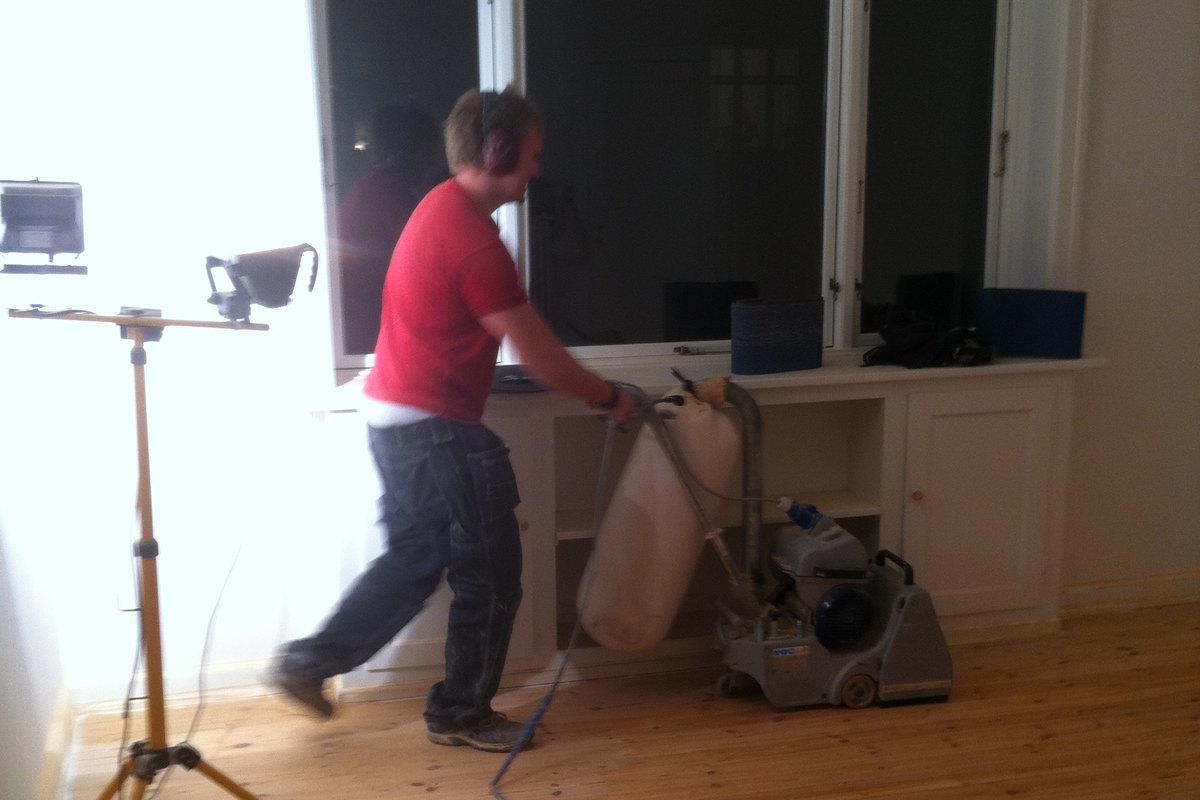
Image context: the earlier cover used a direct artwork reproduction, but post-publish image QA now favors immersive topic-grounded photography over reproductions or analytical visuals. This replacement keeps the article near the same physical grammar: a bent working body, floor machinery, exposed wood, and the unfinished surface that lets the painting's labor argument travel into a real room.[5]
The room is both owned and still being made
The Musee d'Orsay calls The Floor Scrapers one of the first representations of the urban proletariat in painting, which already tells us something important about the subject's novelty.[1] Peasants and stone breakers had precedents; Parisian indoor workers on this scale did not.[1] But the painting's real intelligence lies in the way it stages that novelty inside an emphatically private interior. The balcony doors, the wall moldings, the bottle set off to the right, and the expensive parquet all announce domestic property.[1][3] This is not anonymous labor in an anonymous place.
That fact matters because the room has not yet settled into ownership as pure comfort. According to the Art Institute, Caillebotte's father had an artist's studio built in the family home, and Caillebotte was fascinated enough by the workers planing the floorboards to turn the process into a painting.[3] The setting therefore carries a double status. It belongs to bourgeois life, yet the image catches it at the moment when bourgeois polish still depends on strenuous manual work. The room is elegant in prospect and raw in process.
This is one reason the painting avoids the softness that can creep into later reproductions. Nothing here is decorative yet. The scraped strips across the floor are visibly transitional. The men are not installing luxury as a finished lifestyle image. They are making the surface that will later allow luxury to look effortless.
The three bodies are similar, but not interchangeable
At first glance the composition seems almost mechanical: three shirtless workers, three bent backs, three repeated gestures. Look longer and the repetition becomes more interesting. Each figure is turned at a slightly different angle. One leans further forward, one twists more open to the viewer, one holds the rear of the chain and keeps the rhythm from closing into symmetry. Caillebotte builds collective labor without flattening the men into a single unit.
That tension between pattern and person is central to the painting's force. The Musee d'Orsay's recent Caillebotte Painting Men framing is useful here because it emphasizes the artist's unusual attention to male figures across class positions, from laborers to bourgeois strollers, and describes The Floor Scrapers as a new kind of realistic image of half-naked workers whose effort becomes newly visible.[2] You can feel that visibility in the backs and shoulders. Their musculature is specific enough to register strain, but the picture does not convert them into heroic individuals with biographies. They remain joined by task.
This is where the image grows morally complicated in a productive way. The workers are seen from the vantage of the bourgeois painter above them.[2] There is distance in that angle. Yet the painting also refuses to turn them into tiny accessories within a grand room. They occupy the foreground decisively. Their labor gives the room its tempo, and the eye keeps returning to their repeated reach across the wood.
The floorboards do as much work as the figures
The Orsay object page stresses Caillebotte's academic training under Bonnat and notes that the perspective is heightened by the high viewpoint and the alignment of the floorboards.[1] That observation gets to the painting's deepest formal choice. The floor is not background. It is the engine of the composition. The boards drive the eye inward, while the scraped patches and curls of shavings interrupt that drive with tactile resistance.[1]
The result is a strange fusion of realism and abstraction. We read the room as a believable interior, but we also read the parquet as a system of stripes, cuts, and pressure. The men scrape away old varnish, and at the same time Caillebotte uses their action to redraw the canvas. Labor becomes mark-making. The floor is both the material being worked on and the painting's own field of visual invention.
Light from the balcony matters for the same reason. It does not sentimentalize the scene. It sharpens the contrast between finished air and unfinished surface. The open door promises bourgeois leisure beyond the room, but the room itself remains occupied by friction, dust, and repeated effort. In that sense the painting is modern not because it celebrates speed, but because it reveals the work hidden beneath polish.
Why the painting still feels harder than a social anecdote
Orsay's catalogue text makes an apparently paradoxical claim: Caillebotte does not load the work with an explicit social or political message, yet his documentary study of gestures, tools, and accessories makes the picture one of the strongest realist statements of its period.[1] That paradox is exactly right. The Floor Scrapers does not need melodrama. It is already radical in subject, scale, and attention.
The same text also notes the tension between academic rigor and contemporary matter: the workers' torsos carry something of antique heroism, while the actual task is ordinary Parisian wage labor.[1] That friction helps explain the painting's enduring bite. Caillebotte does not idealize the men into allegory, but he refuses to paint them as merely pitiful or picturesque. He gives the work of scraping a grandeur large enough to hold the room together.
The Art Institute's broader Caillebotte framing sharpens the last point. He was an Impressionist who kept turning toward the people in his own world: family, fellow sportsmen, bourgeois pedestrians, and the workers who came to his house or whom he observed in the street.[4] The Floor Scrapers therefore feels intimate and structural at once. It is not a generalized statement about labor somewhere else. It is a painting of the labor that made his own Paris habitable.
That is why the picture remains difficult to domesticate. Once the room is finished, the owner can forget what it took to make the parquet shine. The painting does the opposite. It fixes the room at the moment when class comfort still has bent backs inside it. The beauty of the surface arrives, but labor gets the last word.[1][2][3][4]
Sources
- Musee d'Orsay, "Raboteurs de parquets" - object page with the work's 1875 metadata, its description as an early representation of the urban proletariat, and notes on Caillebotte's academic method, high viewpoint, and Salon rejection.
- Musee d'Orsay, "Caillebotte Painting Men" - exhibition presentation on Caillebotte's focus on male figures, his treatment of laborers and bourgeois men, and the 1875-1876 reception of The Floor Scrapers.
- Megan True, "Gustave Caillebotte: A Man of Many Hats," The Art Institute of Chicago - article noting that Caillebotte's father commissioned an artist's studio in the family home and that the painter turned the workers planing its wood floors into Floor Scrapers.
- The Art Institute of Chicago, "Gustave Caillebotte: Painting His World" - exhibition page on Caillebotte's distinct attention to workers, family, sportsmen, and the personal Paris he painted.
- Wikimedia Commons, "File:Andreas Sliber Gulve med båndsliber - Stella Nova Gulve.jpg" - source page for the real-world floor-sanding photograph used as the article cover after post-publish image QA.