Angelica Kauffman often enters art history as a useful exception: a gifted woman painter who became a founding member of the Royal Academy. That description is correct, but it leaves her standing still.[1][2][5] Her real achievement was movement. She built a career that could carry classical gravity across cities, patrons, and formats. History painting, portraiture, decorative schemes, and reproductive prints did not sit in separate compartments for her. They formed one system for making learned taste socially mobile.[1][3]
That is why she matters beyond biography. Kauffman did not simply paint antique subjects in an elegant eighteenth-century style. She found a way to make Neoclassicism travel well. In London, it could decorate Robert Adam interiors and circulate through exhibitions and engravings.[1][3] In Rome, it could serve aristocratic and clerical patrons who wanted moral narrative without stiffness.[4] In portraiture, it could turn individual likeness into a performance of cultivation and feeling.[5]
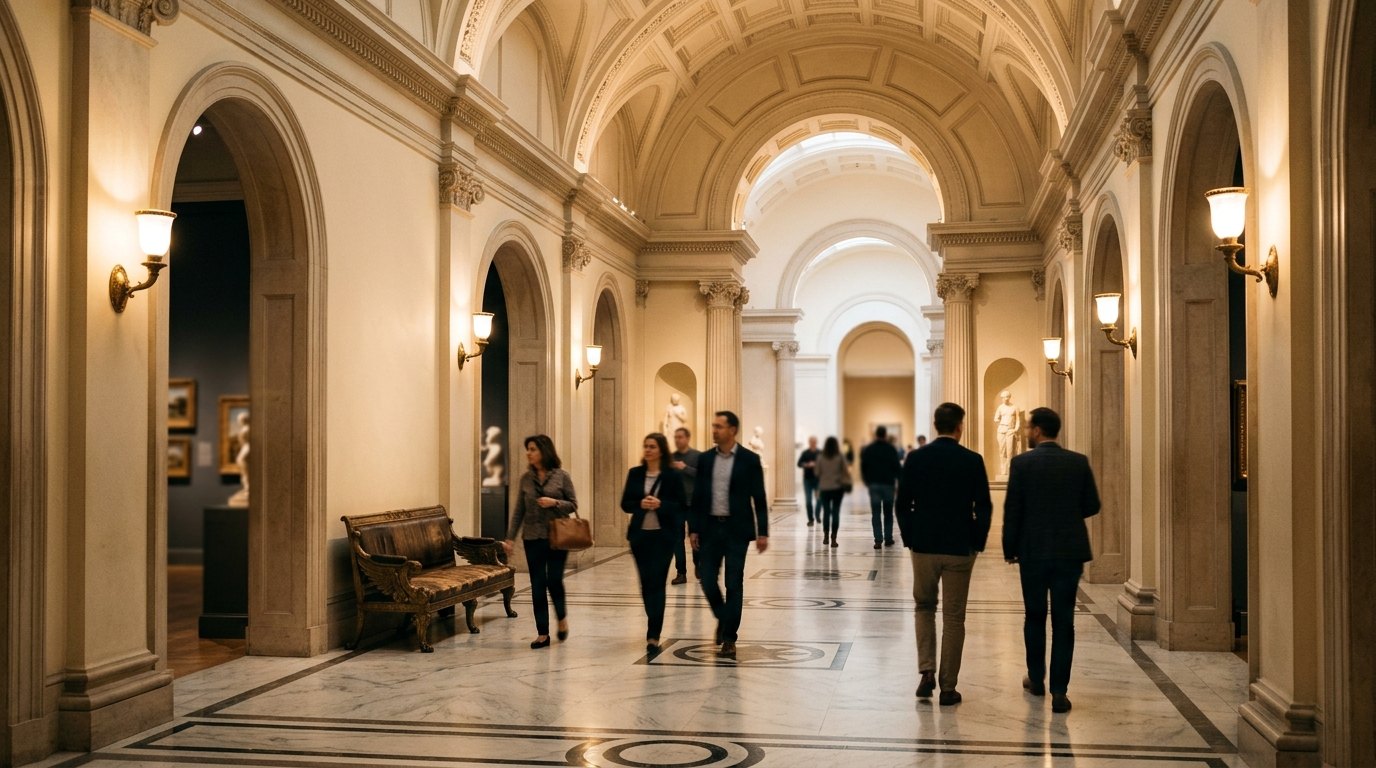
Image context: the hero image now uses an immersive gallery photograph rather than an artwork reproduction. The close-reading reference remains Kauffman's The Sorrow of Telemachus, where the figures are legible without looking blunt, the emotional register is elevated without turning cold, and the classical subject arrives as something intimate enough to live in a room rather than only in a textbook.[4]
Travel was not background; it was the method
Kauffman's early career already had the shape of portability. Britannica and the National Museum of Women in the Arts both stress her precocity, her training with her father Johann Joseph Kauffman, and the years she spent moving through Switzerland, Austria, and Italy while still young.[1][2] That travel mattered for more than contacts. It meant that she learned to paint inside a comparative field. She saw old masters, copied them, absorbed the claims of emerging Neoclassicism, and developed a professional identity that was never fully local.[1][2]
The institutional marker came early. NMWA notes her election to Rome's Accademia di San Luca in 1765, before her London breakthrough.[2] The British Museum's biography page then places her in London from 1766, exhibiting in the Society of Artists and later at the Royal Academy.[3] Put together, those details show why her career feels unusually wide for the period. She was not waiting for one capital to confer legitimacy all at once. She assembled legitimacy step by step across several art worlds.
History painting was her main claim to seriousness
Kauffman was admired as a portraitist, but the engine of her prestige was history painting.[1][2][4] The Met's entry for The Sorrow of Telemachus is especially clear on this point. It describes her as one of Europe's most sought-after history painters and places the 1783 canvas inside a Roman intellectual circle around Monsignor Onorato Caetani.[4] The subject comes from Fenelon's The Adventures of Telemachus, which gave her a classical story already filtered through moral education and polite literary culture.[4]
That combination explains why her paintings could move so easily through elite spaces. They offered antique and literary seriousness, but they did not bury the viewer under archaeological weight. In The Sorrow of Telemachus, grief is readable quickly, the bodies are arranged with clean rhetorical clarity, and the entire scene carries the sheen of sociability rather than heroic violence.[4] Kauffman understood that history painting did not need to look severe in order to look elevated. She made it persuasive by making it legible.
This is where her version of Neoclassicism differs from a harsher, more masculinized model of antique virtue. Her paintings often keep moral feeling in view through soft transitions, theatrical grouping, and emotional readability. That did not make them minor. It made them usable.
Portraiture carried the same learned poise into living society
The Met's Portrait of Emma Hamilton helps clarify how Kauffman handled portraiture.[5] The museum notes her move to London in 1766, her election as a founding Royal Academy member in 1768, and her success as both subject painter and portraitist.[5] What matters in the drawing itself is not only likeness. Emma Hamilton is being shaped as a public role. Beauty, performance, costume, and cultivated association are all bound together.[5]
That same pressure runs through Kauffman's broader portrait practice. She was not simply recording faces for patrons. She was offering sitters a way to look more composed, literate, and historically placed than ordinary life allowed. Portraiture in her hands became a softer extension of history painting. The body remained individual, but the image carried allegorical and theatrical weight.
This is one reason female sitters mattered so much in her work.[2][5] Kauffman could give them grace without passivity. She knew how to let costume, pose, and setting suggest performance, intelligence, and rank all at once. The result is less a private likeness than a polished social proposition.
London multiplied the work through rooms, institutions, and prints
The British Museum biography page is valuable because it makes clear how many lanes Kauffman occupied at once.[3] She executed decorative painting for Robert Adam and others, exhibited repeatedly, and generated a long print afterlife through engravers working from her designs.[3] This matters because it shows that her art was never confined to singular canvases. It moved into domestic interiors, collected prints, and public exhibition culture.
Seen from that angle, the Royal Academy was important not just as an honor but as an amplifier.[3][5] It gave her a platform inside Britain's most visible art institution while her decorative and reproductive channels carried the same sensibility outward. Even her later move with Antonio Zucchi to Venice and then Rome does not look like a retreat from prominence when read this way.[3] The network had already been built. She could change cities without abandoning circulation.
Why this profile still holds
Kauffman remains compelling because she solved a difficult problem with unusual elegance. She made classical painting portable without making it trivial.[1][4] Her works could satisfy institutions, patrons, decorators, engravers, and collectors while still preserving the air of high art. That balance was not automatic. It required technical fluency, social intelligence, and a sharp sense of how pictures travel.
If many later accounts shrink her to a rare woman among male academicians, the paintings push back against that reduction. They show an artist who understood movement better than monumentality: how style crosses borders, how narrative enters daily space, and how prestige survives by circulating. Kauffman did not merely join eighteenth-century art institutions. She taught them how gracefully an image could move through the world.[1][2][3]
Sources
- Encyclopaedia Britannica, "Angelica Kauffmann" - biography covering her early Neoclassical position, childhood training, and decorative work for Robert Adam interiors.
- National Museum of Women in the Arts, "Angelica Kauffman" - artist profile on her early travel, portrait and history painting, and election to Rome's Accademia di San Luca.
- British Museum, "Angelica Kauffman" - collection biography detailing her moves through Italy and London, Royal Academy exhibition history, decorative commissions, marriage to Antonio Zucchi, and later Roman salon life.
- The Metropolitan Museum of Art, "The Sorrow of Telemachus" - object page on the 1783 history painting, the Caetani commission, Fenelon's source text, and Kauffman's standing among Europe's sought-after history painters.
- The Metropolitan Museum of Art, "Portrait of Emma Hamilton" - object page on Kauffman's London move, her founding membership in the Royal Academy, and her handling of celebrity portraiture.