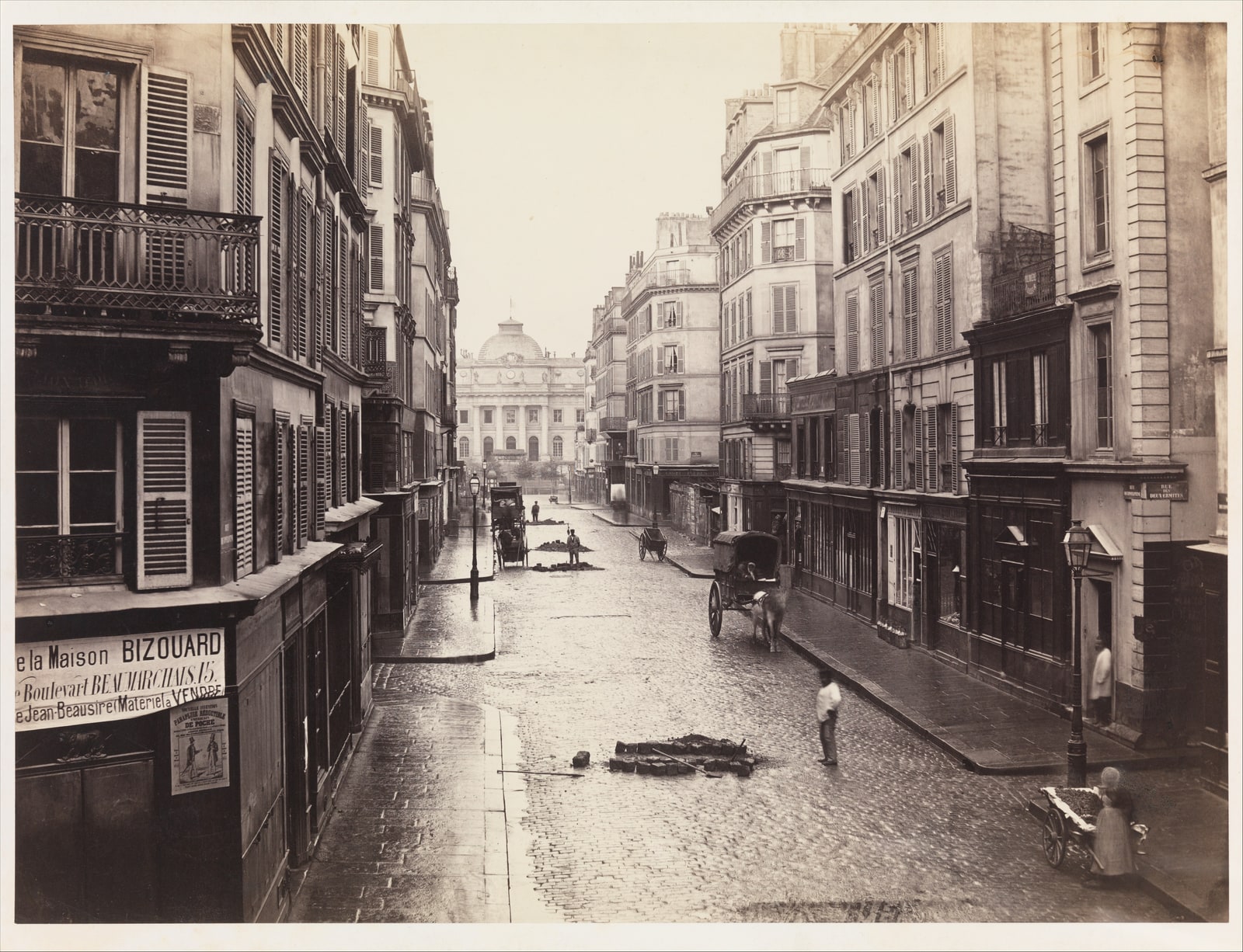
The street looks settled until you notice its pavement. Near the foreground, a low heap of lifted stones interrupts the shining roadway. A small figure stands beside it. Farther back, carts and other figures occupy a corridor of shops and shuttered windows. Charles Marville has made the architecture hold still long enough for us to discover how much is happening inside it.
His Rue de Constantine, cataloged by the Metropolitan Museum of Art as an albumen silver print from a glass negative dated 1866, records a street on the Île de la Cité before demolition.[1] Knowledge of what came next makes every shutter seem ominous. But the photograph rewards a slower reading: the street has a future imposed on it, while its inhabitants still have goods to move and sell, and work underway.
A view that keeps drawing us inward
The strongest movement belongs to the buildings. Window rows, cornices and the edges of the roadway converge toward the distant Palais de Justice, identified in Laurent Gloaguen's reconstruction of the view.[4] The facades seem to usher us down the street. Yet Marville does not give us a perfectly balanced architectural tunnel. The close building at left, with its projecting balcony and dark shutters, presses into the frame; the longer frontage opposite opens gradually into the distance.
That unequal spacing matters. We look both along the street and across it. The near surfaces remain substantial: shutters have slats, the balcony has a pattern, signs occupy awkward pieces of wall. Perspective organizes these objects without making them interchangeable. The photograph offers the pleasure of an orderly view and then keeps supplying details that delay our passage through it.
Marville's elevated position also changes our relation to the road. Gloaguen places the camera on the first floor of a building on the rue d'Arcole.[4] We can see the paving spread below us, with enough room around the figures to study their positions. The viewpoint makes the street legible as a space under inspection. It also leaves the viewer physically apart from the people using it.
The distant building gives the composition a destination. The scattered activity gives us reasons to stop before reaching it. Look back from the pale end of the street toward the little pile of stones: the apparent sweep of an architectural vista becomes a succession of interrupted tasks.
The signs of leaving
On the near left corner, the name BIZOUARD survives in bold lettering. Gloaguen reads the notice beneath it as an announcement of a move to boulevard Beaumarchais. He also identifies a loaded vehicle farther along the left side and blurred movement associated with moving belongings.[4] The image contains evidence of departure within a streetscape that still appears structurally complete.
The notice changes the photograph's timescale. Architecture can suggest permanence; a forwarding address anticipates a different arrangement of everyday life. A business name will continue somewhere else. The wall bearing it will not necessarily follow. Marville's frame holds those two possibilities together without telling us what happened to each person or enterprise.
The paving presents a more uncertain clue. Gloaguen describes workers lifting portions of the roadway but leaves their purpose unresolved.[4] We should preserve that uncertainty. The stones help us see that the street is being worked on; they cannot, by themselves, identify the work as demolition. Turning every visible action into a symbol of destruction would flatten the photograph's particularity.
Even the date needs a small qualification. The Met gives 1866; Gloaguen argues for a photograph taken in 1865.[1][4] The caption follows the museum's catalog. Both accounts place the view amid the street's disappearance, but the distinction reminds us that recognizing a scene and precisely dating its exposure are separate historical tasks.
Stillness is something the camera makes
People do appear here, though they have different degrees of definition. Some register as compact figures; others seem to soften into the pavement or the edges of the street. The City of Paris's account of Marville explains that the long exposures required by contemporary photography could blur moving subjects.[3] It does not establish how long he exposed this particular negative.
That technical condition affects the picture's emotional force. Buildings accumulate clarity while bodies can become uncertain. A modern viewer may feel that the city has already emptied, even when human activity remains visible. Photographic stillness is therefore poor evidence for a claim that everyone had left. The conspicuous solidity of the facades and the relative fragility of the people are partly different responses to the same recording process.
The photograph's official purpose complicates its apparent tenderness. Marville became the city's photographer in 1862, documenting the rebuilding program associated with Napoleon III and Baron Haussmann. As the National Gallery of Art emphasizes, his work encompassed both threatened old quarters and the emerging modern city, including its new amenities and troubled outskirts.[2] His attention to a disappearing street does not establish that he opposed the program employing him.
Yet an administrative record can preserve more than its commission requires. Here the spatial arrangement remains readable, but so do the signs, shutters, cart wheels and patches of disturbed ground. We can study what planners were changing and still become absorbed in the small actions proceeding within it.
Return to the figure beside the lifted stones. The museum's account tells us to expect demolition; the figure brings us back to a task underway. That tension gives the photograph its staying power. We know the street as something about to disappear. Marville lets us spend time in it while there is still work to do.
Sources
- The Metropolitan Museum of Art, Charles Marville, [Rue de Constantine], accession 1986.1141 — collection image, 1866 catalog date, medium, dimensions and identification of the scene before demolition.
- National Gallery of Art, Charles Marville: Photographer of Paris, 2013–14 exhibition — municipal appointment and the photographer's documentation of both old and modern Paris.
- Ville de Paris, “Haussmann et Marville : une histoire de l'urbanisme et de la photographie,” updated April 5, 2023 — archival context and the effect of long exposures on moving figures.
- Laurent Gloaguen, “Rue de Constantine, 1865,” Vergue — reconstruction of the camera position, relocation notice, street activity and alternative dating; the article above reproduces the Met's print.