Autochrome looks dreamy because it was never only a way to add color to a photograph. It was a tiny physical screen, built before the exposure, that forced color to pass through millions of dyed grains before the picture could exist. That is the useful way to read it as art: not as a primitive version of modern color film, but as a medium whose beauty came from the problem it had to solve.[2][3]
Before Autochrome, color photography often meant separation systems, hand-coloring, or experiments too cumbersome for ordinary use. The Lumiere brothers' process, introduced commercially in 1907, made color practical enough for amateurs, pictorialists, portraitists, botanical recorders, and documentary projects to use existing cameras with a new kind of plate.[2][4] The result did not behave like later Kodachrome or digital color. It behaved like a glass object that had to be looked through.
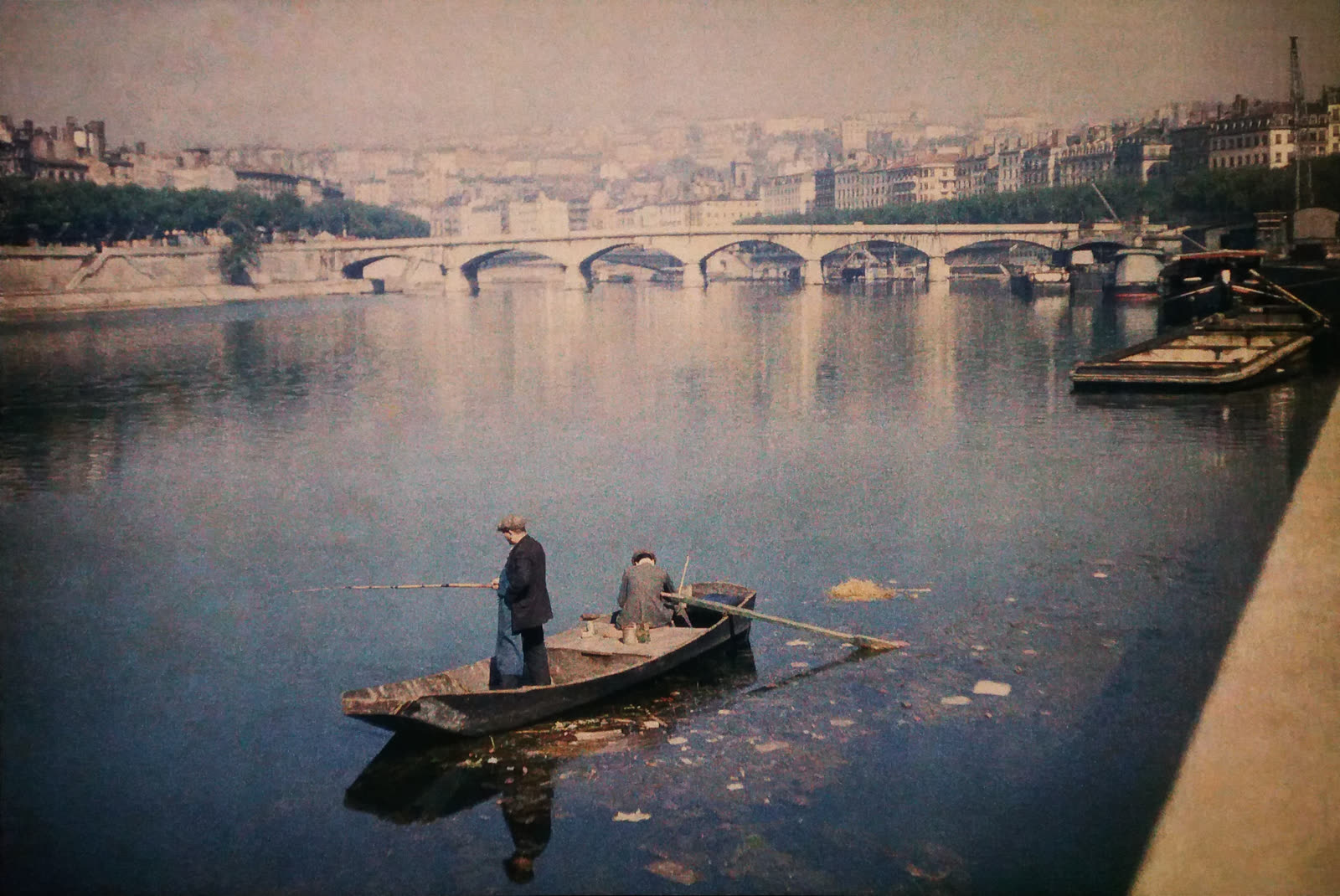
The Plate Was A Color Screen
The technical trick sounds almost domestic until it becomes strange. Transparent potato-starch grains were sorted to microscopic sizes, dyed red-orange, green, and violet-blue, mixed into a gray-looking powder, and spread in a single layer across a sticky varnish on glass.[2][5] Carbon black filled the spaces between the grains so stray white light would not leak through the screen. The plate then received a panchromatic black-and-white emulsion over that color filter layer.[2][5]
This means Autochrome color was not laid on afterward. It was already waiting at the front of the plate. During exposure, light from the subject passed through the dyed starch screen before it reached the silver-halide emulsion. After reversal processing, the finished object became a positive transparency. When light later passed back through the same colored grains, the separate filtered points recombined into a full-color image for the eye.[2]
That physical sequence matters aesthetically. The image is not a clean window with color added invisibly. It is color seen through a material gate. The softness, muted saturation, and granular shimmer are not flaws pasted on top of the photograph. They are the photograph's structure.
Why It Feels Painterly
Autochrome is often described as painterly, but that word can hide the mechanism. The process did not imitate brushwork in any direct sense. Its painterly feeling came from a mosaic of colored points too small to read one by one but coarse enough to affect the whole surface. The National Science and Media Museum notes that the screen used about four million colored starch grains per square inch.[2] The scale is microscopic, yet the consequence is visible: edges soften, skies and walls pick up a powdery atmosphere, and color seems to hover rather than snap into place.
The Met's conservation account explains another part of the effect: an Autochrome is a transparent image on glass that must be viewed by transmitted light or projection, not as an ordinary paper print.[3] That changes the encounter. A print reflects light off a surface toward the viewer. An Autochrome asks light to pass through its body. Even a digitized reproduction can suggest that difference: color appears suspended inside the image, especially in open areas where the screen's scattered hues keep the surface alive.
This is why early art photographers found the process seductive. Alfred Stieglitz and Edward Steichen were among the American photographers who quickly explored Autochrome after its arrival, and the Met notes that some of their early color plates remain important examples in its collection.[3] The process offered color without the obvious artifice of hand-tinting. It also preserved enough softness to sit comfortably beside pictorialist taste.
The Cost Was Time
Autochrome's beauty came with limits that shaped what could be photographed. The dyed starch screen filtered out so much light that exposures were dramatically longer than monochrome plates. The National Science and Media Museum describes exposure times as about thirty times longer than black-and-white plates; a sunny summer landscape could still require at least a second, and cloudy conditions could push exposures much longer.[2]
That slow appetite for light changed the medium's subjects. It rewarded stillness: flowers, gardens, posed portraits, architecture, travel views, interiors with controlled light, and documentary scenes that could hold still long enough to be gathered. It punished the quick street instant. Even when Autochrome documented the modern world, it did so with a slight pause built into the apparatus.
The pause is part of the look. People often appear arranged, landscapes breathe slowly, and urban scenes feel less like captured motion than preserved atmosphere. The process did not merely record early twentieth-century color; it trained photographers to find subjects that color and stillness could share.
A Medium Artists Loved, Then Left
Autochrome's art history is also a story of an intense courtship followed by withdrawal. The museum account records that major pictorialist names were involved early, and that a 1908 salon included many Autochromes by leading figures.[2] Yet the same source notes that many artistic photographers soon abandoned the process because it was difficult to exhibit and offered little opportunity to manipulate the final image.[2]
That complaint is revealing. Pictorialist photographers often valued processes that could be worked by hand: gum bichromate, bromoil, platinum, and other methods that allowed tone, texture, and surface to be adjusted after exposure. Autochrome gave them color, but it also gave them a sealed object. Once the glass plate had done its work, there was less room for the kind of intervention that made a photograph feel authored in the studio.
So Autochrome sits in a productive tension. It looks painterly, but it is stubbornly mechanical. It invites artful composition, but resists post-exposure manipulation. It makes color feel intimate and fragile, but depends on industrial plate manufacture. The Getty Conservation Institute's book description rightly frames it as the first industrially produced form of color photography, with a history inseparable from plate fabrication and preservation.[4]
Fragility Is Part Of The Medium
The Met's conservation article is especially important because it refuses to treat Autochrome as only a historical breakthrough. The dyes used in the starch grains are highly light-sensitive, and ordinary exhibition conditions can cause rapid, irreversible fading.[3] That is why original Autochromes are hard to show. Their color exists because light passes through them; the same light threatens to destroy what viewers came to see.
This vulnerability gives Autochrome a special status among photographic processes. Its survival depends on restricted viewing, careful storage, and conservation decisions that can make the object less publicly available in order to keep it alive. The Getty volume's preservation emphasis and the Met's low-oxygen display research both point to the same truth: Autochrome is not just an image technology but a conservation problem with color at stake.[3][4]
That fragility also changes how digital reproductions should be read. A scan or photograph of an Autochrome can circulate widely, but it is not the same experience as seeing transmitted light move through a glass plate. Digital access protects the original from light exposure while flattening the object into an ordinary image file. The tradeoff is unavoidable, but it should stay visible in the interpretation.
From Art Plate To World Archive
Autochrome's importance widened because it did not remain only an art photographer's novelty. Albert Kahn's Archives de la Planete used Autochrome and film to document places, practices, and social worlds in the early twentieth century. The Musee Albert-Kahn describes the project as a vast visual inventory of a transforming world, and explains that Kahn relied on the Lumiere brothers' two recent inventions: cinema for movement and Autochrome for color.[5]
That documentary ambition reveals another side of the medium. Autochrome was not neutral simply because it recorded color. Its long exposure times, glass support, viewing conditions, and cost all shaped what could enter the archive. Still, it gave documentary photography something black-and-white could not: the color of clothing, buildings, gardens, ceremonies, and streets before modern color film became ordinary.
Autochrome's lasting force comes from that double identity. It was a technology of color accuracy and a surface of visible compromise. It promised realism, but made realism granular, slow, luminous, and vulnerable. The plate solved the color problem by making every photograph pass through a field of dyed matter. That is why Autochrome still feels alive: the color is not simply in the scene. It is in the object that had to learn how to see it.
Sources
- Wikimedia Commons, "File:Autochrome - Lyon - Pont du change - Quai de Saone - Institut Lumiere.jpg" - image source for the 1935 Autochrome Lumiere plate from the Institut Lumiere collection.
- National Science and Media Museum, "History of the autochrome: The dawn of colour photography" - process history, plate structure, exposure limits, early use, and artistic reception.
- Luisa Casella, "Autochrome Research at The Metropolitan Museum of Art: Testing Methodology and Preliminary Results for Anoxia Light-Fading," Topics in Photographic Preservation, 2009 - conservation, transparency viewing, dye fading, and pictorialist context.
- Getty Conservation Institute, The Lumiere Autochrome: History, Technology, and Preservation - publisher page for the technical and preservation history of the first industrially produced color-photography process.
- Musee Albert-Kahn, "Les Archives de la Planete" - institutional account of Albert Kahn's global documentary project and its use of Autochrome and cinema.