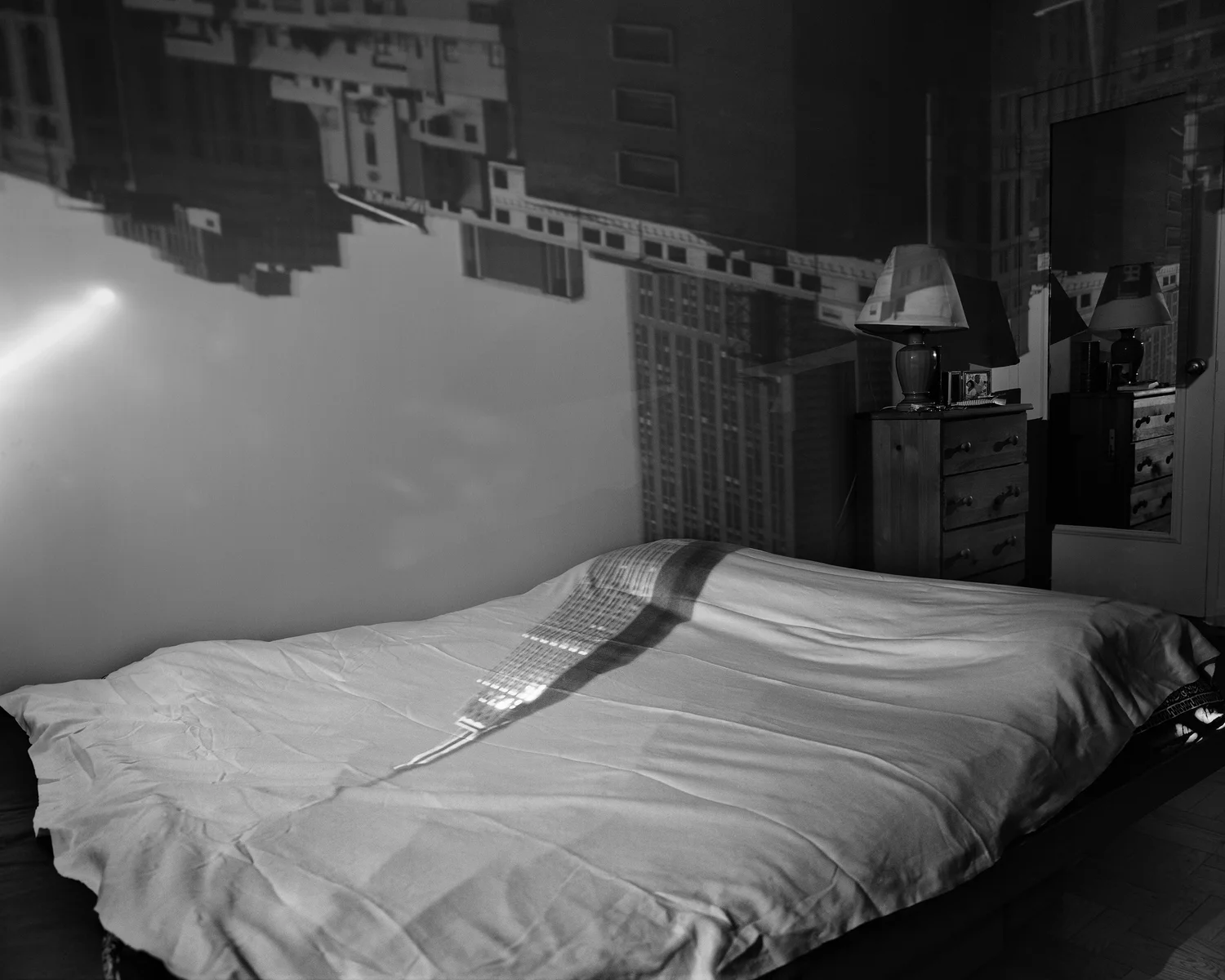
The Empire State Building lies across a bed. Its tower descends the wall and bends onto a pale sheet; the city seems to have entered the room without opening a door. Yet the bedroom in Abelardo Morell’s 1994 photograph keeps its composure. A lamp, a bedside surface, and a small framed photograph remain available for ordinary use. Manhattan has become the strange thing here.[1][2]
The initial pleasure is the collision of scales: a famous skyscraper visiting a modest interior. Stay with the picture, though, and the furniture becomes as consequential as the skyline. Morell gives us a room that receives an image without disappearing beneath it. Looking means continually deciding which space we are seeing.
The bedroom holds its ground
Start with the bed. Its pale fabric occupies the lower part of the photograph, offering a familiar measure of bodily space. We know approximately how a person would fit there. Above it, the inverted building offers a competing measure, belonging to a city much too large to occupy the room. The projection lets both scales coexist without making them agree.
Follow the tower where the projection crosses from wall to bed. The building changes direction as it meets the fabric, and its taper runs across the sheet toward the foreground. The skyline has to submit to the room’s contours. A wrinkle can interrupt architecture that would dwarf the entire apartment outside.
The wall, meanwhile, appears to open into an impossible distance. We can read its surface as plaster or as sky. Neither reading cancels the other. Attention moves between the room’s shallow enclosure and the expansive view carried by its light.
The lampshade makes the encounter funnier and more intimate. SFMOMA’s description singles out its lopsidedness.[2] A slightly awkward household object can hold its own beside the monumental tower. The skyline is inverted, but the lamp still answers to the room’s gravity. The photograph contains two orientations, and our habit of trusting furniture helps us keep them apart.
At the right edge, a tall mirror repeats the lamp and chest of drawers. It offers another route through the room, returning a view that remains upright. Between projection and reflection, the photograph makes an ordinary bedroom unusually difficult to take in at once.
Then notice the small framed photograph. It is an image inside the photographed room, with a boundary we immediately understand. The city has no comparable frame on the wall. Its light spreads through the interior, making the room itself the support. The little picture quietly gives us a conventional example against which to register everything unusual about the larger one.
These details need not become symbols with fixed meanings. The lamp does not have to represent domestic virtue, nor the skyscraper urban menace. Their physical differences already do enough. One occupies space; the other reaches this space as an image. Morell’s composition makes that distinction visible while allowing it to feel unsettled.
A room that makes an image
The process helps explain why the surfaces matter. In his account of the series, Morell describes darkening a room with black plastic, leaving a small opening through which the exterior view projects onto the interior. He then photographs that projection with a large-format camera. His first camera obscura picture was made in his living room in 1991.[1]
There are therefore two stages to the encounter. The room first becomes an optical instrument; a camera inside it then records the result. The city and the furniture meet before the final photograph is made. The peculiar combination exists as light falling on actual surfaces, which gives the viewer something more specific to examine than the idea of two pictures superimposed.
A blank screen would make the projected skyline easier to isolate. Here the room keeps interrupting it. Objects, edges, and changes of surface remind us that the view has landed somewhere. What might ordinarily count as interference becomes the picture’s subject: the conditions under which an image appears.
Time enters that arrangement too. Morell says his early exposures lasted five to ten hours; he does not assign a precise duration to this particular photograph in that account.[1] The series’ method asks us to imagine sustained waiting behind an apparently instantaneous revelation. The empty bedroom becomes a place where the photographer works and watches, even though his body is absent from the finished frame.
The city stays, the room travels
The Getty places Morell’s renewed attention to domestic interiors after the birth of his first child in 1986, when he began exploring unfamiliar viewpoints with a large-format camera. It dates the camera obscura series to 1991 and his move into color versions to 2005. Later refinements included lenses that brightened the projection and prisms that could turn it upright.[3] The inversion in this earlier photograph belongs to a developing practice, rather than an effect he would always need to preserve.
The work also had a public life almost immediately. MoMA’s archive identifies it in an installation photograph of New Photography 10, an exhibition that ran from October 18, 1994, to January 10, 1995. Beside it appears Morell’s 1991 camera obscura image of houses projected into his living room.[4] A private interior had become something visitors could gather around together.
That change of setting adds another pleasure. In a gallery, the photograph offers a room on a wall; inside the photograph, a wall carries a city. The viewer looks through successive spaces while remaining outside all of them. The bedroom feels accessible because its objects are familiar, but it never supplies a place for us to stand within its impossible view.
Return finally to the lampshade. The skyscraper may have drawn us into the picture, yet this small, imperfect object helps us stay. It anchors the scene just enough for the inverted city to remain surprising. Morell lets the bedroom absorb an extraordinary visitor while retaining the untidy authority of an ordinary place.
Sources
- Abelardo Morell, “Camera Obscura” — artist’s account of the process, early exposure times, and official portfolio reproduction of the 1994 Empire State Building photograph.
- San Francisco Museum of Modern Art, “Camera Obscura Image of the Empire State Building in Bedroom,” 1994 — collection record, medium, and description of the room.
- J. Paul Getty Museum, “A Trajectory of Creativity and Curiosity,” from Abelardo Morell: The Universe Next Door — domestic work, the series’ chronology, and later optical refinements.
- Museum of Modern Art, installation view of “New Photography 10: Shimon Attie, Abelardo Morell, Jorge Ribalta, Michal Rovner,” 1994–1995 — photograph by Mali Olatunji, archive reference IN1696.10, with the displayed works identified.