A face looks out from a tangle of cuts and shadows. It has enough features to invite recognition, yet too little solidity to become a person. The more closely we attend to it, the more insistently its surroundings announce the modest material from which it was made: paper.
Francis Bruguière's The Light That Never Was on Land or Sea, I, dated about 1927–30 by the Cleveland Museum of Art, is a gelatin silver photograph of a constructed subject. Its head and upper body emerge from slashed paper. The museum records a crucial further intervention: Bruguière kept the lens open while moving the light source, allowing shadows from different directions to accumulate in the exposure.[1]
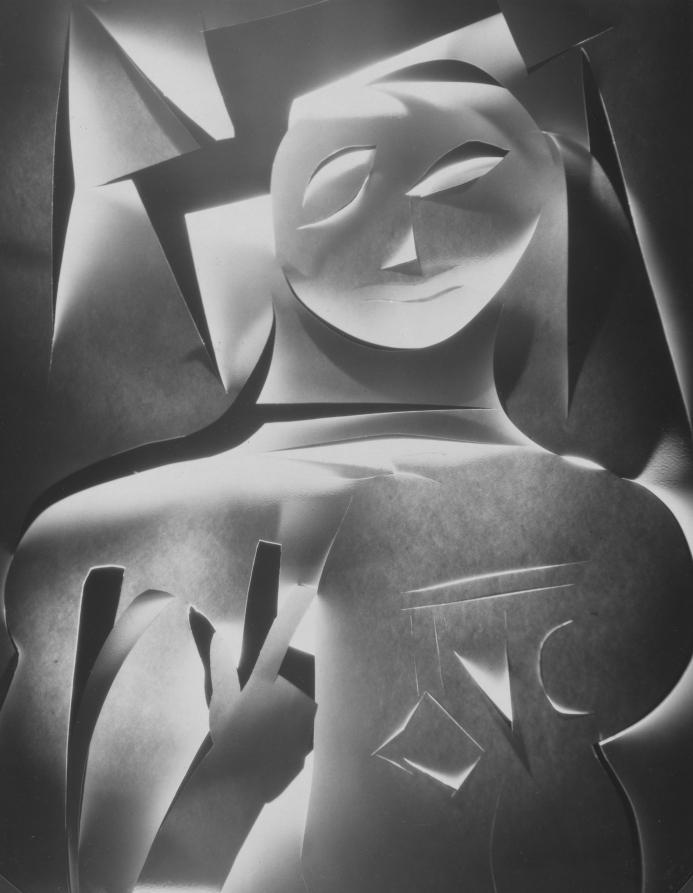
That information changes the encounter. We are looking at the trace of an arrangement that existed before a camera, but the photograph gathers lighting conditions that unfolded over time. The apparent body belongs to a small performance whose movements have been compressed onto one surface.
Start with the face. The narrow eyes, triangular nose and short mouth are economical signs: there is almost nothing here to distract us with a sitter's age or identity. The oval gives those signs a shared territory. It is enough for the eye to assemble a head, even while the surrounding incisions keep breaking up the space from which it emerges.
The result has the reserve of a mask. A viewer might find it amused, solemn or faintly alarming, but none of those moods can be established as the feeling of a represented person. There is no sitter whose expression would settle the question. What we recognize as character develops in the interval between the cut shape and our habit of reading faces.
Below it, the wider curves of the shoulders make the small head seem more precarious. At the lower left, a handlike form reaches upward. The gesture tempts us toward a story, perhaps an address or a warning, without providing an event to explain it. Meanwhile, the abrupt dark shapes behind the figure interrupt any comfortable sense of a room. The construction gives us a presence before it gives us a place.
Bruguière had been exploring the relationship between paper and illumination for years. The Metropolitan Museum of Art's Design in Abstract Forms of Light, dated 1925, belongs to a practice of twisting cut paper into relief and lighting it with a lamp in different positions. The Met also records an exhibition of these abstractions at Berlin's Der Sturm gallery in 1928.[2] The paper face takes that investigation toward something recognizable without abandoning its unstable space.
A cut edge ordinarily helps us distinguish a solid object from the shadow it casts. Here, those clues proliferate. A dark area might first read as an opening, then as a surface turned away from light; an adjacent bright strip can seem to project forward before being absorbed into the pattern. Looking becomes a series of small revisions.
Knowing the exposure method does not remove that uncertainty. It tells us why a reconstruction based on one fixed lamp would be inadequate. It cannot tell us, from the finished print alone, the exact route the light followed or the order in which every shadow appeared. The museum's account establishes the procedure; the image preserves its mingled results.[1]
There is a theatrical history behind this kind of orchestration. Bruguière worked for magazines including Vogue and Vanity Fair, and served as the Theatre Guild's official photographer until 1927. His commercial practice coexisted with experiments in abstraction and multiple exposure, according to the International Center of Photography.[3] Making a convincing photographic space was a professional problem as well as an artistic interest.
Art historian Kristen A. Adlhoch gives that connection more precision. She describes Bruguière photographing stage settings with a stationary camera and a long exposure, manipulating lighting to translate a designer's intentions into a black-and-white image. Her account places the paper experiments alongside this theatrical work, where faithfully conveying an effect could require actively reconstructing its illumination.[4]
Adlhoch also emphasizes the tactile possibilities of such photographs: light can appear to have substance, inviting an imagined sense of touch.[4] That is a useful suggestion here. The broad pale surfaces look as though they might bend under a finger. The shadows seem to open spaces behind them. Yet the physical object before a museum visitor is a flat print. Paper has supplied one kind of surface so that photography can produce the illusion of another.
My reading is that the face gives this uncertainty a point of attachment. Without it, we might travel through the photograph primarily as a collection of intersecting forms. With it, each return to the upper part of the picture renews the sensation of meeting someone. The recognizable head holds our attention while the space around it refuses to become fully consistent.
The title's impossible light thus finds a concrete counterpart in the way the photograph was made. The lamp and the paper were real. Their successive relationships became a single image. Look back at the face after following the surrounding shadows: its stillness now contains the time spent making it visible.
Sources
- Cleveland Museum of Art, “The Light That Never Was on Land or Sea, I,” accession 1994.104 — artwork, reproduction, date, dimensions and the moving-light exposure method.
- The Metropolitan Museum of Art, “Design in Abstract Forms of Light,” 1925, accession 1987.1100.39 — cut-paper reliefs, lighting and the 1928 Der Sturm exhibition.
- International Center of Photography, “Francis Bruguière” — magazine commissions, Theatre Guild work and experimental photography.
- Kristen A. Adlhoch, “The Synaesthetic Experience of Light: Francis Bruguière's Abstract Photographs,” Interfaces 36, 2015, pp. 75–93, especially pp. 76–77 and 82–83 — light, touch and theatrical photography; full article PDF.