Anna Ancher is often introduced as the quiet insider of the Skagen painters: the local daughter in a colony better known internationally through Michael Ancher and P.S. Kroyer, the painter of modest interiors rather than grand statements.[1][2] That summary is tidy, but it misses what makes her feel so sharp. Ancher's real distinction is that she treated sunlight not as background atmosphere but as a structuring force. In her hands, a blue wall, a red parlor, a seated woman by a window, or a nearly empty room could become a full modern event because light was allowed to do the heavy work.[1][3][6][7]
That is why her paintings never sit comfortably inside the category of charming domestic realism. The rooms are domestic, but they are not merely descriptive. The women are local, but they are not picturesque types. Ancher keeps stripping away story until color, silence, posture, and reflected brightness begin to feel like the real subjects.[1][3][4] The result is one of the strongest arguments in Nordic painting that everyday life could be modern without becoming loud.
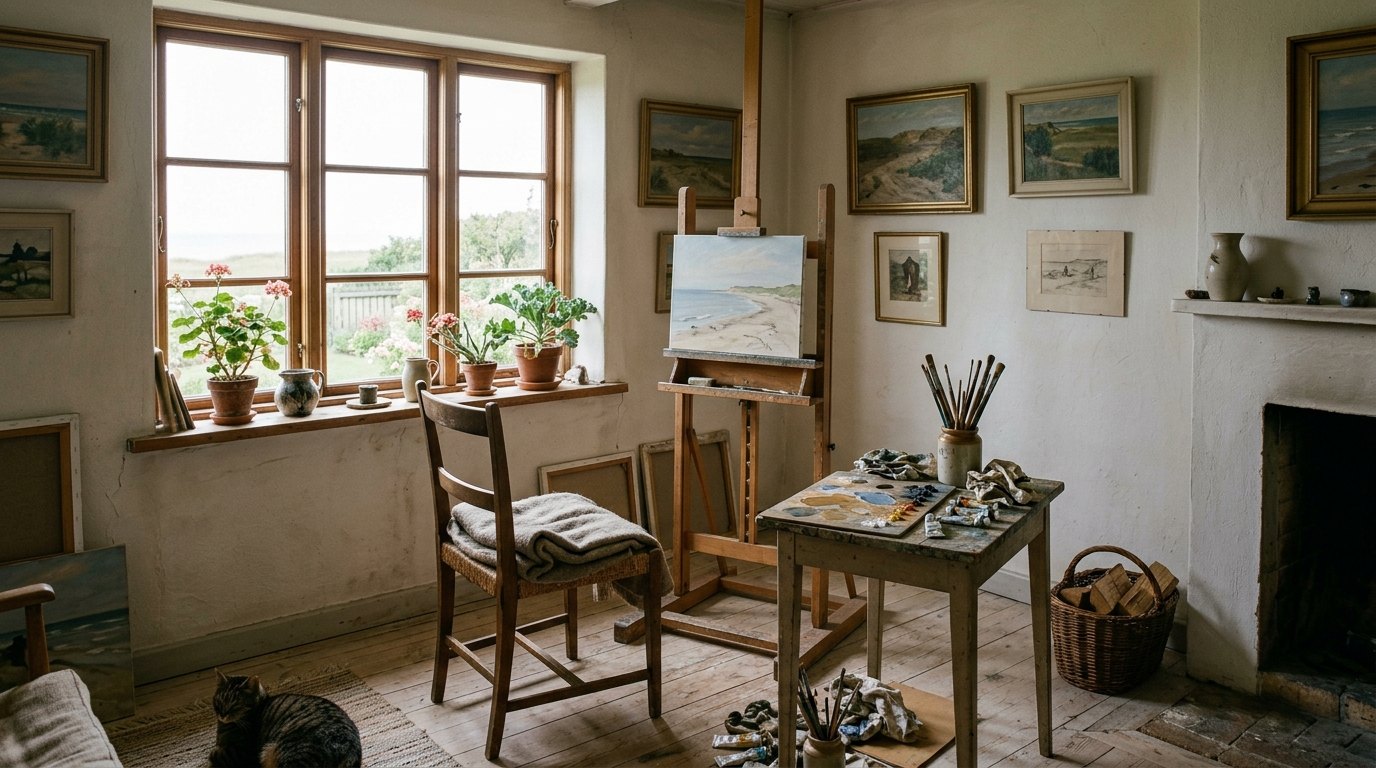
Image context: the hero image now uses an immersive studio-room photograph rather than an artwork reproduction. The article still turns on Sunlight in the Blue Room as a close-reading anchor: a seated figure remains present, but the real protagonist is the beam of light that turns wall, curtain, chair, and floor into a measured color system rather than a simple interior scene.[7]
She painted from inside Skagen, not from a visitor's distance
The first thing that matters about Ancher is geographic and social, not stylistic. As the National Museum of Women in the Arts notes, she was the only member of the Skagen painters to be born in the town itself, where her parents ran the only inn and where visiting artists gathered, argued, and worked.[1] That position gave her a different relation to the place. She was not arriving in search of northern atmosphere or rugged local color. She was painting the human world that had formed her.
That difference helps explain why Skagen in her work rarely behaves like a postcard coast. The 2013 NMWA exhibition page stresses that she was the only professional female artist within the colony and that her work, while touched by Impressionism, Realism, Naturalism, and Symbolism, resists easy classification.[2] It resists classification because Ancher does not use local life as raw material for a single style label. Fisherwomen, mothers, churchgoers, daughters, and domestic rooms become occasions for a tougher question: how can light and color make ordinary life feel fully seen without sentimentalizing it?[1][2]
Mette Bogh Jensen's remarks, recorded by NMWA during that exhibition, are especially useful here. Jensen says the outside did not interest Ancher as much as the interior, and that her interior pictures are above all about color and light.[3] That should not be read as retreat from seriousness. It is the core of her seriousness. Ancher moves the site of artistic drama indoors, then proves that four walls and one window can generate as much formal pressure as a harbor, a sermon, or a beach crowd.[3]
Light becomes the subject before the subject disappears
The best way to understand Ancher is to stop treating light as one beautiful ingredient among others. In her paintings it becomes the principal organizer. NMWA's artist profile says she sought to capture the fleeting effects of light and painted small-scale interiors that recall Vermeer and Chardin.[1] That lineage is useful, but Ancher is often less interested in furnishing an inhabitable room than in showing what sunlight does once it enters one.
SMK Connect's page on The Artist's Mother Ane Hedvig Brondum in the Red Room makes this exact point with unusual clarity. The old mother may seem to be the subject, yet the museum text says Ancher was especially preoccupied with depicting sunlight and how it marks itself inside an interior; the blue and red walls carry vertical reflections that matter as much as the seated figure herself.[6] That description is practically a definition of her art. A person remains inside the picture, but light begins to compete with biography.
The same thing happens in Sunlight in the Blue Room.[7] The seated figure anchors the composition, but the painting's conviction comes from the way light breaks and settles. The chair, the curtain, the floor pattern, and the blue wall are not props around a model. They are surfaces testing how illumination becomes structure. Ancher's modernity lives here. She does not need fractured Cubist planes or futurist speed lines to make painting feel newly exact. She lets one shaft of light reorganize the whole room.
Her domestic rooms are not sentimental shelters
This is also why her interiors should not be mistaken for soft private worlds. NMWA's "Gendered Interiors" essay notes that when Ancher painted rooms associated with herself, they were often sparse, simple, and stripped of ornament, quite unlike the prosperous surroundings she sometimes gave Michael Ancher.[4] The distinction matters. Her own spaces are not staged as decorative proof of feminine domesticity. They are emptied enough to let looking intensify.
In that sense, Ancher's rooms behave almost like studios of reduction. She eliminates clutter, withholds anecdote, and narrows the social script. What remains is not emptiness for its own sake, but a field in which wall, window, table, flower, chair, and seated body can be read with unusual pressure.[4] Her local women are likewise treated without theatrical uplift. NMWA's artist page notes her unidealized way of painting women in profile.[1] She does not turn them into abstract symbols of virtue or folk authenticity. She lets them keep the weight of actual presence.
That restraint is one reason the paintings age so well. Many nineteenth-century interiors now feel trapped inside genre sentiment or moral anecdote. Ancher's do not. They stay alive because their emotional register is carried by formal decisions rather than by overt narrative. Light falls across a room, and the room becomes legible as time, labor, habit, and pause all at once.[3][4][6]
Professional equality mattered, but she refused spectacle
Ancher's career also clarifies something larger about women and artistic professionalism at the turn of the century. She was barred from the Royal Danish Academy because she was a woman and instead trained privately with Vilhelm Kyhn before further exposure to Paris and to the Skagen circle.[1] Yet she did not disappear into the role of talented spouse. The Nationalmuseum page for Michael Ancher's Anna Ancher Painting a Model states bluntly that the two were remarkably equal professionally for married artists of the late nineteenth century and often painted each other's portraits as an expression of mutual respect.[5]
That equality matters because it changes how we read her quietness. Silence in Ancher is not submission. It is control. Even when she paints her own studio or her mother's room, she refuses the easy rhetoric of self-display. The NMWA blog notes that she did not define herself through household ornament or through the visible trappings of feminine domestic identity; her physical absence from some interiors quietly pushed against those boundaries.[4] So the rooms are private, but they are not confessional. They are places where observation wins over performance.
This is where Ancher becomes more radical than her reputation suggests. She did not advertise modernity through scandal, manifesto, or aggressive rupture. She made it arrive through calibration. A room could become modern if color was allowed to dominate description. A local mother could remain a person while also becoming the support for light itself. A woman artist could occupy the center of a colony without loudly mythologizing her own singularity.[1][2][4][5]
Why she still feels current
Seen now, Ancher's art offers a model of seriousness without noise. She proves that painting can be modern through concentration rather than escalation. The motifs stay local: family rooms, women at work or rest, the town she knew from birth. But the treatment is unsentimental and formally daring. As Jensen puts it in the NMWA account, Ancher was the modern one of the colony.[3]
That judgment holds because her paintings keep discovering how much can happen when almost nothing happens. A figure reads. A mother sits. A model waits. Sunlight moves across colored walls. Yet those small conditions become exact because Ancher trusts light to build the picture from within. She made Skagen interiors feel less like records of a vanished town than like durable demonstrations of how seeing itself can become form.[1][3][6][7]
Sources
- National Museum of Women in the Arts, "Anna Ancher" - artist profile covering her Skagen origins, private training, continued professional work after marriage, and focus on fleeting light effects in small-scale interiors.
- National Museum of Women in the Arts, "A World Apart: Anna Ancher and the Skagen Art Colony" - exhibition page describing Ancher's role as the colony's only professional female artist and the avant-garde reach of her light-filled interiors.
- National Museum of Women in the Arts, "Shedding Light: A Curator's Perspective on Anna Ancher" - exhibition blog relaying curator Mette Bogh Jensen's remarks on Ancher's interior focus, her handling of color and light, and her modern position within the colony.
- National Museum of Women in the Arts, "Gendered Interiors" - essay on how Ancher differentiated her own rooms from Michael Ancher's and used sparse interiors to reverse expected gendered readings of domestic space.
- Nationalmuseum, "Anna Ancher Painting a Model" - collection page for Michael Ancher's portrait of Anna at work, including the museum's note that the two artists were professionally remarkable equals.
- SMK Connect, "Kunstnerens mor Ane Hedvig Brondum i den rode stue" - official artwork page explaining that reflected sunlight on the walls matters as much as the seated mother in Anna Ancher's 1909 interior.
- Wikimedia Commons, "Anna Ancher - Sunlight in the blue room - Google Art Project" - file page for the artwork discussed in the close reading, with title, date, medium, and Skagens Museum location metadata.