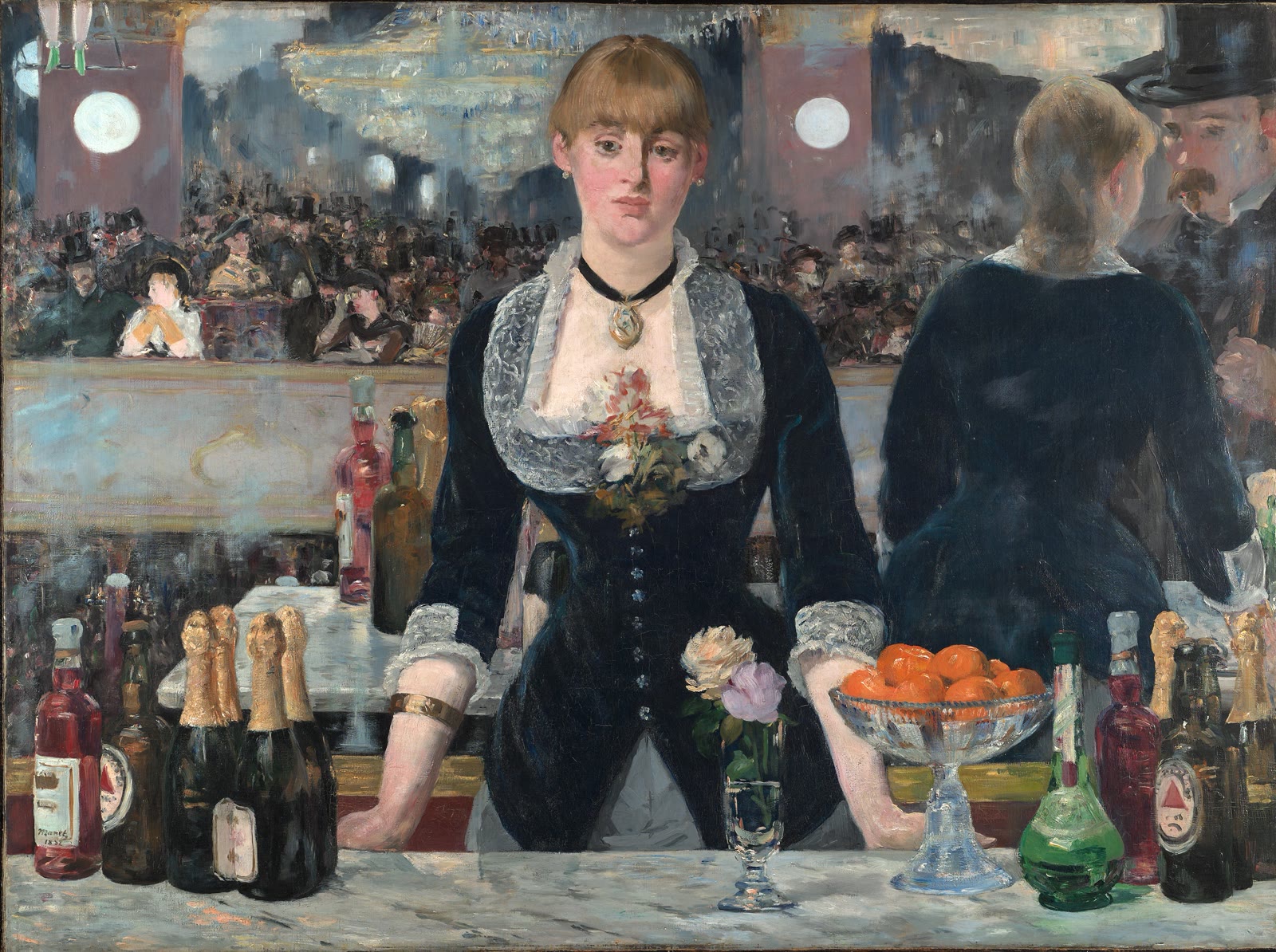
At first glance, Manet's A Bar at the Folies-Bergère looks almost over-explained by art history. Everyone knows the talking point: the mirror does something strange.[1][3] But that shorthand can make the painting seem like a visual riddle with one correct solution. It is stronger than that. The picture keeps its grip because it never lets the room settle into a single contract between worker, customer, spectacle, and viewer. The mirror's drift is not a puzzle pasted onto a finished scene. It is the scene's governing condition.[1][2][3]
That is why the painting still feels modern in a way many more obviously avant-garde works do not. Manet does not give us the Folies-Bergère as an energetic nightlife souvenir. He gives us a place where commerce, entertainment, and loneliness occupy the same surface. The crowd glitters, the bottles shine, the trapeze act flashes at the upper left, yet the barmaid stands in a zone of emotional stillness that the room cannot absorb.[1][2][4]
Image context: the hero image uses the full painting because the argument depends on the whole arrangement staying visible at once. The barmaid, the bottles, the mirror, the man in the top hat, and the tiny trapeze legs all matter because the picture's instability is distributed across the entire field rather than concentrated in one detail.[1][2][3]
1) The painting looks like a portrait, then refuses to behave like one
Courtauld's overview gets at the first important surprise: when the work appeared at the 1882 Salon, it seemed to borrow the format of portraiture while withholding the normal satisfactions of a portrait.[1] The woman at the center was not even identified by name in the exhibition frame, and the painting does not present her as a socially elevated sitter. She appears behind the counter amid wine, champagne, liqueur, fruit, flowers, and Bass beer, so that the figure and the goods arrive in the same frontal zone.[1][3]
That matters because Manet makes the barmaid feel both singular and objectified at once. Britannica notes that she was a real barmaid rather than a professional model.[3] Courtauld names her as Suzon and notes that she posed for the final painting in Manet's studio after he had sketched at the Folies itself.[2] Those facts sharpen the work's tension. Suzon is not a generic allegory of nightlife, but neither is she granted the secure individuality of a commissioned portrait. She is present, unmistakably human, and yet arranged inside a system of display.
The picture's emotional force begins there. Her face is calm, tired, withholding. The expression does not resolve into flirtation, misery, or boredom. Manet places her before us but keeps motive opaque. In a room built for spectacle, she becomes the least theatrical presence in sight.[1][3]
2) The mirror does not explain the scene; it destabilizes it
Most viewers first register the painting through the mismatch between the centered barmaid and the reflection shifted to the right.[1][3] The man in the top hat appears only in the mirror, and the bottles do not line up neatly either.[2] If this were merely a technical mistake, the painting would have lost its power long ago. Instead the misalignment does something more unsettling: it denies the viewer a stable place from which the transaction can be fully grasped.
Britannica is blunt that Manet used artistic license, shifting the reflection and tilting it to make the image work as a painting rather than as a strict optical diagram.[3] That is useful because it clears away the false demand that the picture behave like a camera. The larger point follows from the way the picture distributes reflection, display, and crowd activity across one unsettled surface: it keeps asking where we stand and what relation we bear to the woman facing us.[1][2][3]
The strongest way to read that choice is ethical as well as spatial. If the reflected man shares the viewer's rough position, then the picture keeps inviting us into the role of customer while refusing to let us occupy it securely.[3] We are close enough to the bar to meet Suzon's eyes, but the mirror dislodges the encounter. The scene becomes one of partial implication. We are not outside the transaction, yet we cannot master it from within.
That is why the painting's famous "mistake" continues to feel alive. The room is crowded, but knowledge is fractured. Seeing does not produce possession. It produces uncertainty.
3) The counter is a display surface before it is a workplace
The objects on the marble ledge are not still-life decoration added to enrich the scene. They are the painting's economic grammar.[1][2] Courtauld's description names the foreground array with precision: wine, champagne, peppermint liqueur, fruit, and British Bass beer with its red triangle logo.[1] Britannica adds a detail that is easy to miss once you know the mirror story: Manet even placed his signature on a bottle at the left.[3]
Those details matter because they make the counter read as a branded, legible interface. Before we decode the spatial trick, we have already been taught how to scan the surface as merchandise. The bottles stand upright like vertical markers of choice and price. The oranges offer a softer, tactile contrast. Flowers promise ornament and ephemerality. Suzon stands behind all of it, but the counter's neat display turns her labor into part of the arrangement.
This is one reason the painting resists romantic readings of Parisian nightlife. Pleasure is present, but it is organized. The bar is a site where looking, serving, buying, and being looked at converge.[1][4] Manet does not dramatize this through overt satire. He lets the stillness of the central figure do the work. Surrounded by commodities and reflections, Suzon reads less like the hostess of pleasure than like the human cost of maintaining the room's smooth surface.
4) The spectacle had to be rebuilt in the studio
One of the most revealing facts about the painting is that its busiest public scene was finalized away from the public venue itself. Courtauld says Manet made sketches on site, but the final picture was painted entirely in the studio, where Suzon came to pose.[2] Britannica adds that he installed an imitation bar there, which helps explain why the foreground feels so sharply arranged while the reflected crowd remains more vaporous.[3]
That studio reconstruction is not a secondary anecdote. It helps explain the painting's strange balance of exactness and haze. The bottles, fruit, hands, bodice, and marble edge possess a deliberate clarity. Behind them, the music hall becomes shimmer: chandeliers, balconies, figures, and the trapeze act all seem caught between memory and sensation.[1][2][3]
Seen this way, the painting stages two kinds of truth at once. The front edge records the discipline of work, pose, and placement. The background records the sensory overload of modern entertainment, where bodies become flashes in a mirror and social life arrives as vibration rather than stable narrative.[2][4] The famous spatial inconsistency belongs to that larger construction. Manet is not correcting a room; he is painting the felt conditions of a room that can only be held together imperfectly.
5) Why the painting still reads as a modern social image
The Folies-Bergère was one of the emblematic entertainment spaces of late nineteenth-century Paris, and the National Gallery of Art's Manet and Modern Paris materials treat the painting as one of Manet's most topical large subjects.[4] That topicality matters, but it is not enough to explain the work's afterlife. Plenty of topical paintings go dead once their immediate context fades. This one does not.
It survives because its core structure remains legible inside later service economies. The painting understands a crowded leisure space as a machine for asymmetrical contact. Someone serves; someone watches; someone buys; someone performs overhead; a crowd enjoys the scene; and the person at the center of the exchange is emotionally elsewhere. Manet compresses those relations into one image without simplifying them into one message.[1][2][4]
A useful museum sequence is simple:
- Start with Suzon's face and posture before looking at the mirror.[1][2]
- Then scan the counter from left to right as if it were a display window: bottles, fruit, flowers, hands, marble edge.[1][4]
- Only after that move into the mirror and ask what kind of social position it offers the viewer.[2][3]
Read in that order, A Bar at the Folies-Bergère stops looking like a single clever paradox. It becomes a painting about modern surface itself: how a room can appear full while a person remains isolated inside it, how merchandise can organize attention before narrative begins, and how the act of looking can make us participants without ever giving us control.
Sources
- The Courtauld, "A Bar at the Folies-Bergère" — collection highlight with foreground object details, Salon context, and mirror description.
- The Courtauld, A closer look: A Bar at the Folies-Bergère (PDF) — short guide to Suzon, the studio setup, and the shifted reflections.
- Encyclopaedia Britannica, "A Bar at the Folies-Bergère" — overview of the 1882 painting, the mirror shift, and the studio-built bar.
- National Gallery of Art, Manet and Modern Paris (PDF) — exhibition publication on Manet's Paris subjects and the Folies-Bergère as a topical modern venue.