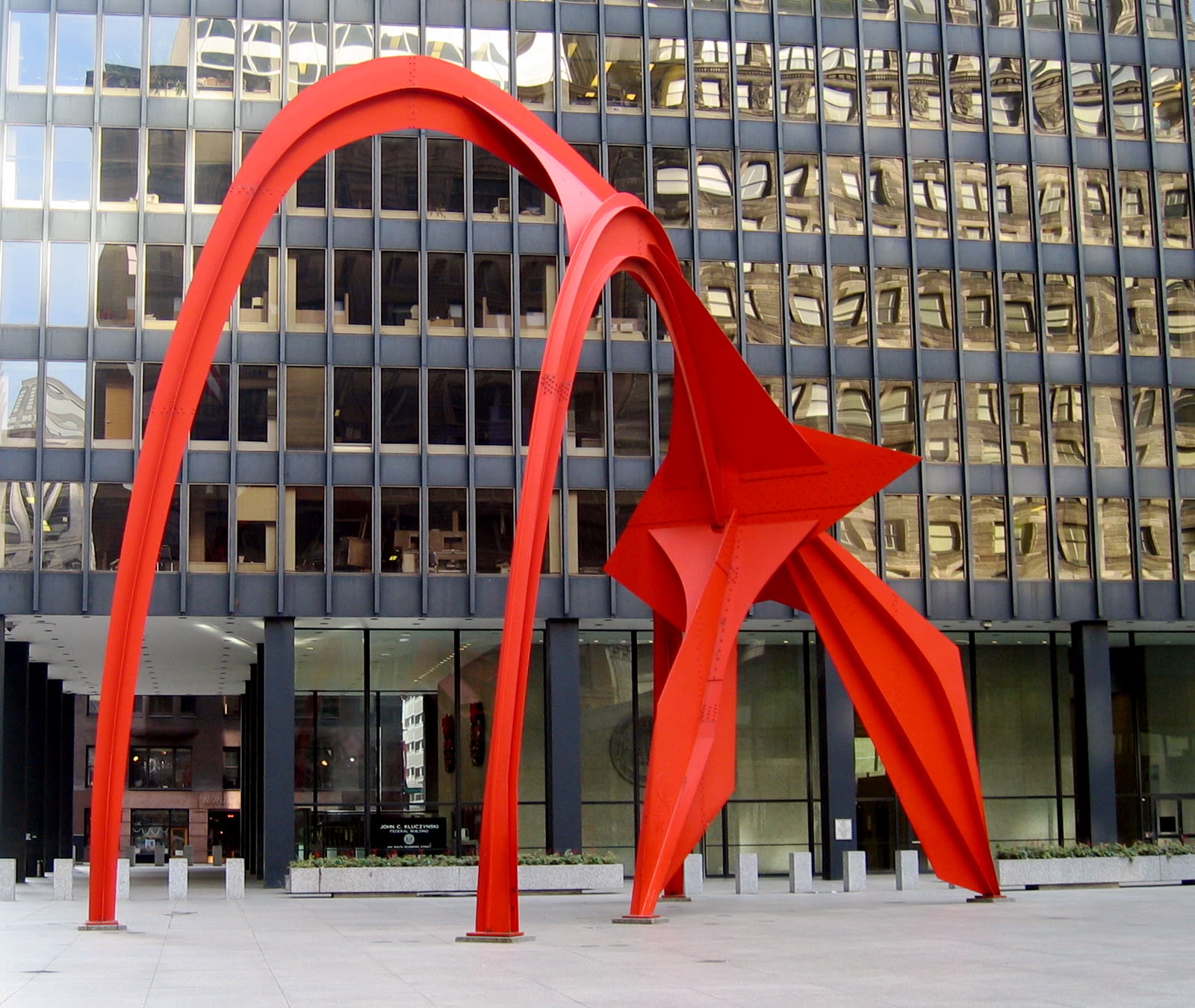
Flamingo is one of those public sculptures that can seem solved too quickly. It is large, red, and famous. People pass under it, photograph it, and let the title do part of the reading. But Alexander Calder's sculpture earns its place not because it resembles a bird in any literal way.[1][3] It earns it because it changes the behavior of a severe civic space. In Chicago's Federal Center Plaza, Calder takes sheets of painted steel and turns them into something unexpectedly light on its feet: a work that does not decorate Mies van der Rohe's black grid so much as interrupt it with curve, lift, and usable air.[2][4][6]
That interruption is the real subject. The General Services Administration describes Flamingo as standing in dramatic contrast to the rigorously restrained Federal Center while also humanizing an environment dominated by skyscrapers and paved surfaces.[2] Choose Chicago makes the complementary point that the sculpture is made of related industrial materials and still shares enough design principles with the architecture to integrate successfully into the plaza.[6] Put those claims together and the work becomes easier to read. Calder is not offering an escape from modernism. He is bending modernism from inside its own material world.
Image context: the cover uses a real photograph of Flamingo in situ because this article depends on the work's exact urban setting. Remove the plaza, the black towers, and the walkable space under the legs, and the sculpture loses the pressure system that gives it meaning.[2][5]
The sculpture works by refusing to become a literal bird
The Smithsonian American Art Museum's page for Calder's Maquette for Flamingo is useful here because it names the work's double charge directly.[3] The subject is a flamingo, but the model also keeps Calder's long affection for whimsical and exotic creatures at a visible distance from strict representation.[3] That distance matters. The sculpture gives you a neck-like rise, splayed leg-like supports, and a poised stance, but it never lets anatomy harden into illustration.
That is why the title feels playful rather than descriptive. A literal bird would shrink the work into an oversized mascot. Calder instead keeps the avian cue skeletal and structural. The long arcs feel elegant because they rise and land with the precarious grace of a bird shifting weight, not because they describe feathers, eyes, or beaks. The name supplies a rhythm for the body to test, then the steel immediately abstracts it again.[1][3]
This balance keeps the sculpture public in the best sense. A passerby does not need art-historical training to understand why the title belongs. At the same time, the work does not collapse into easy legibility. It stays open enough to be bodily before it becomes symbolic.
Curve matters more here because the plaza is so disciplined
WTTW's short Chicago guide gets the key contrast right: Flamingo adds color and texture to the stark black backdrop of the Federal Center.[4] The point is not merely chromatic. The plaza's architecture is orthogonal, dark, rectilinear, and administratively calm. Against that field, Calder's painted steel arcs do not read as random exuberance. They read as a different geometry entering the room.
The GSA page sharpens the same point by stressing the sculpture's curvilinear forms and soaring height.[2] At roughly 53 feet tall, Flamingo does not sit in the plaza as an object on a pedestal.[2][3] It rises to the scale of the buildings without trying to mimic them. That is a difficult thing for public art to do. Too small, and it becomes plaza furniture. Too monumental in the wrong way, and it starts fighting the site like a rival tower. Calder avoids both traps by making the work tall but open, emphatic but permeable.
The red color helps because it lands as a clear civic signal rather than a precious sculptural finish. Choose Chicago notes the familiar phrase "Calder Red," and the phrase is apt because the paint behaves almost like a public utility line drawn into space.[6] The color is bright enough to declare itself from a distance, but the work's real intelligence appears when one gets closer and the structure stops being silhouette alone.
The legs make the plaza pass through the sculpture
The deepest formal decision in Flamingo may be the openness at ground level. The feet touch down narrowly, the arches spread above, and the middle stays available. That availability is what turns the sculpture from a thing to look at into a space to move through. The SAAM page's story about the 1974 dedication parade, with Calder riding above cheering crowds, sounds almost comic at first.[3] In fact it reveals exactly what kind of public sculpture this is. Flamingo invites ceremony because it already behaves like a temporary gateway.
Walk beneath it and the scale changes. From a distance, the work looks balanced and almost calligraphic. Underneath, the steel thickens, the red planes tilt, and the plaza feels briefly vaulted. The sculpture does not provide enclosure in the architectural sense. It provides a passing sensation of shelter. That is enough to reorganize a large open forecourt.
This is why the work keeps its force even after decades of familiarity. Many public sculptures are consumed best from one approved viewpoint. Flamingo improves when approached obliquely, entered, and crossed. Its interior voids are not leftovers between metal plates. They are the active medium. Calder makes emptiness do civic work.
The result is play under federal seriousness, not escape from it
The GSA notes that Flamingo was commissioned through the Art in Architecture Program.[2] That bureaucratic fact belongs inside the reading of the sculpture itself. This is not rebellious art smuggled into hostile space. It is officially commissioned work that nonetheless keeps a certain wit alive inside an administrative setting. SAAM records that some Chicagoans called it junk, a droopy tulip, or a steel mosquito when it arrived.[3] Those reactions are revealing because they show the work refusing solemn monument language even at monumental scale.
Calder's answer was not to make the sculpture smaller or sweeter. He made it exact. The arcs are clean, the stance is stable, the voids are disciplined, and the title is just figurative enough to keep the whole structure from freezing into pure abstraction.[1][2][3] The piece does not mock the plaza. It teaches the plaza another posture.
That is why Flamingo still feels fresh. It proves that public sculpture can humanize a severe site without sentimentalizing it. The work does not plant a fake garden in front of the towers or hide the federal grid behind expressive gesture. It keeps the steel, keeps the scale, keeps the civic seriousness, and then alters the emotional weather through lift, asymmetry, and walkable space.[2][4][6] In a plaza built from right angles and institutional restraint, Calder made one large red curve system that lets the air start moving.
Sources
- Calder Foundation, "Flamingo (1973)" - official work page for Calder's monumental steel sculpture in Chicago.
- U.S. General Services Administration Fine Arts Collection, "Flamingo" - official artwork page with date, dimensions, commission context, and notes on the sculpture's contrast with Mies van der Rohe's Federal Center.
- Smithsonian American Art Museum, "Maquette for Flamingo" - official page on Calder's 1972 model, the 1974 dedication, and the sculpture's whimsical bird reference.
- WTTW Chicago, "Flamingo by Alexander Calder" - local public-art guide noting the sculpture's 1974 unveiling, scale, and relationship to the Federal Center backdrop.
- Wikimedia Commons, "File:Calder Flamingo.jpg" - source page for the documentary photograph used as the article image.
- Choose Chicago, "Calder's Flamingo" - local context page on the sculpture's plaza setting, Calder Red, and integration with the surrounding federal buildings.