Jenny Holzer's art still lands with unusual force because it does not ask language to sit quietly inside a frame.[1][2] From the late 1970s onward, she kept moving text into places where authority already circulates: walls, signboards, billboards, LED displays, benches, projections, and museum architecture.[1][2] That migration is the real subject. Holzer did not just write sharp sentences. She made delivery systems carry the work, so that reading could feel public, involuntary, and faintly political before a viewer had even sorted out what they agreed with.
That is why her art still feels contemporary after the feed era rather than stranded in an earlier conceptual moment. The basic units are short, portable, repeatable statements. The deeper engine is infrastructural. A phrase arrives in a format normally used for commands, warnings, civic information, or commercial persuasion, and the medium's borrowed authority starts pressing on the sentence.[1][2] Viewers are left inside a productive uncertainty: who is speaking, why does the message sound official, and what happens when conviction and contradiction share the same glowing surface?
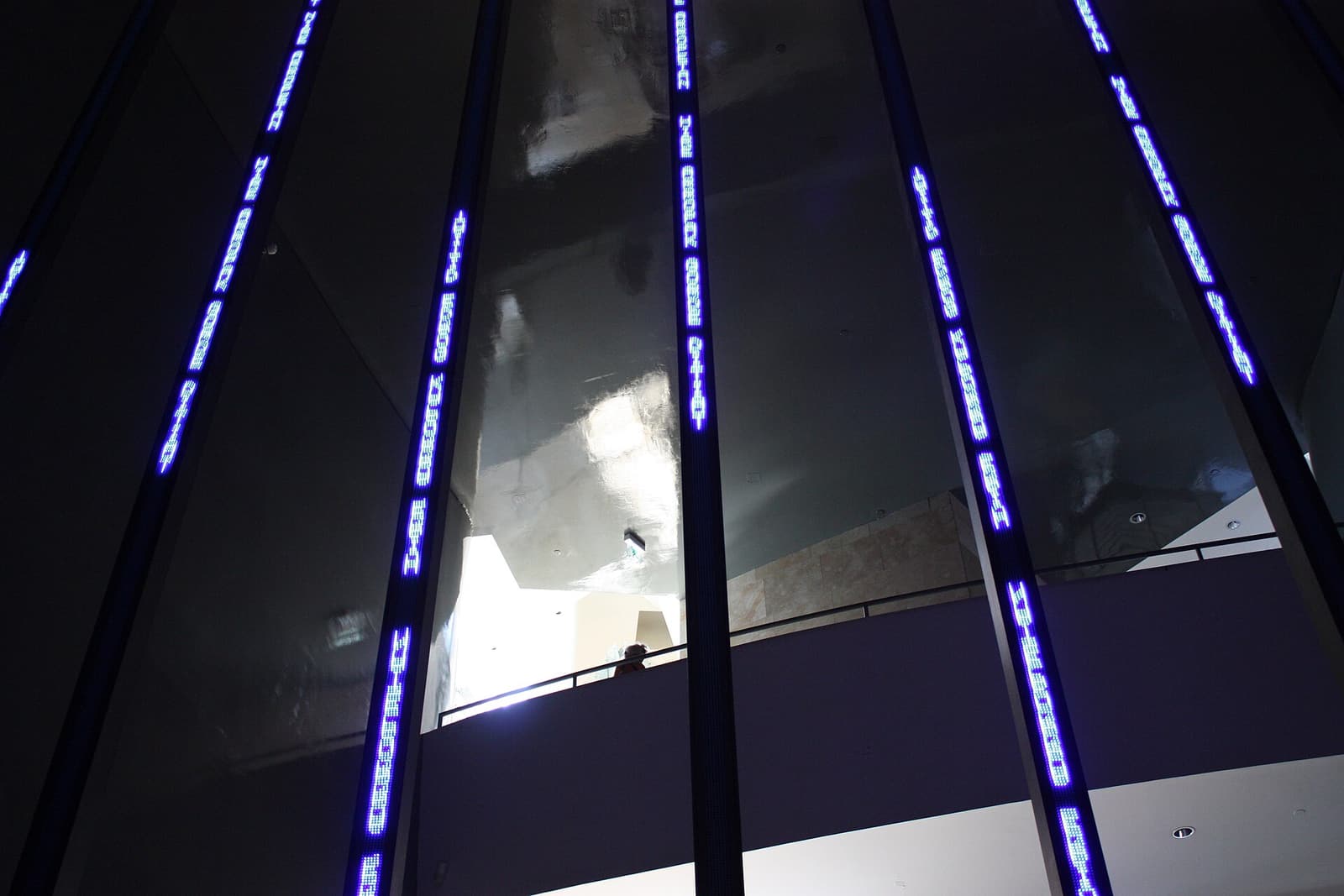
Image context: the cover image uses a real 2010 photograph of Installation for Bilbao, the permanent Guggenheim Museum Bilbao work that channels Holzer's text through vertical LED columns in English, Spanish, and Basque.[3][6] It is the right visual anchor because this article turns on scale and delivery. The issue is not language in the abstract. It is language when it acquires hardware, height, reflection, and room pressure.
Truisms stripped the sentence of a stable owner
The starting point is the early Truisms series from 1977-79.[1][2] The Smithsonian American Art Museum notes that after moving to New York and entering the Whitney Independent Study Program, Holzer began producing typed aphoristic statements and posting them anonymously around the city.[2] That anonymity mattered as much as the phrasing. A line such as "Money creates taste" does not come wrapped in one stable character or declared ideology. It arrives like something already in circulation, half proverb and half command.[2]
The Whitney frames the series in a similar way, stressing that the Truisms first appeared as posters wheat-pasted onto Manhattan buildings and walls and that the statements were deliberately contradictory and plural in voice.[1] That plurality is the formal breakthrough. Holzer's sentences do not ask to be admired as singular literary objects. They are built to test how public language works once authorship becomes diffuse and certainty starts sounding manufactured.
This is one reason Holzer stayed more abrasive than artists who simply placed text beside images. She treated public writing as a live social material. A slogan on a wall already resembles advice, propaganda, self-help, common wisdom, and bureaucratic instruction all at once.[1][2] Holzer found that unstable zone early and never really left it.
Electronic signage turned reading into a civic event
The next decisive move came in 1982, when Holzer was invited to use the Spectacolor signboard in Times Square.[2] The Smithsonian artist page identifies that invitation as her first use of electronic signage and a turning point she kept developing through later site-specific LED works.[2] Once the sentence entered that medium, the work changed temperature. Printed posters still had the feel of something made by a person and stuck on a wall. Electronic signs borrowed the look of institutions, transit systems, finance, and broadcast urgency.
The Whitney's artist overview traces the same expansion: illuminated signs, posters, billboard advertisements, and projections on buildings all become part of one larger practice of public display.[1] Read that way, Holzer's LED works are not decorative upgrades to the Truisms. They are a study in what happens when a sentence is delivered by a machine that usually carries orders, prices, alerts, or state-sanctioned information.
That shift explains why Holzer's art keeps outrunning the category of "word art." Her text is rarely interesting as pure typography alone. Its force comes from how a delivery format leans on the viewer. LED light does not ask for the same kind of attention as ink on paper. It pulses, loops, scrolls, and occupies peripheral vision. The sentence becomes environmental before it becomes interpretive.[1][2][5]
Buildings became reading surfaces
By the time Holzer arrived at large museum-scale installations, the work had already learned how to operate without the traditional picture plane. The Guggenheim Museum Bilbao's page on Installation for Bilbao describes the permanent piece as a 1997/2017 electronic LED sign and links it back to the earlier Truisms, whose many voices and biases required viewers to decide legitimacy for themselves.[3] In Bilbao, that problem acquires verticality. Text does not sit on the wall as label or caption. It rises in luminous columns and turns the room into a channel.
The multilingual structure matters too. The museum notes the work's English, Spanish, and Basque text streams, which keep the installation from settling into one single public.[3] Holzer's language always had many voices inside it; here, the architecture makes that multiplicity visible. Reading becomes staggered, partial, and social. Some viewers catch one lane first, others another. The room behaves less like a container for an object than like a machine for distributing attention.
The Smithsonian American Art Museum's page for For SAAM clarifies the next extension.[4] Created for a tall, open gallery, the work gathers texts from four series across decades of Holzer's career and sends them swirling around a white LED column at different speeds.[4] The museum's description emphasizes that the movement rewards slow viewing and keeps the question of interest and authority active.[4] That is crucial. Holzer's art uses media associated with quick command, but often to force delayed reading.
The Guggenheim's 2023 press release for Light Line adds a conservation and architectural dimension that makes the technology argument sharper.[5] It describes the 1989 Guggenheim installation as taking three revolutions of the Frank Lloyd Wright rotunda, while the 2024 manifestation climbs all six ramps to the oculus and was rebuilt through research into the original hardware and computer program.[5] In other words, Holzer's work does not just borrow technology as visual atmosphere. It ties meaning to specific display systems, specific rooms, and specific maintenance histories.
Why Holzer still feels structurally current
Holzer's relevance now is often flattened into one easy claim: she predicted the internet. That shorthand leaves out the better point. She identified a harder modern condition, one that survived changes in hardware.[1][2][4][5] Public language keeps arriving in forms that sound neutral, official, or communal even when their underlying interests are mixed, strategic, or unstable. Holzer made that condition visible by refusing to separate content from delivery.
This is why her work still cuts through contemporary visual noise. On today's platforms, authoritative fragments circulate detached from context, voice, and accountability. Holzer found an earlier version of that pressure in posters, billboards, LED signs, and projections.[1][2] Yet her installations also slow the process down. A viewer has to stand there, track the scroll, sort the contradictions, and feel the sentence in space. The work does not let the message dissolve into frictionless consumption.
That is the scale of her achievement. Holzer turned language into public infrastructure without letting it harden into doctrine. The sentence could glow, rise, circulate, and command attention like official information, yet still remain open enough to expose the machinery of belief behind it.[1][3][4][5] Once she established that grammar, a bench, a signboard, a museum ramp, a riverbank projection, and a dark room of LED columns could all become versions of the same artistic question: what kind of power enters the sentence when the sentence acquires a system?
Sources
- Whitney Museum of American Art, "Jenny Holzer" - artist page on Holzer's large-scale public displays of language, early Manhattan posters, and later illuminated signs, billboards, and projections.
- Smithsonian American Art Museum, "Jenny Holzer" - artist page on the Truisms, anonymous city posting, and the 1982 Spectacolor invitation that led to Holzer's first use of electronic signage.
- Guggenheim Museum Bilbao, "Installation for Bilbao" - official collection page on the 1997/2017 electronic LED installation and its English, Spanish, and Basque text streams.
- Smithsonian American Art Museum, "For SAAM" - official object page on the white LED column, multi-series text selection, and the work's question of public authority and viewpoint.
- Solomon R. Guggenheim Museum, "The Guggenheim Museum Presents Jenny Holzer: Light Line" - official press release on the 1989/2024 rotunda installation, six-ramp expansion, and reverse-engineering of the original LED hardware and program.
- Wikimedia Commons, "File:Installation for Bilbao, July 2010 (02).JPG" - source page for the installation photograph used as the article image.