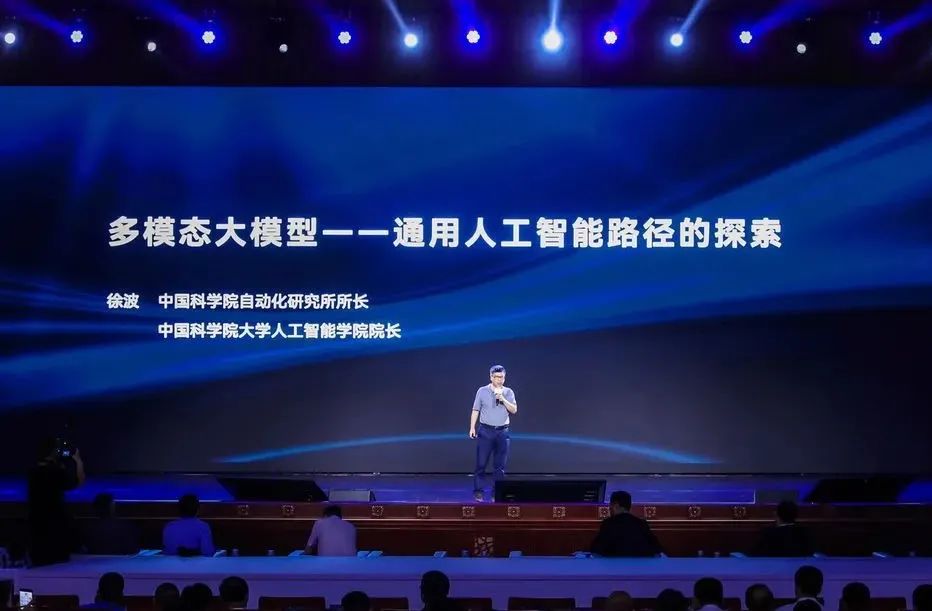
In July 2021, the Chinese Academy of Sciences Institute of Automation put a virtual presenter called Xiaochu on display at the World Artificial Intelligence Conference. Its ZiDong-Taichu platform could connect pictures, speech and text: describe video, retrieve images and answer questions through the same research program. The ambition was to make these forms of information work together.[1]
Five years later, the program's latest public release asks a more physical question: where are things, and what could happen next? ZDTaichu5.0-9B, released on September 15, 2026, targets spatial understanding and the planning that can support robots and scientific automation.[5] The continuity matters. This is a laboratory gradually changing what it expects a multimodal model to understand, while changing the machinery used to get there.
A research department behind the name
ZiDong-Taichu sits within the Institute of Automation, where its dedicated research center became an independently organized department in 2022. The institute describes a remit spanning vision, language, pattern recognition and their applications, with a goal of building a shared AI platform for complex environments.[2]
That institutional shape helps explain the project's persistence. A model release can be one output of a longer research program, alongside trained researchers, deployment methods and partnerships. Reading ZiDong-Taichu solely as a succession of version numbers would miss the organization keeping these strands together.
An early public code repository makes the original approach concrete. Its OPT architecture used separate encoders for individual modalities, a cross-modal encoder and two cross-modal decoders. Training objectives operated at token, modality and sample levels. In plain language, the system had to learn useful representations within each kind of input and connections between them.[3]
The repository also exposes the engineering setting: Huawei Ascend hardware, CANN 5.0.4 and MindSpore 1.6.1. These are historical requirements from that release, not installation advice for the current model. Its description distinguishes the billion-parameter-scale public code from the much larger model announced by the project.[3] Even at the beginning, the research headline and the artifact another team could run required separate reading.
More of the world enters the input
By the June 16, 2023 launch of version 2.0, the institute was explicitly reaching beyond images, speech and text to video, signals and three-dimensional point clouds. Its report describes demonstrations involving music, scene analysis and navigation in three-dimensional environments. It also identifies Ascend infrastructure and the Wuhan Artificial Intelligence Computing Center as part of the development arrangement.[4]
The change was consequential because a room presents a different problem from a caption. Describing a chair does not establish whether it blocks a passage. Identifying two objects does not determine which one lies within reach. Those examples illustrate the motivation for spatial reasoning; they are not additional claims about the 2023 demonstrations.
The institute's account already connected multimodal research to applications involving physical equipment.[4] The question running through subsequent work is how much of a situation the model must represent before its output becomes useful to another system.
A smaller release with inherited strengths
The 2026 model card makes the composition unusually legible: a Qwen3.5-9B language backbone, a C-RADIOv4-H vision encoder, and inputs comprising text, images and video.[6] Readers should not assume that every modality advertised across the project's history is a native input to this particular checkpoint.
For the lab, that architecture suggests a different place to concentrate effort. Existing language and vision components provide a starting point; the research contribution can lie in connecting them, choosing training material and improving spatial judgments. This is an interpretation of the published design, rather than a claim that the team rebuilt every component itself.
The team's results show both promise and unevenness. Its model card reports 62.50 on ViewSpatial against 48.20 for Qwen3.5-9B, while CV-Bench is slightly lower, at 86.82 against 87.19. These are developer-reported benchmark scores. For the multi-image spatial tests, the stated prompt requests intermediate reasoning and a boxed final answer. They provide directional evidence of a spatial gain under that evaluation, not a measured robot-task completion rate.[6]
What the lab can hand to someone else
The September institute announcement emphasizes sharing the spatial-data production process alongside the model, describing stages from cleaning and selecting material through annotation, fine-tuning and reinforcement learning.[5] That is an important ambition for a research organization: another laboratory's camera views and equipment will differ from the material used to train the released checkpoint.
The project page gives a more specific account of the training sequence. It moves from broad vision-language alignment toward longer contexts, complex instructions and reinforcement learning using checks on answers, spatial grounding and output format.[7] A published recipe helps explain the intended transfer of capability. It does not, by itself, establish that another team has reproduced the whole process.
The same page carefully labels its paired LIBERO manipulation demonstrations as selected individual runs. Models share the initial state and other test conditions within each comparison, but a few successful sequences cannot establish reliability across a factory or laboratory.[7] The useful next evidence would be repeated trials on unfamiliar arrangements, including recoveries after a mistaken grasp or a changed scene.
The model card draws another essential boundary: the surrounding application must implement and validate tool execution.[6] A spatial answer still needs to become a permitted action, and the system must observe whether that action worked.
For ZiDong-Taichu, this makes the next stage of the institutional project especially interesting. The lab has moved from linking ways of describing the world toward representing conditions for acting within it. What to watch now is whether outside teams can adapt that understanding to their own equipment and report repeatable outcomes. That would carry the research program beyond the launch stage and into someone else's working day.
Sources
- CAS Institute of Automation, “Multimodal large models: exploring a path toward general artificial intelligence,” July 9, 2021 — original Chinese launch account, Xiaochu demonstration and archival event photograph.
- CAS Institute of Automation, “ZiDong-Taichu Large Model Research Center” — institutional profile and the center's establishment in 2022; consulted October 15, 2026.
- MindSpore AI, “ZiDong-Taichu / OPT,” public repository — early architecture, historical Ascend/MindSpore environment and the scope of the released code.
- CAS Institute of Automation, “ZiDong-Taichu all-modal large model officially released,” June 16, 2023 — version 2.0 demonstrations, expanded modalities and computing partners.
- CAS Institute of Automation, “ZiDong-Taichu ZDTaichu5.0 9B open release: helping AI understand the three-dimensional physical world,” September 28, 2026 — September 15 release date, spatial focus and data-process sharing claims.
- TaichuAI, “ZDTaichu5.0-9B,” official model card — components, input modalities, benchmark results and prompt conditions, and the application's responsibility for tool execution; consulted October 15, 2026.
- ZDTaichu Team, “ZDTaichu5.0-9B: From Visual Understanding to Spatial Intelligence,” official project page — training stages and the stated limits of the selected LIBERO comparisons; consulted October 15, 2026.