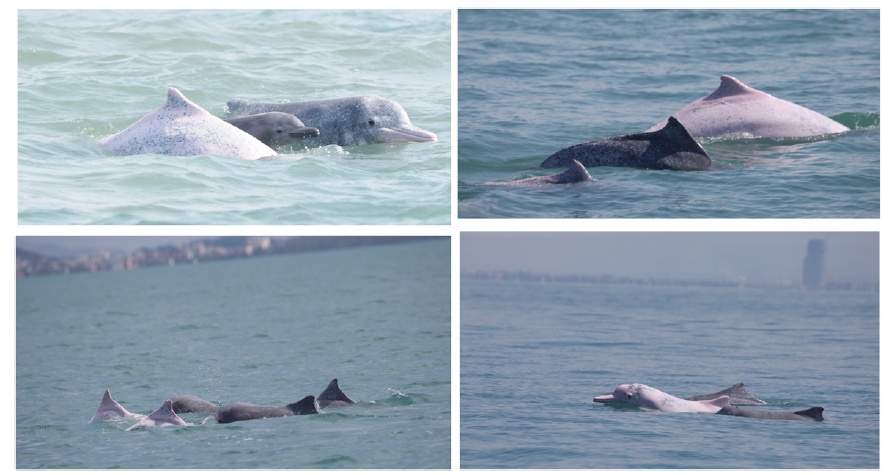
A boat survey has a closing time. Darkness and difficult sea conditions can end the opportunity to watch dolphins surface, even while the animals continue using the coast. For researchers studying Indo-Pacific humpback dolphins off southwestern Hainan, underwater recorders offered a way to extend that window.[1]
Machine learning made the accumulated recordings easier to search. Read together, the project’s 2016–2022 publications show a practical form of Chinese AI research: a classifier embedded in fieldwork, helping turn scattered encounters into a longer record of habitat use. The interesting change is how much of an animal’s world becomes available for examination.
The first instrument was a conversation
The Institute of Deep-sea Science and Engineering’s team began by asking people who already worked on the water. In late 2013, researchers interviewed 510 fishers at 16 ports and villages around Hainan. Their answers directed attention toward the island’s southwestern coast. Boat surveys followed in April 2014.[1]
The institute dates the team’s first sighting to October 20, 2014. Its 2016 account describes encounters during six of thirteen survey days that October–December, including adults and smaller grey young. The finding extended the species’ previously known distribution in Chinese waters roughly 300 kilometres southward.[2]
“Discovery” therefore needs a little care. Local encounters had supplied the lead; systematic observation gave that knowledge a place in the scientific record. The archival photograph accompanying this article belongs to that stage of the work, before the acoustic classifier entered the story.
This sequence matters for anyone judging the AI contribution. A model needs more than examples of a sound. Someone must decide where the microphones should go, which animal is plausibly present, and what question the resulting detections can answer.
Give the recordings a first reader
The April 2020 methods paper describes 19,215 five-minute recordings, about 4.2 terabytes, collected at six sites over 75 days in February–May 2018. The instruments recorded five minutes every half hour, sampling across day and night.[3]
A cubic support-vector machine classified pulses into five categories: humpback dolphins, finless porpoises, snapping shrimp, rain, and ship-related sounds. This was supervised classification using measured signal features. Across 51,238 labelled observations, random fivefold cross-validation produced 89.9% overall accuracy and a 96% true-positive rate for the humpback-dolphin class. Those figures describe different measures within that evaluation; neither establishes performance on every coastline.[3]
The computer’s selections then passed through filtering and expert inspection of spectrograms, which display how sound frequencies change over time. Human confirmation remained part of the process.[3]
My reading is that the useful unit of progress here is a recording worth examining. Automation gives researchers a way to search a large collection; review determines whether a selected sound can support an ecological observation. A promising score acquires meaning through that second step.
Hear the neighbourhood around the animal
A companion study published in PLOS ONE in August 2020 widened the acoustic picture. It analysed recordings gathered from February 2018 to February 2019 at ten sites along roughly 200 kilometres of coast. Its subject was the surrounding soundscape: fish calls, shrimp snaps, dolphin sounds, passing vessels, pile-driving, and explosions.[4]
The water had its own daily rhythm. Sound levels in bands centred on 0.5 and 1 kilohertz were higher at dusk and night at all but one site. These were measurements of ambient sound, not a finding that dolphins were more numerous after sunset. Shipping noise appeared frequently across the monitored locations.[4]
That distinction changes how to read an acoustic survey. A detector operates inside a changing environment. Comparing observations means attending to the listening conditions as well as the target sound. The companion paper explicitly left the effects of that complex environment on dolphin ecology as a question for further investigation.[4]
There is also a more basic limit: the classifier study did not derive animals’ distances or their abundance from its detections.[3] A succession of clicks cannot simply become a succession of individuals. The survey’s answer concerns acoustic presence, while a population estimate requires additional evidence and assumptions.
The work returns to the boat
The institute’s August 2022 account makes the maintenance visible. Researchers recovered equipment, downloaded data, recharged it, and redeployed it every two or three months. One of eleven stations was lost. These were recurring field operations supporting a monitoring programme.[1]
For China’s scientific AI, this case suggests a useful way to judge deployment: ask what observation becomes feasible, then follow it back through the people and equipment that made it possible. Here, the classifier fits between a microphone and an expert’s reading. Its contribution depends on both.
The evidence supports a richer survey, with access to hours a visual expedition could miss. Whether that knowledge produces effective protection remains a further question. The strongest achievement already visible is more concrete: researchers acquired a way to keep asking where dolphins were audible after the day’s watching had ended.
Sources
- Institute of Deep-sea Science and Engineering, Chinese Academy of Sciences, account of its integrated cetacean-monitoring strategy, August 2, 2022; Chinese-language primary source on fisher interviews, surveys, and equipment servicing.
- Institute of Deep-sea Science and Engineering, Chinese Academy of Sciences, first record of humpback dolphins southwest of Hainan, March 15, 2016; survey chronology and archival photograph.
- Francesco Caruso et al., “Monitoring of a Nearshore Small Dolphin Species Using Passive Acoustic Platforms and Supervised Machine Learning Techniques,” Frontiers in Marine Science, April 28, 2020; sampling, classifier validation, human review, and detection limits.
- Wanxue Xu et al., “Long-term and large-scale spatiotemporal patterns of soundscape in a tropical habitat of the Indo-Pacific humpback dolphin (Sousa chinensis),” PLOS ONE, August 12, 2020; coastal sound sources, temporal variation, and ecological limits.