As of 2026-05-31 UTC, Zhipu's most useful AI-China signal is not simply that GLM-5.1-HighSpeed claims a faster output rate. It is that the company is trying to make latency a first-class routing surface for agents. The official BigModel documentation frames the model as a high-speed version of GLM-5.1, optimized across the inference engine, scheduling system, and infrastructure, with a claimed output speed of 400 tokens/s and selective availability for enterprise customers on the BigModel platform.[1]
That last boundary matters. This is not a public, reproducible benchmark that every developer can validate by calling an open endpoint today. It is a vendor-side production claim tied to a gated enterprise API. The strong reading is therefore narrower and more interesting: Zhipu is saying that flagship capability and low latency should not live in separate product lanes. If that holds in real workloads, routing teams no longer choose only between "smart but slow" and "fast but shallow." They can start asking whether the fast path is good enough for coding agents, realtime interfaces, and tool-heavy loops that currently stall when a model pauses between steps.
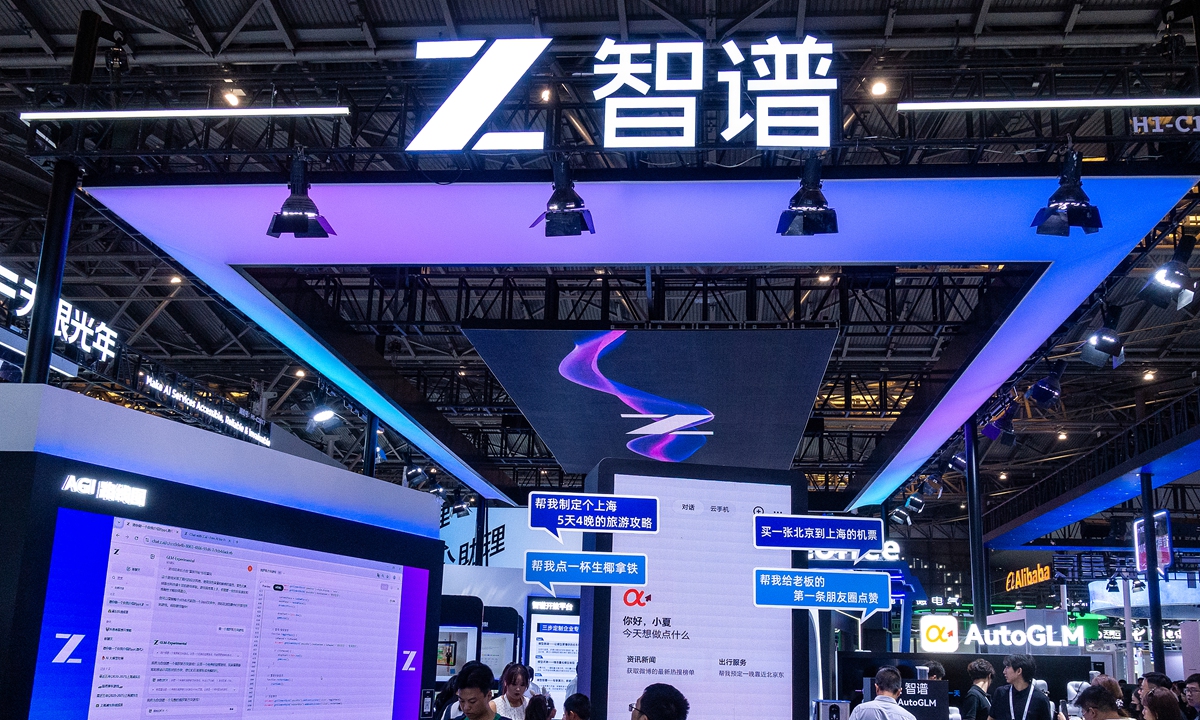
Image context: the cover uses a real Global Times photograph of Zhipu's booth at the 2025 World Artificial Intelligence Conference. It is a photographic event image, not a generated visual, chart, diagram, or generic AI illustration. The image is relevant because the article is about Zhipu's company-level platform strategy and product surface, not a synthetic model concept.[6]
What Changed
GLM-5.1-HighSpeed sits on top of a broader GLM-5.1 story. Z.ai's English developer documentation presents GLM-5.1 as a flagship foundation model for long-horizon work, with a 200K context length, 128K maximum output tokens, coding strength, tool use, and sustained autonomous task execution as core positioning points.[3] The high-speed variant keeps the same general direction but changes the operating question: how much agent work can fit inside a latency budget that still feels interactive?
The official Chinese page lists support for streaming output, function calling, context caching, structured JSON output, and MCP tool access.[1] Those are not decorative bullets. They are the surfaces where agent latency compounds. A coding assistant may need to plan, call a tool, inspect a file, rewrite a patch, run a test, and recover from an error. A realtime UI builder may need to update output repeatedly as the user nudges constraints. A voice assistant has even less tolerance for a slow decode path because speech synthesis and recognition already consume part of the turn-taking budget.
Zhipu and TileRT describe the high-speed API as a system-level effort rather than a model-card-only release. The BigModel page says the work spans the inference engine, scheduling, and underlying infrastructure; the TileRT technical blog argues that inference bottlenecks have shifted from total throughput alone toward end-to-end response speed, especially for agents, speech interaction, code completion, tool calls, and test-time scaling.[1][2] That is the field signal: the product is being sold as an execution stack, not just as one more checkpoint.
The Latency Claim Needs a Boundary
The 400 tokens/s number should be treated as a vendor claim with a clear evaluation boundary. The official page says it is intended to be stable production capability rather than a peak-only number, but the page does not provide a full third-party harness, request mix, hardware bill of materials, or public test endpoint for independent replication.[1] CnTechPost reported the launch on May 22, 2026, also noting that the API was available to selected enterprise customers and that Zhipu positioned it for latency-sensitive AI coding, realtime interaction, and business decision-making scenarios.[5]
That means the right conclusion is not "GLM-5.1-HighSpeed is now the fastest model in every workload." The right conclusion is that Zhipu is trying to move competition from a leaderboard screenshot into a service-level argument. For agent routing, the relevant measurements are not just average output speed. Teams need time to first token, tail latency, stream smoothness, rate-limit behavior, cache-hit behavior, tool-call reliability, context-window pressure, and quality under long multi-step work.
TileRT's blog is useful because it explains why the speed story is an infrastructure story. It argues that decode workloads expose fixed overheads that older throughput-first serving designs can hide: kernel-launch boundaries, synchronization, memory trips, communication pauses, and runtime scheduling gaps.[2] TileRT's answer is persistent execution, tile-level scheduling, warp and block specialization, and heterogeneous worker design for GLM-5.1 attention. Even if a reader treats the performance claims cautiously, the architectural direction is legible: Zhipu's model work is being coupled to compiler, runtime, and cluster behavior.
Why It Matters For AI-China
Chinese AI competition has already been crowded at the model-family layer: Qwen, DeepSeek, Kimi, GLM, MiniMax, ERNIE, Hunyuan, InternLM, and others keep shortening release cycles. The next durable advantage is likely to be less glamorous. It sits in whether a provider can make a strong model respond fast enough, cheaply enough, and predictably enough to sit inside daily work software.
Zhipu's pricing page adds another part of the signal. As of the current docs, GLM-5.1 is listed at $1.4 per million input tokens and $4.4 per million output tokens, with lower cached-input pricing.[4] Pricing alone does not decide routing, but it sets the frame. If a model is strong enough for coding and agents, and if the high-speed lane can shorten waiting time without sending costs out of range, Zhipu gains a practical wedge in workflows where latency has direct user-experience value.
That wedge is different from a pure benchmark win. A model that produces a better answer after a long wait can still be awkward in a collaborative coding loop. A model that is slightly less impressive in a single static test may win a product slot if it streams quickly, keeps tool loops moving, and lets the user stay oriented. In agent systems, latency changes behavior: faster intermediate steps make it feasible to attempt more rollouts, run more checks, ask for clarifications earlier, or keep multiple sub-agents active without making the interface feel broken.
The domestic-stack angle is also hard to separate from the product angle. Global Times reported earlier in 2026 that Zhipu had partnered with Huawei on GLM-Image and framed that release around Chinese chips, MindSpore, and Ascend Atlas hardware.[6] GLM-5.1-HighSpeed is not the same product, and the high-speed docs do not make the same hardware claim. But the pattern is consistent: Zhipu is trying to present itself not only as a model lab, but as a company that can align models with deployment infrastructure, enterprise customers, and China-specific stack constraints.
The Routing Implication
For builders, the immediate implication is not to swap everything to GLM-5.1-HighSpeed. Access is gated, the full benchmark envelope is not public, and a 400 tokens/s headline is not enough to judge quality, failure recovery, or tool-call correctness. The more useful implication is to treat latency as a separate routing dimension rather than an afterthought.
A practical routing table for agentic work now needs at least four lanes. One lane handles cheap background summarization. Another handles deep reasoning where waiting is acceptable. A third handles local or private-context work where data boundary dominates. The fourth handles interactive agent loops where delay compounds across many turns. Zhipu is explicitly targeting that fourth lane.[1][5]
That fourth lane changes what "best model" means. In a coding agent, a slow but brilliant model can still be useful for architectural review or final validation. During edit-test-debug loops, though, the model that keeps the pipeline moving may produce more total value even if a static benchmark says it is not the absolute strongest. The same logic applies to realtime dashboards, game generation, voice coaching, customer-service copilots, and multi-agent business analysis: once the user is waiting inside the loop, latency becomes part of capability.
What Would Confirm The Signal
The first confirmation would be broader access. If GLM-5.1-HighSpeed becomes available beyond selected enterprise customers, outside teams can measure whether the latency claim survives real prompts, long contexts, tool calls, and mixed traffic.[1]
The second confirmation would be third-party traces that report time to first token, output stability, tail latency, error rates, and task success against comparable models. The high-speed claim is promising only if speed does not quietly trade away reliability in the moments agents need it most.
The third confirmation would be product adoption inside coding plans, enterprise assistants, or realtime interaction tools where users can feel the difference. Z.ai already positions GLM-5.1 as a long-horizon coding and autonomous-agent model; the high-speed variant would matter most if it becomes the low-latency execution lane above that foundation.[3]
The narrow conclusion is that GLM-5.1-HighSpeed is a field signal about where China's AI competition is moving. Model releases still matter, but the next routing fight is increasingly about the infrastructure around a model: streaming, cache behavior, scheduling, tail latency, tool loops, pricing, and the ability to make an agent feel continuous rather than episodic. Zhipu's 400 tokens/s claim may or may not become broadly reproducible, but the product direction is already clear.[1][2][4]
Sources
- Zhipu BigModel docs, "GLM-5.1-HighSpeed" (official Chinese product documentation covering 400 tokens/s claim, selective enterprise access, context size, capabilities, scenarios, and API examples).
- TileRT Team, "Speed as the Next Scaling Law" (May 21, 2026; technical blog on TileRT, GLM-5.1 production practice, persistent execution, tile-level scheduling, and latency-first inference).
- Z.ai Developer Docs, "GLM-5.1" (official English model documentation covering positioning, context length, maximum output tokens, coding capability, and long-horizon autonomous task framing).
- Z.ai Developer Docs, "Pricing" (official model pricing table for GLM-5.1 input, cached input, and output tokens).
- CnTechPost, "Chinese AI startup Zhipu rolls out ultra-fast version of flagship model" (May 22, 2026; launch report, enterprise availability, speed claim, and use-case positioning).
- Global Times, "Zhipu AI open-sources advanced multimodal model trained on Huawei Ascend chips..." (Jan. 14, 2026; source page for the Zhipu WAIC booth photograph and context on Zhipu's domestic-stack positioning).