As of 2026-05-31 UTC, the useful way to read Alibaba's RTP-LLM paper is not as another "faster than vLLM" headline. The sharper AI-China signal is that Alibaba is making a production-bounded inference claim: it is saying the hard part of serving models is not one isolated kernel, but the whole route from model loading to request scheduling, prefill/decode separation, KV-cache reuse, multimodal processing, speculative decoding, quantized inference, and business-unit traffic.[1][2]
That matters because China's model race has already produced a crowded surface of strong checkpoints: Qwen, DeepSeek, Kimi, GLM, MiniMax, ERNIE, Hunyuan, InternLM, MiniCPM, and more. The next constraint is not only whether a model can score well in a public table. It is whether a provider can keep many model families cheap, responsive, and stable when real users arrive in bursts, ask multi-turn questions, attach images, trigger reasoning paths, and expect latency that feels ordinary rather than experimental.
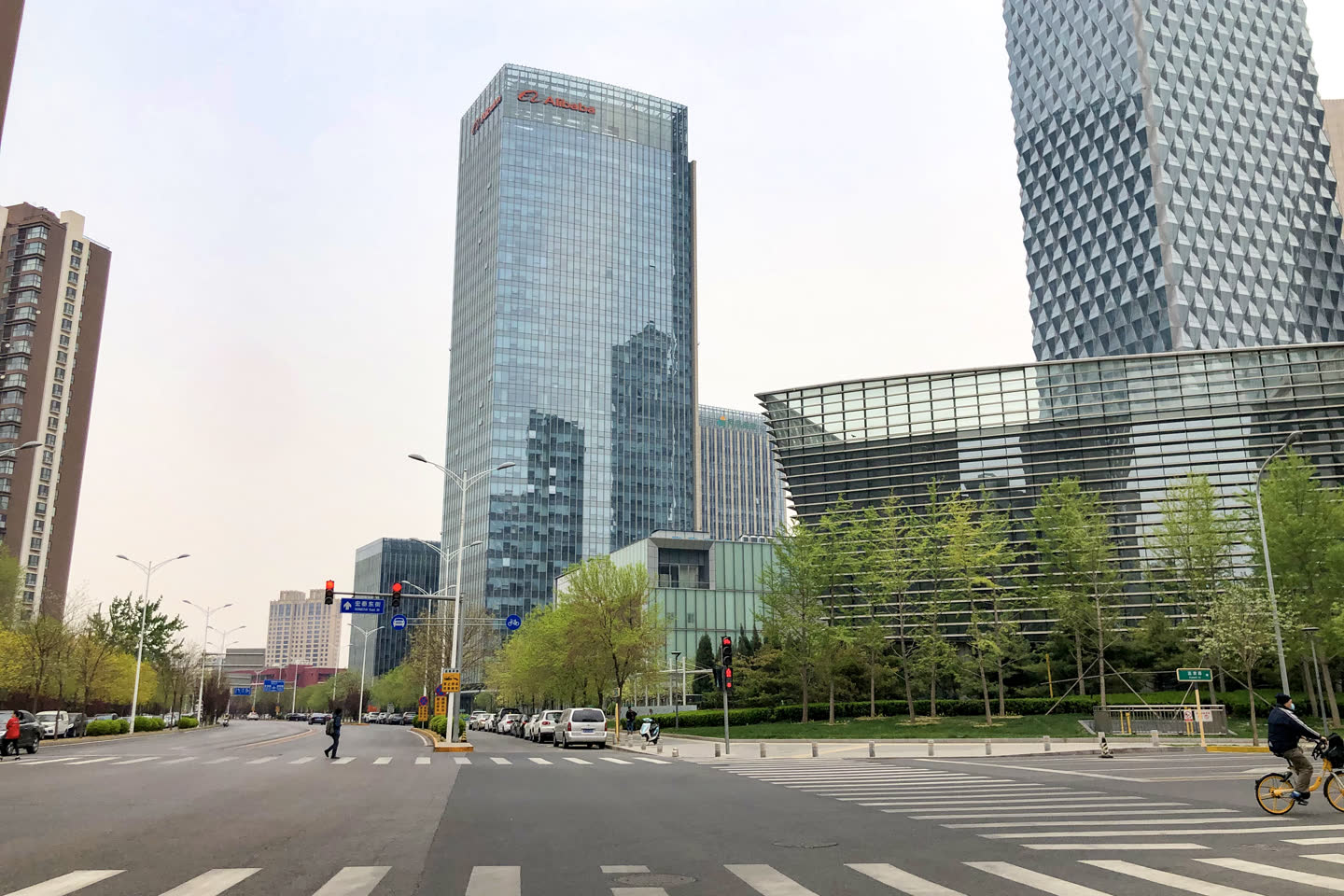
Image context: the cover uses a real Wikimedia Commons photograph of Alibaba Group's Beijing headquarters at Greenland Center in Wangjing. It is a photographic image, not a generated visual, diagram, chart, or synthetic AI metaphor. The image fits because RTP-LLM is evaluated as Alibaba production infrastructure, not as a purely academic prototype.[6]
The benchmark boundary is unusually explicit
The paper, submitted to arXiv on 2026-05-28, states the core boundary plainly: RTP-LLM has been deployed across Alibaba Group and serves over 100 million users.[1] That number should not be read as a neutral market-share statistic. It is a scope marker. Alibaba is asking readers to judge the system as infrastructure that has touched broad internal demand, not only as a lab framework with synthetic throughput curves.
The evaluation scope is also broader than a single number. The paper says it tests model architectures from 8B to 235B parameters using both controlled benchmarks and real production workloads.[1] That matters because inference systems fail in different places depending on model size, workload composition, cache behavior, modality, and traffic shape. A small dense chat model can make a serving stack look clean. A larger MoE model, a multimodal request, or a reasoning-heavy session can expose different bottlenecks.
Alibaba's reported deltas are large enough to be interesting, but they need to stay attached to their setup. The paper reports 4.7x to 6.3x faster model loading, 35% to 37% lower P95 time-to-first-token in production traffic scheduling, a 215% cache-reuse improvement, 1.12x to 2.48x speculative-decoding throughput gains, 1.86x to 2.52x multimodal inference throughput gains, and 35% to 40% lower batch latency with 1.9x to 3.0x better TTFT in quantized inference.[1] Those are not universal guarantees for every deployment. They are Alibaba's published results under the paper's benchmark and production-trace boundaries.
That boundary discipline is the most useful part of the release. In AI-China, benchmark claims often get flattened into a rank order: fastest, cheapest, longest context, strongest reasoning, best multimodal demo. RTP-LLM is more valuable when read as a set of evaluation questions. What does loading cost when models change? What happens when prefill and decode need different hardware behavior? How much repeated context can be reused? Does speculative decoding still help when traffic is messy? Does multimodal serving preserve throughput instead of quietly becoming the expensive side lane?
The architecture is about traffic, not elegance
RTP-LLM's public repository describes it as Alibaba's high-performance LLM inference engine and says it is widely used across Alibaba business units including Taobao, Tmall, Idlefish, Cainiao, Amap, Ele.me, AliExpress, and Lazada.[2] That list is important because these surfaces do not represent one clean workload. Search rewriting, shopping assistance, maps, logistics, food delivery, international commerce, and customer support all push different shapes of input, output, latency sensitivity, and availability expectations.
The feature list follows from that pressure. The repository names PagedAttention, FlashAttention, FlashDecoding, weight-only INT8 quantization, INT4 quantization through GPTQ and AWQ, adaptive KV-cache quantization, dynamic-batching optimization, V100-specific optimization, Hugging Face weight-format support, multi-LoRA serving from a single model instance, multimodal inputs, multi-machine and multi-GPU tensor parallelism, contextual prefix cache, system prompt cache, and speculative decoding.[2]
That is a lot of machinery, but the theme is consistent: RTP-LLM is trying to keep the serving layer from becoming a pile of one-off exceptions. A large company does not only need a fast path for the current flagship model. It needs a way to absorb model churn, model-size differences, adapter usage, multimodal traffic, old GPU fleets, cache reuse, and business-specific prompts without rebuilding the serving platform each time.
The prefill/decode split is the clearest example. In a transformer service, prefill is compute-heavy because the system processes the whole prompt context, while decode is memory-bandwidth-sensitive because it generates tokens step by step. The RTP-LLM paper says its Prefill-Decode Disaggregation architecture decouples those phases and combines them with hierarchical multi-tier KV-cache management.[1] The strategic point is not only lower latency. It is resource matching. If China-linked providers face constrained access to top-end accelerators, they have strong incentives to squeeze more useful work from the fleet they already have.
Production traces change what "fast" means
The companion context from Alibaba's ServeGen project explains why production-bounded serving is hard to fake. ServeGen says it is powered by analysis of billions of inference requests across 12 production models on Alibaba Cloud Model Studio, covering bursty request arrivals, shifting input and output length distributions, multimodal Qwen-VL workloads, and bimodal reasoning-length behavior in DeepSeek-R1 workloads.[4] The related arXiv paper says the framework avoids 50% under-provisioning compared with naive workload generation in a production use case.[3]
That should change how readers evaluate RTP-LLM. If the workload model is too smooth, a serving engine can be optimized for a world that does not exist. Real LLM traffic has uneven arrivals, long and short prompts, repeated system context, multi-turn sessions, image payloads, reasoning traces, and enterprise users whose requests may cluster around office rhythms or business events. In that environment, "throughput" by itself is not enough. The useful measurement is whether throughput, tail latency, cache reuse, memory pressure, and deployment recoverability hold together.
This is why the cache-reuse claim matters more than it first appears. A 215% improvement in cache reuse under production traffic scheduling is not just a speed claim.[1] It is a claim about recognizing repeated context and routing requests so the serving system does less redundant work. For shopping, maps, customer service, logistics, and enterprise assistant surfaces, many requests share long system prompts, tool instructions, user histories, or similar document contexts. Cache reuse turns that repetition into infrastructure leverage.
There is a boundary here too. Cache reuse can improve economics only when the product surface, privacy model, routing policy, and invalidation rules make reuse safe. A provider cannot blindly share context across users or tasks. Alibaba's paper gives a performance result; operators still need to ask which context is reusable, how long it lives, how it is isolated, and what happens when a prompt template changes.
Why this is an AI-China signal
RTP-LLM belongs in AI-China coverage because it shows Alibaba competing below the visible model card. Qwen remains the model brand most readers notice. ModelScope, ms-swift, MNN, ACK deployment guides, and RTP-LLM point to a different ambition: Alibaba wants to own the operating lane around the model, from model distribution and post-training to local or cloud inference and Kubernetes deployment.[2][5]
The Alibaba Cloud ACK documentation makes that lane concrete. Its RTP-LLM deployment guide walks through serving Qwen1.5-4B-Chat with a custom inference service, a mounted model PVC, readiness probes, RESTful port 8000, one replica, and either a single A10 or T4 GPU image path.[5] The example is old compared with the 2026 paper, but that is part of the point. RTP-LLM has not appeared only as a fresh arXiv artifact. It has had a cloud deployment surface that turns an inference engine into something a platform team can run.
For Chinese AI vendors, that stack depth is increasingly strategic. Open weights make model access broader, but production inference remains expensive and operationally unforgiving. If a cloud or platform company can lower loading time, improve TTFT, reuse cache safely, serve multimodal requests efficiently, and keep quantized paths acceptable, then it can turn model velocity into usable product velocity. The visible release cadence matters less if the serving layer cannot keep up.
The comparison with vLLM and SGLang should be read carefully. vLLM's own documentation shows a broad production-grade feature surface: online serving, OpenAI-compatible APIs, disaggregated serving, automatic prefix caching, speculative decoding, multimodal inputs, quantization, tool calling, observability, Kubernetes deployment, and many integrations.[7] RTP-LLM is not competing against a static baseline. It is entering a fast-moving serving-framework field where the right conclusion depends on workload, hardware, model family, and operational maturity.
That is why the strongest reading is not "Alibaba has solved inference." The stronger reading is narrower: Alibaba is publishing a production-shaped benchmark envelope for the serving layer, and that envelope is exactly where China's AI competition is moving. Model quality still matters, but the economic question is increasingly whether a provider can serve many models, many modalities, many users, and many business surfaces without letting latency and GPU cost swallow the product.
What would confirm it
The first confirmation would be reproducible operator evidence outside Alibaba's own paper. If third-party users can reproduce the same direction of gains on their models, hardware, and traffic, RTP-LLM becomes more than an internal optimization story.[1][2]
The second confirmation would be clearer public deployment recipes for current Qwen, DeepSeek, Kimi, GLM, and multimodal families, not only older Qwen1.5 examples.[2][5] Production relevance depends on keeping pace with the model ecosystem.
The third confirmation would be stronger observability around tail latency, cache isolation, failure recovery, and mixed-workload scheduling. These are the places where serving systems become trustworthy or painful. Throughput gains are attractive; operational predictability is what lets teams route revenue-bearing traffic through the stack.
The narrow conclusion is that RTP-LLM matters because it makes Alibaba's inference argument auditable at the right layer. The paper's numbers are interesting, but the bigger signal is the test shape: production workloads, many model sizes, cache reuse, multimodal serving, quantized inference, and Alibaba's own business traffic. In AI-China, that is where the next serious competition sits - not only who releases the next model, but who can make the model cheap and fast enough to live inside real products.[1][2][3][4]
Sources
- Tan et al., "RTP-LLM: High-Performance Alibaba LLM Inference Engine," arXiv:2605.29639 (submitted May 28, 2026; architecture, production deployment claim, benchmark boundary, and reported performance deltas).
- Alibaba,
alibaba/rtp-llmGitHub repository README (project description, Alibaba business-unit usage, release notes, features, model-serving capabilities, and Apache-2.0 source distribution). - Xiang et al., "ServeGen: Workload Characterization and Generation of Large Language Model Serving in Production," arXiv:2505.09999 (revised May 11, 2026; production workload characterization and under-provisioning result).
- Alibaba,
alibaba/ServeGenGitHub repository README (billions of inference requests across 12 Alibaba Cloud Model Studio production models, bursty arrivals, multimodal and reasoning workload categories). - Alibaba Cloud, "Use rtp-llm to deploy Qwen inference services in ACK" (official Kubernetes deployment guide with Qwen1.5-4B-Chat, GPU, readiness probe, image, PVC, and REST serving details).
- Wikimedia Commons, "File:Alibaba Group Beijing headquarters at Greenland Center, Wangjing (20210410104117).jpg" by N509FZ (source page for the real photographic article image).
- vLLM project documentation (current serving-framework feature surface including online serving, disaggregated serving, prefix caching, speculative decoding, multimodal inputs, quantization, tool calling, and deployment topics).