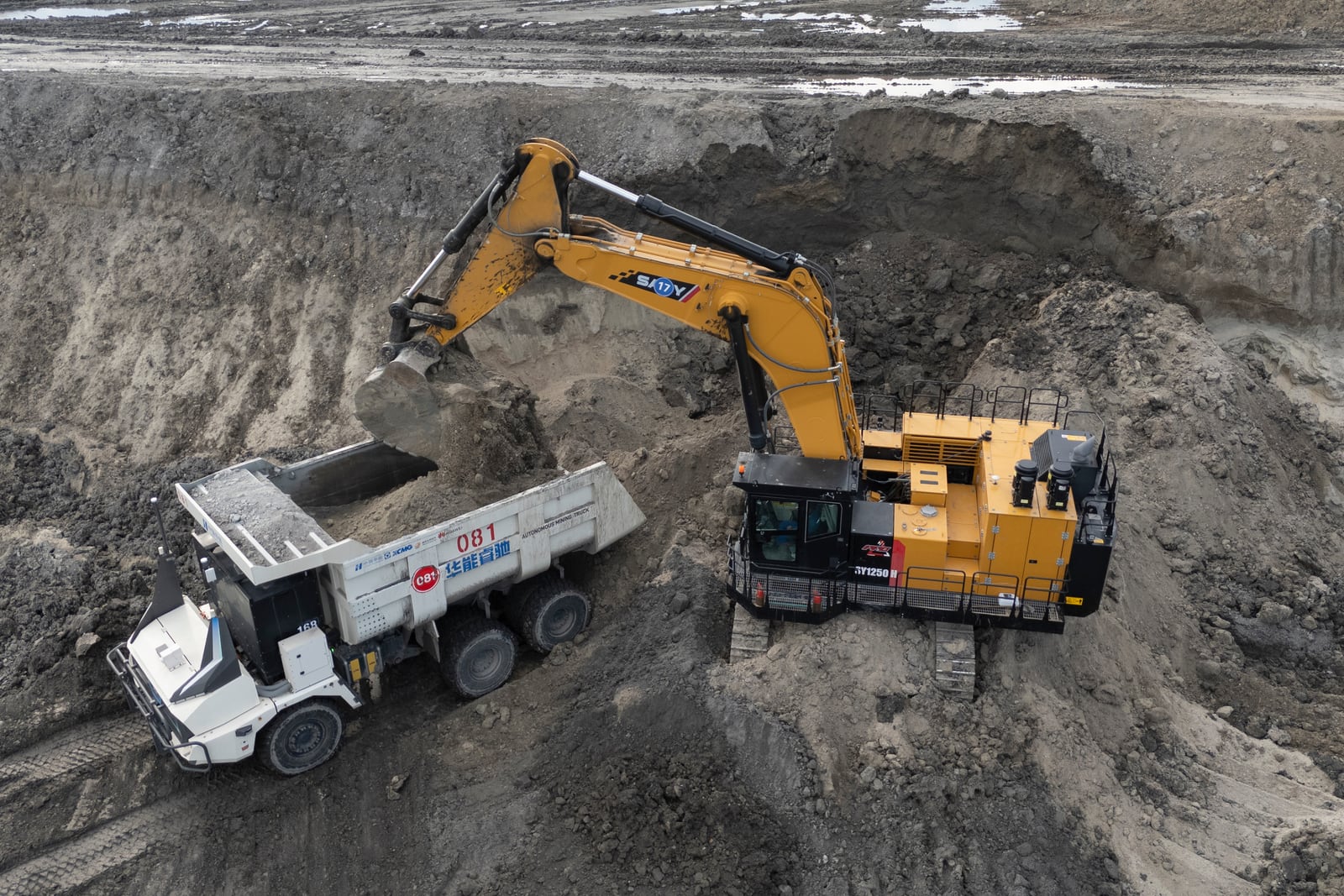
The most conspicuous thing about haul truck 081 is the driver's cab it was designed without.[1][4] In an Associated Press photograph from Huaneng's Yimin open-pit coal mine, a yellow excavator hangs a full bucket over the truck's white bed.[8] The missing cab makes the machine look futuristic; the bucket poised above it reveals the harder problem. A truck can steer itself and still leave the mine waiting if it cannot arrive beneath the shovel at the right angle, join the right queue, take the right newly cut road, find a charged battery, and yield when any part of that chain becomes uncertain.[3][4]
Yimin put 100 purpose-built, all-electric autonomous trucks into grouped operation on May 15, 2025. Project partner Huawei called it the first 100-vehicle fleet of its kind and described each truck as carrying 90 tonnes without a driver's cab.[1][4] In a May 2026 update, Huaneng said the fleet had operated stably for more than 350 days and accumulated over 3.6 million kilometres of “safe” travel.[5] Those are operator-supplied claims, not an independent safety audit. They are nevertheless enough to move the useful question beyond whether one prototype can follow a route.
At 100-truck scale, the product is no longer a self-driving truck. It is a continuously revised model of the mine.
The road is a temporary answer
Urban autonomy starts with a road that is expected to persist. At an active face or dump, a route can disappear because the work itself reshapes the ground. Excavation changes the loading face; dumping moves an edge outward; rain softens a lane; repeated tyres cut ruts; blasting, grading, and rockfall alter what is driveable. The route from shovel to dump is an operational decision written into moving ground.
Huaneng's technical lecture says the Yimin system uses vehicles to crowdsource road data, capture imagery within seconds, and update maps of changing work areas at minute scale.[4] That claim becomes more intelligible beside a 2024 peer-reviewed paper about YuGong, an earlier autonomous-mining system tested over the long term at Yimin. The research system scanned and updated a three-dimensional high-definition map, then combined its point cloud, elevation, and vector layers with perception, planning, and control. The paper identifies dynamic mapping as a response to frequently changing work areas, not as a cosmetic navigation feature.[3]
The paper did not evaluate the later fleet of 100 electric trucks: its long-term Yimin test used five much larger haul trucks, one electric shovel, and a bulldozer.[3] It should therefore be read as evidence about the site's system architecture and operating problem, not as independent confirmation of the 2025 fleet's performance claims.
That distinction matters because “minute-level” is not, by itself, a safety guarantee. A useful map-freshness measure would start when terrain becomes materially different, not when a server completes an update. It would ask how quickly the change is detected, reviewed or trusted, distributed to every affected truck, and reflected in a new route—and what trucks do during the gap. A map that is one minute old may be excellent on a graded haul road and dangerously stale at an active dump edge.
The shovel sets the clock
The cover photograph captures an industrial handshake. The excavator's bucket establishes where a truck must stop. The truck's arrival determines whether the excavator keeps producing or idles with its next load. Accuracy is measured not only in centimetres but in the seconds lost across every cycle.
YuGong's cooperative-loading design tracks the excavator bucket from a localization unit on the boom. The truck reverses to a loading point derived from that position. Once the loaded truck leaves, a vehicle-to-everything link tells the excavator to wait and calls the next truck forward. The same research describes dispatch creating collision-free paths for merging fleets and an anti-rutting function spreading wheel tracks instead of repeatedly damaging one line of road.[3]
Unloading tightens the coupling. The edge changes as material accumulates, the ground can be soft, and a positioning error can become a rollover. In the research architecture, vehicle sensors are supplemented by roadside cameras and lidar; a virtual mine can predict a dangerous future trajectory; the physical truck can be stopped or handed to a remote operator.[3] None of those protections lives entirely inside the truck.
This is why the decisive unit of productivity is the cycle: queue, reverse, load, travel loaded, position at the dump, unload, return, and sometimes swap a battery. A faster autonomous-driving model can lower total output if it sends too many trucks to one shovel, starves another, damages a lane, or reaches the swap station in a wave. Fleet intelligence is the art of preventing locally sensible movements from composing into a traffic jam.
One hundred trucks turn coverage into a control surface
Yimin's path to scale was incremental. Huawei's account dates retrofitted-diesel trials to 2020, autonomous open-pit operation after sitewide 5G coverage to 2022, and a nine-truck electric phase that moved 1.3 million cubic metres before the 100-truck launch.[2] Huawei says early autonomous operation reached 87 percent of human-driver efficiency and rose to 120 percent by 2024.[2] Those comparisons come from a network vendor and project partner; the account does not publish the denominator, duty-cycle controls, intervention rate, or confidence intervals needed to reproduce them.
The network is still part of the use case. Huawei reports 5G-Advanced zones of roughly 500–600 metres, up to 500 Mbps uplink, and 20-millisecond latency for high-resolution video, remote control, and coordination.[2] Those are infrastructure specifications, not an end-to-end guarantee. A safety case would also disclose dead zones after the mine face moves, handover failures, latency tails rather than averages, packet loss in bad weather, and how many vehicles enter a minimal-risk state when the control path degrades.
Scale has exposed more prosaic work. In a December 2025 technical lecture hosted by China's National Mine Safety Administration, Yimin personnel described analysing more than 2,500 fault codes, making over 60 technical modifications, validating more than 20 operating schemes, and completing more than 50 rounds of tuning. They reported equipment availability above 90 percent and 20–21 effective operating hours a day.[4] These remain operator-reported figures, but they show what a polished fleet video hides: autonomy becomes production only after faults have owners, spares have schedules, software releases have acceptance criteria, and a mine has procedures for abnormal states.
Xinhua's August 2026 report adds a newer version of the same lesson. It says the mine participated in 15 cloud-system upgrades and pushed resolution of more than 70 issues, including different excavator-label configurations for coal and overburden loading.[6] The AI story is partly a configuration-management story. “Excavator” is not one stable object if its role, attachment, work face, or expected truck position changes the correct behaviour.
The battery station belongs inside the route
The trucks replace the driver's compartment with large lithium-iron-phosphate battery packs.[4] Huaneng's technical lecture gives two operating measures: nominal range of about 60 kilometres in the mine's conditions and automated swapping in under six minutes.[4] A dispatcher does not merely assign destinations. It schedules state of charge, travel distance, queue time, battery temperature, station capacity, and the production cost of taking a truck out of its haul cycle.
The mine operates in severe cold; project sources cite operation at −40°C and perception through snow, dust, and low visibility.[1][6] Extreme weather should make the missing denominator impossible to ignore. Average swap time is less informative than the 95th percentile during the coldest shift. Nominal range matters less than loaded range on grade after a battery has aged. Equipment availability should say whether the constraint was a truck, battery, robotic swapper, network link, shovel, or road.
Project accounts say photovoltaic electricity at the dump area powers the trucks and describe the transport stage as zero-carbon, with the fleet replacing 15,000 tonnes of diesel and avoiding 48,000 tonnes of carbon dioxide each year.[4][6] That is a bounded operational claim, not a life-cycle assessment. It does not include vehicle and battery production, grid power when solar is unavailable, or the emissions from burning the coal the mine exists to produce. Electrifying haulage can reduce diesel use and local exposure without turning a coal mine into a zero-carbon system.
Cabless is not humanless
The driver's seat has moved and multiplied. Xinhua describes a former loader driver dispatching the fleet from a control centre, while a smaller team watches vehicle tracks, work states, and commands.[6] The YuGong research architecture explicitly provides manual intervention if driving and cooperative-operation modules fail, plus remote takeover when a predicted trajectory risks overturning.[3] The mine's own lecture lists dedicated operations, maintenance, management, and technical teams alongside new procedures.[4]
Removing people from a truck cab can reduce exposure to dust, cold, fatigue, and heavy-equipment interactions. It also concentrates responsibility in less visible places: the map service that marks a berm, the technician accepting a software version, the dispatcher authorizing a new work area, the maintainer deciding a sensor is clean enough, and the remote operator seeing a scene through a delayed or occluded feed.
China's formal safety contract for this class of system is still being written. As of August 29, 2026, the national standards platform lists the mandatory standard plan 20256239-Q-627, “Safety technical requirements for autonomous haulage systems in open-pit mines,” at the public-comment stage. The 18-month project is organized by the National Mine Safety Administration and is intended to take effect 12 months after eventual publication.[7] Deployment has therefore reached fleet scale before the planned national mandatory standard has reached its final text.
That is not proof that Yimin is unsafe. It is a reason to separate a production milestone from a complete, portable safety case. A mine operator knows its own roads and exceptions; a national standard must define what another site, vendor, regulator, and worker can demand before trusting the system.
The next milestone is an inspectable operating ledger
The strongest public evidence would connect output to the exceptions that produced it. For every 1,000 vehicle-hours: how many hard stops, remote takeovers, false obstacle detections, missed objects, network-loss events, map rollbacks, and work-area closures occurred? How long did shovels wait for trucks, trucks wait for shovels, and both wait for batteries? How did those rates change by snowfall, dust, darkness, grade, payload, map age, and software version?
The same ledger should distinguish safe kilometres from kilometres without a reported collision. It should record near misses, boundary incursions, contact with berms, emergency braking, and cases in which a human intervened before an event. It should publish the fleet's availability denominator and show whether planned downtime has been excluded. Independent review could then test whether higher throughput came from better coordination, more operating hours, a changed route, different weather, or a more permissive threshold.
Yimin is already a useful case because it makes the system boundary visible. The truck must perceive and steer, but the mine must tell it what the road has become. The shovel must expose its bucket position. Roadside sensors must cover blind spots. Dispatch must compose 100 routes. The swap station must behave like part of the timetable. People must maintain the fleet and take responsibility at the edges.
The cab is absent because the intelligence is elsewhere—distributed across machines, maps, radios, batteries, procedures, and a control room. The mine does not become autonomous when a truck learns to drive. It becomes autonomous only for as long as that whole changing arrangement can keep redrawing a safe road before the next truck reaches it.
Sources
- Huawei, “World's First Fleet of 100 5G-A Autonomous Electric Mining Trucks Launched at Yimin Mine” (May 15, 2025; official project-partner launch account, fleet size, payload, cabless design, crowdsourced operational mapping, cold-weather operation, and network specifications).
- Huawei, “North China's Yimin Mine deploys world's first fleet of 100 5G-A connected, self-driving electric trucks” (June 2025; project chronology, network specifications, battery system, and vendor-reported efficiency).
- Long Chen et al., “Autonomous mining through cooperative driving and operations enabled by parallel intelligence,” Communications Engineering 3, 75 (May 31, 2024; peer-reviewed Yimin field study of dynamic mapping, cooperative loading, roadside perception, simulation, and intervention architecture).
- Shu Yingqiu / Huaneng Yimin Coal and Power, “无人电动矿卡在伊敏露天矿的成功研发与应用” (“Successful R&D and Application of Driverless Electric Mining Trucks at Yimin Open-pit Mine”; technical lecture hosted by the National Mine Safety Administration, December 2025; operations, maintenance, mapping, battery swapping, weather, and production figures; PDF in Chinese).
- China Huaneng, “Huaneng Ruichi coal and rock transport total exceeds 20 million” (May 12, 2026; first-hand operating update and cumulative driving distance; in Chinese).
- Xinhua, “The hard-tech character of Huaneng Ruichi” (August 11, 2026; Chinese field account and operator-supplied system updates, dispatch workflow, battery specification, and emissions claims).
- National Public Service Platform for Standards Information, “Safety technical requirements for autonomous haulage systems in open-pit mines,” plan 20256239-Q-627 (current project status, mandatory classification, drafting authority, and proposed timing; accessed August 29, 2026).
- Associated Press, “Open-pit coal mining in China in photos” (September 17, 2025; independent photographic record of Yimin Mine, including autonomous truck 081 being loaded; photograph by Ng Han Guan).