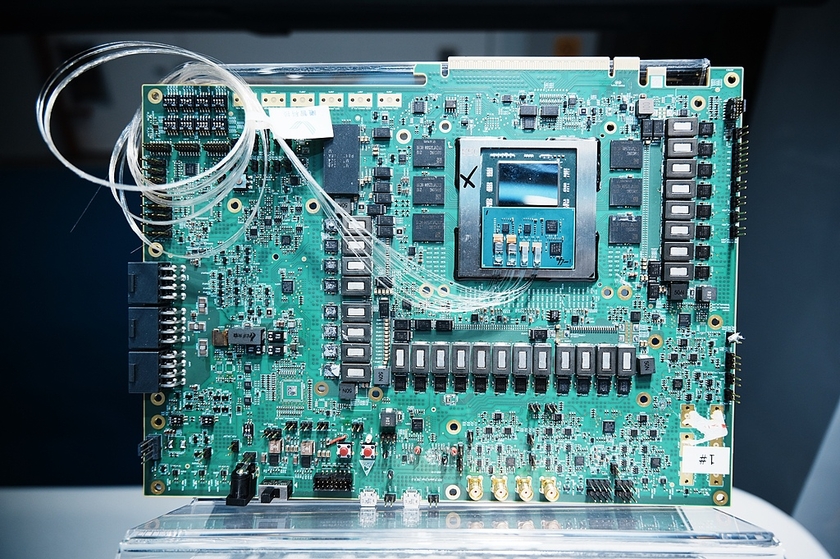
The cover photograph turns an infrastructure thesis into an object. Clear fibers loop over a green circuit board; an exposed processor sits near the center; nothing is hidden behind the smooth shell of a finished server. Lightelligence displayed the co-packaged-optics prototype at a Hangzhou exhibition on April 23, 2026. Five days later, the Shanghai company listed in Hong Kong as 01879.HK.[5]
The timing is useful. A stock-market debut forced Lightelligence to describe its business with more precision than a laboratory demonstration or product launch normally requires. The resulting prospectus separates two jobs that are often compressed into the phrase photonic computing. In one, photons perform part of the calculation. In the other, photons move data among electronic processors. Both start from silicon photonics. They have reached very different stages of commercial proof.[1]
As of August 30, 2026, the clearest reading is not that Lightelligence has already replaced electronic computing with light. Its own filing says the opposite: the optical-compute cards are intended to sit beside GPUs and offload selected linear operations. The stronger company story is that Lightelligence's interconnect products have found the nearer market, while its compute products still carry the more striking scientific result.[1][3]
One company, two jobs for light
Lightelligence's optical-compute line begins with matrix multiplication. A photonic integrated circuit encodes values into light, performs a linear operation through an optical network, and hands control and other work back to electronics. That division is important. Neural networks contain plenty of matrix multiplication, but they also require memory access, nonlinear functions, control flow, data conversion, and software orchestration. The useful question is therefore not whether light can calculate. It is how much of a real workload can be moved into the optical core without the surrounding system erasing the advantage.[1][3][4]
The interconnect line solves a different problem. GPUs remain electronic, but optical links replace some short-reach electrical paths as devices are joined within a server, across racks, or into a larger cluster. The prospectus distinguishes scale-up connections, which make many accelerators behave like a tightly coupled unit, from scale-out links among nodes. Here, light is not being asked to execute the model. It is being asked to keep model data moving as the cluster grows.[1]
That distinction explains why the two businesses need different evidence. A compute card has to preserve accuracy, expose useful operators, fit a software stack, and beat a full-system baseline on a named workload. An interconnect product has to survive qualification with chip and server makers, sustain bandwidth and latency under production traffic, and ship reliably at cluster scale. Shared physics does not make those sales cycles interchangeable.
Revenue arrived through the links
Lightelligence's three-year revenue trail shows the handoff. In 2023, it recorded RMB38.2 million of revenue, all under optical computing, but RMB33.6 million of that came from technology-development services and related work rather than product sales. In 2024, optical-interconnect product sales appeared at RMB47.0 million and supplied 78.1% of total revenue. In 2025, interconnect revenue rose to RMB84.3 million, or 79.2% of a RMB106.4 million total. Optical computing contributed RMB22.1 million, including RMB20.2 million from product sales.[1]
This is the dossier's central delta. Lightelligence began with the harder, more theatrical proposition—put an optical matrix engine to work on computation. Its first material hardware business emerged in the less glamorous space between processors. The company says its interconnect solutions have been deployed in three clusters containing thousands of GPUs and that it has entered more than fifteen design-in collaborations with GPU and server manufacturers. Those are company disclosures, not named-customer case studies, but they describe a recognizable qualification path rather than a collection of research demos.[1]
The commercial base is still small and concentrated. Lightelligence reported 44 cumulative revenue-generating customers by the end of 2025. Its top five customers supplied 78.9% of that year's revenue, and the largest supplied 40.6%. Gross margin was 39.0%, down from 60.7% in 2023, while research and development expense reached RMB479.0 million. The filing's adjusted net loss was RMB271.5 million.[1]
Those figures do not negate the revenue growth. They define its boundary. A few large design wins can make an emerging component business grow quickly before they prove broad demand, renewal, pricing power, or a diversified customer base. For Lightelligence, commercialization is no longer hypothetical; durable commercialization remains unproven.
PACE is real—and narrower than its headline
The compute side has a different kind of receipt. In April 2025, Nature published Lightelligence's experimental results for PACE, a hybrid system built around a 64 × 64 optical matrix-vector core with more than 16,000 photonic components. The photonic and electronic chips were integrated in one package, with electronics handling control and iterative logic around the optical multiply-accumulate operation.[3]
The paper tested a heuristic recurrent algorithm on Ising and graph-optimization problems. In one comparison, the authors reported a configured 5-nanosecond PACE cycle and 2.7 microseconds of total solution time, versus 798.1 microseconds on an Nvidia A10 GPU running the same algorithm. The comparison was not a simple equal-work clock race: PACE averaged 537 iterations to solution and the GPU 347, while the systems implemented the recurrence differently. The paper's achievement is still substantial. It demonstrates a large, packaged photonic core doing useful iterative work at very low latency. It does not demonstrate that a complete language model, vision pipeline, or arbitrary tensor program runs hundreds of times faster.[3]
That boundary matches the wider literature. A 2024 review of optical neural networks describes hybrid optoelectronic systems as a practical direction precisely because optical networks still depend on electronic hardware for broader inference tasks and because programmability, universality, conversion, and system integration remain constraints. The review cites PACE as an important integrated platform, not as evidence that optical processors have made electronic accelerators obsolete.[4]
The most responsible reading is therefore neither dismissal nor extrapolation. PACE answers a hard technical question: can a densely integrated photonic matrix engine be packaged with electronics and complete a defined optimization workload? Yes. It leaves the product question open: which recurring workloads benefit after inputs, outputs, memory, nonlinear operations, software, and error tolerance are counted?
PACE 2 is more product-shaped than benchmark-shaped
PACE 2, released in 2025, moves closer to a conventional accelerator card. Lightelligence's Chinese product page specifies a 128 × 128 configurable optical matrix, more than 40,000 photonic devices, a PCIe Gen4 ×16 interface, 8-bit optical output, and separate peak figures of 32 TOPS for the photonic and electronic cores. It also says users can configure matrix coefficients through APIs.[2]
These are integration and programmability claims, not an end-to-end evaluation. The page names image analysis, industrial inspection, financial engineering, biomedicine, and scientific computing as application areas, but it does not publish a model, dataset, batch size, accuracy target, wall-clock runtime, whole-card power measurement, or electronic baseline for those scenarios. The prospectus is candid about the gap: optical-compute customers are still mainly early adopters conducting research, validation, and pilot projects, while pilot areas such as financial technology, materials, and visual inspection had not generated material revenue.[1][2]
It would also be a mistake to splice the generations together. The Nature result belongs to the 64 × 64 PACE research system and its stated optimization setup. The 128 × 128 PACE 2 page describes a newer card and a wider intended application surface. Until Lightelligence publishes comparable workload-level evidence for PACE 2, the older paper cannot serve as a benchmark for the newer product.[2][3]
The portfolio is coherent; the moat is not yet proved
Ahead of the March 2026 Optical Fiber Communication Conference, Lightelligence said it would showcase PACE 2 alongside a distributed optical-circuit-switch module, Photowave hardware for disaggregated memory over PCIe/CXL, and near-packaged-optics products. The announced lineup makes the strategy legible. Photonics can sit inside a compute card, between a processor and memory, or across the fabric joining accelerators.[6]
There is a plausible technical flywheel here. Photonic-device design, electronic control, packaging, calibration, manufacturing relationships, and customer qualification can support more than one product family. There is also a plausible commercial flywheel: an interconnect design-in can put Lightelligence near the same server and accelerator makers that might later evaluate an optical compute card. Those are implications of the portfolio, not disclosed outcomes. The prospectus does not show whether the same customer adopts both lines or whether interconnect revenue reduces the cost of bringing compute products to market.[1][6]
The next proof should arrive at two different scales. For interconnect, it is repeat orders, lower customer concentration, production reliability, and margins that hold as shipments grow. For optical compute, it is a named, reproducible workload with accuracy, latency, throughput, power, host-system overhead, and a fair accelerator baseline—followed by a customer returning for more than a pilot.
The falsifier is equally clear. If interconnect remains a concentrated component business while PACE remains a sequence of university and enterprise trials, Lightelligence will own two adjacent photonics businesses rather than one compounding platform. If the interconnect line keeps earning design-ins and PACE 2 or PACE 3 wins repeat production workloads under inspectable system-level tests, the shared technology base will look less like a corporate narrative and more like an operating advantage.
Lightelligence's story is compelling because the public evidence resists the easiest slogan. Light can already do the math. The peer-reviewed result proves that within a carefully bounded system. The business, for now, is being built where data has to move.
Sources
- Lightelligence, Global Offering Prospectus (Hong Kong Stock Exchange, April 20, 2026) — product architecture, commercialization stage, segment revenue, customers, concentration, margins, R&D, and adjusted-loss disclosures.
- 曦智科技, “曦智天枢(PACE 2)” — official Chinese product page for the 128 × 128 optical matrix, PCIe interface, packaging, precision, peak-core figures, APIs, and stated application surface (inspected August 30, 2026).
- Shiyue Hua et al., “An integrated large-scale photonic accelerator with ultralow latency,” Nature 640 (published online April 9, 2025) — PACE architecture, experimental setup, optimization workloads, timing comparison, and limitations.
- Tingzhao Fu et al., “Optical neural networks: progress and challenges,” Light: Science & Applications 13 (September 20, 2024) — independent review of hybrid architectures, programmability, universality, conversion, and system-level constraints.
- Gu Zhaowei, “Lightelligence surges 383% on first day of Hong Kong trading,” Caixin (April 28, 2026) — listing context and source page for Visual China's April 23 photograph of the CPO-based accelerator used as the cover image.
- Lightelligence, “Lightelligence Demonstrates its Full Complement of Optical Compute Products at OFC” (March 5, 2026; exhibitor release hosted by the Optical Fiber Communication Conference) — pre-event showcase plan for PACE 2, distributed optical switching, Photowave, and near-packaged optics.