As of 2026-03-30 UTC, the most useful way to read Xiaomi's public AI stack is to stop asking whether it wants to win the same game as a model-first API vendor. The stronger reading is narrower and more practical: Xiaomi is building MiMo as in-house leverage, but the real commercial surface sits in HyperOS and the device base that carries it.[1][2][3][4]
That distinction matters because Xiaomi now shows both halves in public. On one side, it has a serious model line with open technical claims, reinforcement-learning infrastructure, and an API surface under the MiMo name.[1][2] On the other side, it has a much larger distribution machine: phones, tablets, AI assistant traffic, Mi Home traffic, and an AIoT graph that already reaches hundreds of millions of devices and users.[3][4]
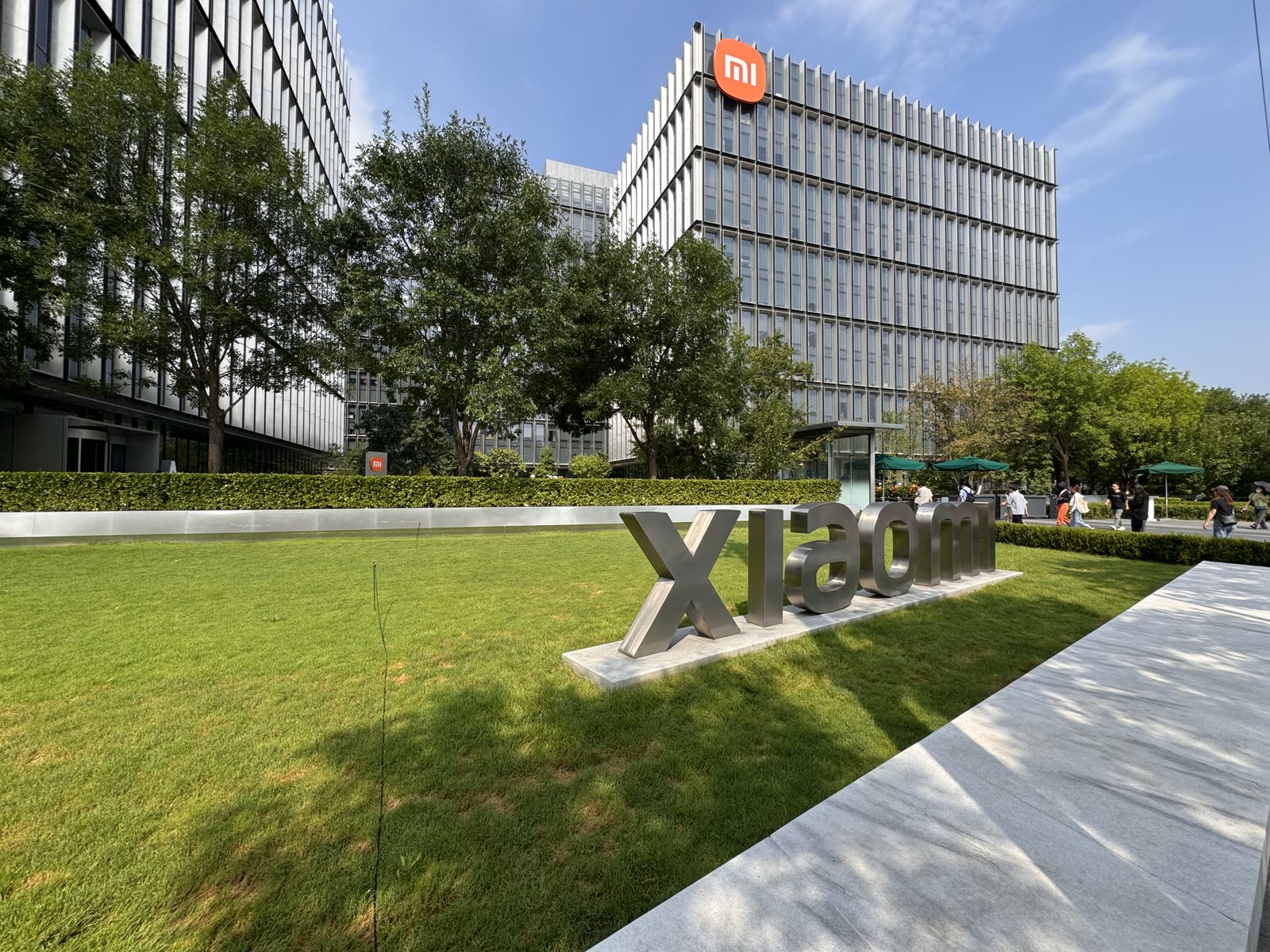
Image context: the cover uses a real Wikimedia Commons photograph of Xiaomi's science and technology park in Beijing. That is the right visual here because this article is about a company-level distribution system anchored in hardware, OS, and real operating surfaces, not about a synthetic benchmark leaderboard.[5]
What Xiaomi has actually put on the table
The model side is real and should not be dismissed as branding theater.
XiaomiMiMo's public MiMo repository describes a 7B reasoning line trained from scratch, with roughly 25 trillion pretraining tokens, a curated 130K mathematics-and-code RL dataset, and evaluation notes that state key boundaries directly: the reported results were run at temperature=0.6, with repeated runs for benchmarks such as AIME 2025 and LiveCodeBench v6.[1] That is useful because it tells engineers how seriously to take the numbers. The benchmarks are not just floating slogans; Xiaomi is disclosing at least part of the evaluation protocol.[1]
The next step is more ambitious. Xiaomi's official MiMo-V2-Flash page describes a 309B total-parameter / 15B active-parameter MoE model with a 256k context window, hybrid attention, multi-token prediction, and an explicit pitch toward reasoning, coding, and agentic workflows.[2] Just as important, Xiaomi is not presenting this as a paper-only artifact. The page points users to MiMo Studio and an API Platform, says the model is built for tool use and long agent loops, and frames it as a practical foundation model rather than a lab curiosity.[2]
That matters because a lot of China AI companies are still easiest to read through a single headline model. Xiaomi is already showing something more layered: an open research line, a larger MoE line, and a developer-facing service surface under the same family name.[1][2]
Why this is a distribution story first
Even so, the cleaner strategic signal does not come from MiMo's raw benchmark line by itself. It comes from where Xiaomi can actually place AI features at scale.
The official Xiaomi HyperAI page is explicit about that surface. Xiaomi describes AI writing, speech recognition, interpretation, image creation and editing, and AI-assisted video creation as user-facing features, then lists live device surfaces including Xiaomi 15 Ultra, Xiaomi 15, Xiaomi Pad 7 Pro, and Xiaomi Pad 7, with more supported models to come.[3] That means Xiaomi's AI story is already attached to owned hardware distribution, not only to a cloud endpoint.
The investor presentation makes the scale argument harder to ignore. In Xiaomi's 24Q4 results deck, the company says global MAU had exceeded 700 million by December 2024, reports 904.6 million connected devices on its AIoT platform excluding smartphones, tablets, and laptops, shows 100.8 million Mi Home monthly active users, and reports 137.1 million Xiaomi AI Assistant monthly active users.[4] In the same deck, Xiaomi places HyperOS 2 and Xiaomi HyperAI among its 2024 R&D accomplishments.[4]
Put together, those numbers change the frame. For Xiaomi, the highest-value question is not only whether MiMo wins one more public model comparison. The higher-value question is whether Xiaomi can push more capable AI into the device, OS, and home-control surfaces that already have scale.[3][4]
That is an inference from the sources, not a quoted Xiaomi sentence. But it is the most coherent way to read them. A company that already has phone premiumization, tablet growth, a large AI assistant base, and a very large AIoT graph has a different AI monetization path from a lab whose main business is selling model access.[2][3][4]
Why MiMo still matters inside that thesis
Saying distribution is the real edge does not make MiMo secondary in a trivial sense. It makes MiMo instrumental.
An in-house model line gives Xiaomi several things that a pure partner strategy cannot provide cleanly. It gives Xiaomi a house view on reasoning and coding quality.[1][2] It gives Xiaomi a way to tune for product-specific latency, device form factors, multilingual UX, and tool behavior.[2] It also gives Xiaomi a negotiating position: if HyperAI rides entirely on outside models, Xiaomi owns the shell but not the technical center of gravity. A credible internal model stack shifts that balance.
This is why the public API platform matters even if it never becomes the main economic story.[2] It lets Xiaomi learn from developers, gather product feedback from tool-using workloads, and keep MiMo relevant in software ecosystems beyond Xiaomi's own devices. But the bigger economic upside still looks upstream and downstream from the API call itself: upstream in hardware and OS distribution, downstream in retention, premium-device mix, and cross-device stickiness.[3][4]
Xiaomi's own operating data supports that reading. The 24Q4 presentation highlights premiumization in mainland China, with premium smartphones at or above RMB3,000 rising to 23.3% of total Xiaomi smartphone units sold in 2024, and shows strong tablet growth at the same time.[4] In that context, AI is easier to read as a feature system that helps Xiaomi sell better devices and deepen ecosystem usage, not only as a standalone inference-revenue product.
How to read MiMo's benchmark claims without overreading them
This is where dossier-style discipline matters.
MiMo's public benchmark tables are worth reading, but they need boundaries attached. The MiMo README states that several headline numbers were run at temperature=0.6, that AIME24/AIME25 scores are averaged across 32 repetitions, and that LiveCodeBench v5/v6, GPQA-Diamond, and IF-Eval were averaged across 8 repetitions.[1] MiMo-V2-Flash then adds stronger claims around SWE-Bench Verified, SWE-Bench Multilingual, and agentic performance, while also pitching a 256k context and long-horizon tool use.[2]
The right conclusion is not "Xiaomi has proved universal superiority." The right conclusion is tighter: Xiaomi has shown enough model and infrastructure seriousness that its AI story should now be read as a real internal capability, not just a feature-reskin operation.[1][2]
For builders, that changes the company classification. Xiaomi is no longer only a handset company that adds third-party AI. It is becoming a consumer-device company with its own model stack, API layer, and OS-level AI distribution lane.[2][3][4]
What to watch next
- Watch whether MiMo capabilities move deeper into named HyperAI features across phones, tablets, and other Xiaomi surfaces rather than staying mostly at the demo or developer-platform layer.[2][3]
- Watch whether Xiaomi keeps expanding the AI assistant and AIoT usage base fast enough that model quality improvements can compound on top of existing distribution.[4]
- Watch whether Xiaomi's public API platform remains a side channel for developer learning or becomes a meaningful external product in its own right.[2]
Bottom line
The cleanest way to understand Xiaomi in AI-China right now is to separate capability from distribution.
MiMo is Xiaomi's capability layer: real models, real training claims, real developer surfaces, and increasingly credible agentic engineering.[1][2] HyperOS, HyperAI, phones, tablets, AI assistants, and the AIoT graph are Xiaomi's distribution layer.[3][4] The stronger thesis is that Xiaomi's edge will come from how tightly those two layers are joined.
That does not make MiMo unimportant. It makes MiMo more strategically useful than a standalone endpoint story would suggest.
Sources
- XiaomiMiMo, "MiMo" GitHub README (MiMo-7B training recipe, RL data scale, benchmark setup notes, and deployment references).
- Xiaomi MiMo, "MiMo-V2-Flash" (official page covering MiMo-V2-Flash architecture, 309B/15B parameters, 256k context, agentic claims, MiMo Studio, and API Platform).
- Xiaomi, "Xiaomi HyperAI" (official page describing user-facing AI features and supported Xiaomi device models).
- Xiaomi Corporation, "Xiaomi Corp. 24Q4 ER ENG" (2025-03-18 presentation; global MAU, connected-device base, Xiaomi AI Assistant MAU, HyperOS 2, and HyperAI references).
- Wikimedia Commons, "File:Xiaomi Headquarters.jpg" (source page for the cover photograph of Xiaomi's Beijing science and technology park).