As of 2026-03-30 UTC, the most useful way to watch Qwen's 6-minute 35-second launch video for Qwen3-Omni, published on September 22, 2025, is to stop treating it as a generic kitchen-sink multimodal reel.[1] The clip certainly does what launch videos usually do: it moves quickly, piles use cases on top of each other, and tries to leave the impression that the model can do almost everything. But the written materials behind it point to a more specific thesis. Qwen3-Omni is being framed as a system that processes text, images, audio, and video while replying in text and natural speech with low-latency streaming, multilingual coverage, and a Thinker-Talker architecture meant to keep reasoning and speech generation inside one coherent loop.[2][3][4]
That matters because the video does not spend its time on leaderboard slides. Instead, it keeps returning to a repeated interaction pattern: a user speaks, points, shows, or plays something, and the model answers as if those signals belong to one conversation rather than to a bundle of separate pipelines.[1] The GitHub README and Hugging Face model card describe that same ambition in product language, emphasizing real-time audio-video interaction, natural turn-taking, multilingual input and output, and cookbooks that cut across speech recognition, speech translation, audio-visual dialogue, music analysis, video description, and even image math.[2][3]
The technical report gives the design claim more weight. It says Qwen3-Omni supports 119 text languages, 19 speech-input languages, and 10 speech-output languages, uses a Thinker-Talker MoE architecture, and pursues low first-packet latency through a multi-codebook speech stack, with a theoretical 234 ms cold-start first packet in streaming settings.[4] Taken together, those sources suggest that the video's real pitch is narrower and more ambitious than "Alibaba has an omni model." The pitch is that Alibaba wants every modality to collapse into one turn-taking interface contract: speak to it, show it something, let it watch a clip, play a song, point at a document, and keep the interaction inside the same conversational frame.[2][3][4]
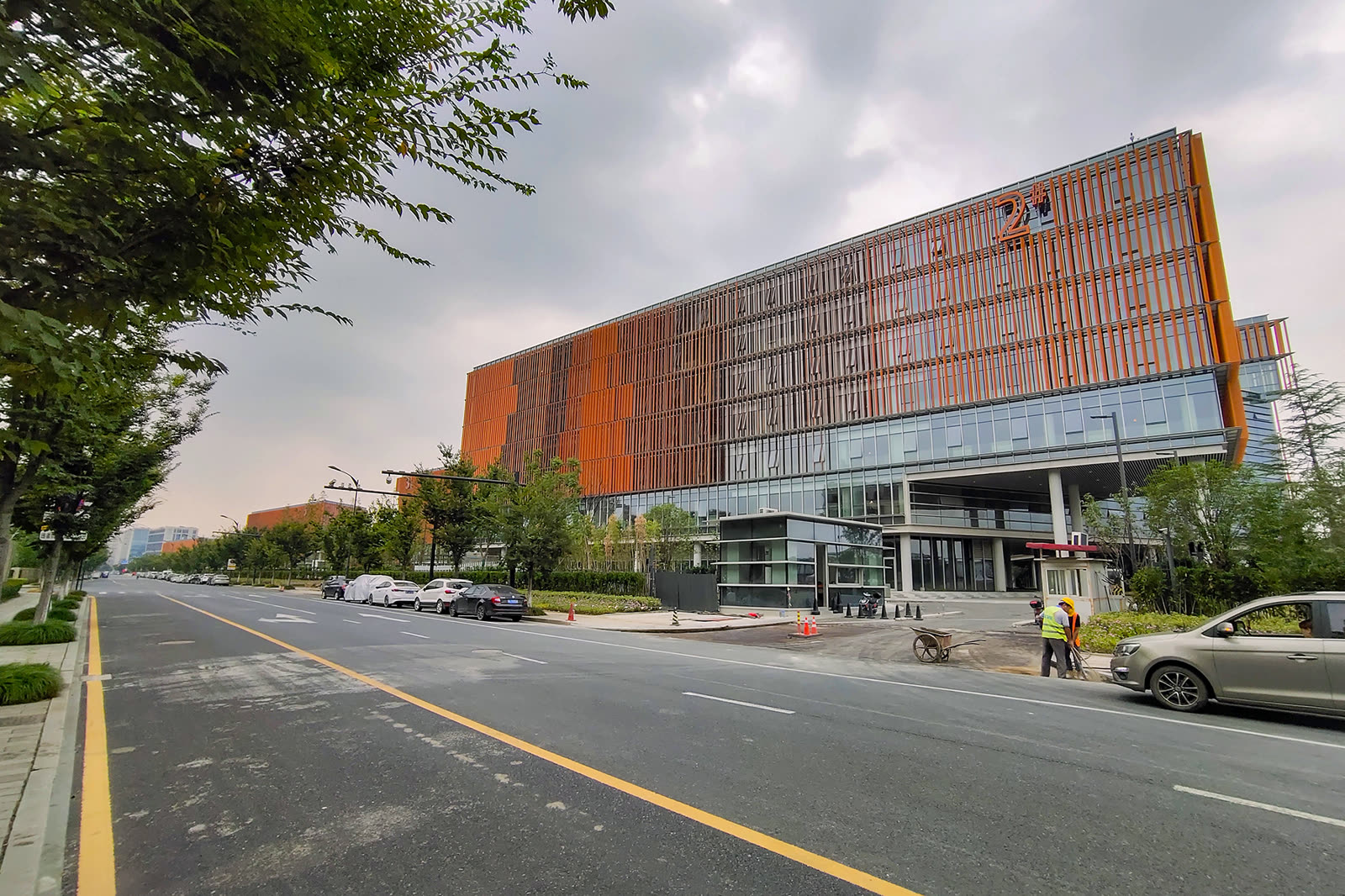
Image context: the cover uses a real Wikimedia Commons photograph of Phase 4 of Alibaba Xixi Park in Hangzhou. A documentary campus image fits this piece because the video's real story is institutional interface-building, not an abstract rendering of model internals or a synthetic concept illustration.[5]
Around 0:25, the opening restaurant prompt turns translation into a single social turn
The first concrete demo is deceptively simple. A user says, "I took my French friend to an Italian restaurant for a meal. Could you please recommend a pasta dish for us and introduce it in French?" and the model answers in speech rather than in a cold transcription-and-translation sequence.[1] The screen labels this as cross-lingual, but the important thing is not only that multiple languages are involved. The important thing is that recommendation, context, and speech delivery are fused into a single reply.
That is exactly how Qwen's written materials frame the product. The README and model card stress that Qwen3-Omni is not only a text-plus-audio recognizer. It is meant to accept mixed-modality input and deliver natural streaming output, with speech translation and audio-visual dialogue included among the core cookbook lanes.[2][3] In other words, the launch clip does not open with raw multilingual coverage as a static capability list. It opens with a social scene that makes multilingual interaction feel conversational and immediate.
That choice reveals the product thesis. Alibaba is not just trying to say that the model can convert speech between languages. It is trying to make the user feel that language switching should happen inside the same assistant turn, without a visible handoff from one subsystem to another. In AI-China terms, that is an interface claim as much as a model claim.
Around 1:24 and 1:30, the video moves from speech to grounded audio-video reference
The second notable sequence asks what "Elliot" is talking about and what the context of a historical site is, while the screen shows a visual scene rather than a plain transcript window.[1] Soon after, the video switches to a Japanese restaurant scene where Qwen3-Omni answers a grounded question about what is happening in the clip, effectively binding spoken language to objects, actions, and setting.[1]
This is where the supporting documents become useful. Qwen's GitHub repository does not describe Qwen3-Omni as a speech model with optional vision bolted on later. It presents video description, audio-visual question answering, and audio-visual dialogue as first-class cookbook categories.[2] The Hugging Face card repeats the same structure, which is a signal in itself: the product is organized around crossing modalities inside a single model family rather than around maintaining separate branded tools for each task.[3]
Seen through that lens, the historical-site and restaurant demos matter because they demonstrate reference binding. The model is being asked to keep track of speech, visual context, and temporal sequence at once. The technical report's description of unified perception and generation across text, images, audio, and video gives the systems explanation for what the video is dramatizing on screen.[4] The clip is selling grounded conversation, not just broad input support.
Around 2:31 and 3:35, multi-person video becomes a memory and diarization test
The middle of the video is where the real interface argument sharpens. At roughly 2:31, Qwen3-Omni moves into a multi-person video segment in which several speakers introduce themselves and mention personal details, moods, and pets.[1] By 3:35, the model is asked follow-up questions such as what one speaker said about his pet and why another person broke up with his girlfriend, and it answers by pulling the right detail from the right speaker.[1]
That sequence is much more revealing than a simple transcription demo. Basic speech recognition can turn audio into words. Basic speaker diarization can separate voices. A stronger assistant has to do more: it has to hold speaker identity, retain details over multiple turns, and answer questions against that remembered scene without losing who said what. The Qwen materials repeatedly emphasize audio-visual dialogue, multimodal reasoning, and natural turn-taking, and this is the point in the video where those claims stop sounding abstract.[2][3][4]
For AI-China readers, this is also the moment where Qwen3-Omni starts looking less like a flashy demo model and more like an interface layer for meetings, customer-service review, video notes, or any situation where memory over mixed media matters. The product value is not exhausted by "understands audio and video." The deeper claim is that the model can stay inside the conversational thread after the first pass and answer follow-up questions as if it had actually listened to the scene.
Around 3:58, 5:00, and 5:53, the clip compresses meetings, music, and documents into the same loop
After the multi-speaker section, the video pivots again. Around 3:58, a meeting-style exchange about a real-time co-editing feature and a slipping deadline is summarized inside the same conversational pattern.[1] Around 5:00, the clip turns to music analysis, with Qwen3-Omni describing the mood and lyrical content of a song.[1] By 5:53, it is asked to look at handwriting or notation and calculate an integral from what it sees.[1]
These are not random capability postcards. They map cleanly onto the cookbooks in the README and model card: speech and dialogue, music analysis, audio captioning, video description, and image math all appear as explicit usage categories.[2][3] The technical report then supplies the architecture story underneath them: a single multimodal model that is supposed to preserve strong performance across text, image, audio, and video without degrading into a weak compromise system.[4]
The video's editing makes a specific product argument through that sequence. Meetings, songs, and documents are different media, but the clip presents them through the same user grammar: show the model something, ask a question, get a fast answer, keep going. That is why the video's key unit is not the benchmark or the task family. It is the turn.
Around 6:07, the closing car request hints at the end state
The last substantial prompt is almost throwaway: "It's too cold. Quickly close the car window for me and play me a folk song."[1] The clip ends soon after, but that final example is strategically placed. It gestures beyond analysis and toward action. Once text, audio, video, and scene understanding all sit inside one conversational contract, lightweight tool use becomes the natural next step.
Qwen's written materials do not overstate that point, but they do make room for it. The README and model card mention flexible control, adaptation by system prompt, and even agent-like use cases such as audio function calling in the cookbook set.[2][3] The technical report adds the broader framing: Qwen3-Omni is meant to unify perception and generation so the model can reason over arbitrary inputs and respond in real time.[4]
That is why this launch video is worth watching carefully now. Its strongest message is not just that Qwen3-Omni can see, hear, read, and speak. Its stronger message is that Alibaba wants all of those capabilities to feel like they belong to one ongoing conversation. If that framing holds, then the competitive boundary in AI-China shifts away from isolated modal demos and toward who owns the turn-taking layer between user intent, multimodal context, and immediate response.
Sources
- Qwen, "Qwen3-Omni: Natively Omni-Modal Foundation Models!", official YouTube video, published September 22, 2025.
- Qwen Team, "Qwen3-Omni" GitHub repository README (overview, multilingual coverage, Thinker-Talker architecture, cookbook categories, and deployment notes).
- Qwen Team, "Qwen3-Omni-30B-A3B-Instruct" Hugging Face model card (feature summary, cookbook structure, multilingual support, and real-time interaction framing).
- Qwen Team, "Qwen3-Omni Technical Report" arXiv entry and abstract page (benchmark framing, Thinker-Talker MoE design, language counts, and first-packet latency).
- Wikimedia Commons, "File:Phase 4 of Alibaba Xixi Park 20200913.jpg."