
As of 2026-03-31 UTC, the useful way to watch Baidu's 10-minute, 43-second video "Introducing ERNIE X1.1" is to stop treating it as one more generic reasoning-model victory lap.[1] The clip does contain the familiar frontier cues. It opens at WAVE SUMMIT 2025, talks about stronger reasoning, and places X1.1 against other top-tier systems. But the video's real sales object is narrower and more commercial. Baidu is trying to show that a reasoning model becomes valuable when it is easier to steer: it hallucinates less, follows formatting instructions more tightly, handles agentic and tool-calling tasks more reliably, and delivers shorter answers that stay inside the user's requested shape.[1][2]
That reading gets stronger when the video is placed next to Baidu's written launch material. The September 9, 2025 release says ERNIE X1.1 made gains in factuality, instruction following, and agentic capabilities, and that it had already been deployed on Qianfan, Baidu AI Cloud's MaaS platform for enterprise clients and developers.[2] That is a very specific commercial frame. Baidu is not only saying "this model reasons well." It is saying "this model behaves well enough to route into real developer surfaces."
The prehistory matters too. In June 2025, Baidu open-sourced the ERNIE 4.5 family as a ten-variant multimodal line under Apache 2.0, while the Qianfan community positioned that same release as both an open-source event and an API-service event on the managed platform.[3][4] My inference from the video and those documents is that Baidu wants readers to understand X1.1 as part of a two-lane strategy: open enough to widen developer adoption, managed enough to keep enterprise traffic inside Baidu's own serving surface.[2][3][4]
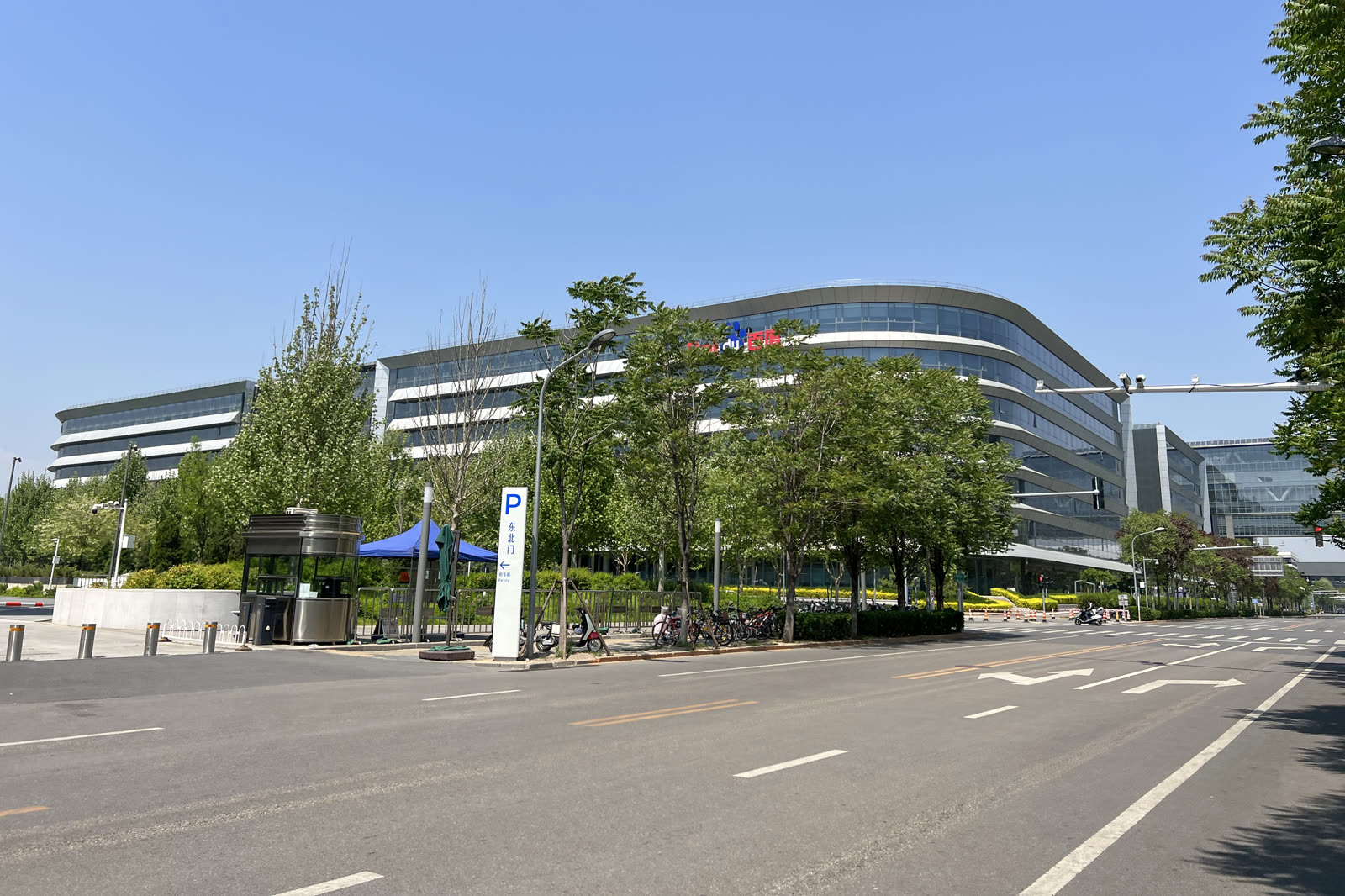
Image context: the cover uses a real Wikimedia Commons photograph of Baidu Technology Park at ZPark Phase II in Beijing. That is the right visual here because the article is about operational credibility and platform surface area, not a generated illustration of reasoning internals.[5]
Around 0:55, the shift from ERNIE 4.5 to X1.1 frames the product as a stack, not a single hero model
The first revealing move comes before the demos. Around 0:55, the presenters say that roughly three months earlier Baidu had open-sourced ERNIE 4.5, then explain that the company is now "shifting gear" from vision-language models to reasoning models.[1] That sequence matters more than it first appears to. It tells the viewer that X1.1 is not meant to stand alone as a fresh idol. It is being introduced as the next layer on top of a model family that Baidu has already widened and distributed.[1][3]
The ERNIE 4.5 blog post supports that reading in unusually concrete terms. Baidu describes a ten-model multimodal family, including different scales and thinking or non-thinking modes, published under Apache 2.0 with accompanying development toolkits.[3] The Qianfan community note pushes the same event into platform language: the open-source release arrived together with synchronized API availability on Qianfan.[4] Read beside those pages, the video's opening stops looking like a simple chronological recap. It becomes a packaging signal. Baidu is telling developers that the open lane and the managed lane belong to the same story.
That is an important AI-China distinction. Many launches still ask viewers to admire a model as a singular breakthrough. Here Baidu instead highlights continuity across model family, serving platform, and developer workflow.[1][2][3][4] My inference is that the company wants X1.1 to feel less like a one-off research artifact and more like a reasoning upgrade inside an already-routed stack.
Around 1:50, the headline claim is not raw intelligence but behavioral discipline
The clearest statement of intent arrives around 1:50. The presenters say reasoning models are powerful but often hallucinate because of extended chains of thought, then claim that X1.1 hallucinates less, follows instructions more accurately, and performs well on agentic tasks and tool calling.[1] That list is much more revealing than a generic benchmark boast would have been. Each item is really a complaint about production behavior: wrong facts, loose adherence to prompts, and brittle multi-step execution.[1]
Baidu's written release makes the same point in more explicit product language. It says ERNIE X1.1 posted gains of 34.8% in factuality, 12.5% in instruction following, and 9.6% in agentic capabilities, while being made available on Qianfan for enterprise users and developers.[2] Those are not consumer-marketing categories. They are categories for deciding whether a model can be trusted inside application flows where error shape matters as much as raw capability.
That is why "controllability" is the better word here than "reasoning." The video's first analytical payload is that Baidu wants to turn reasoning-model progress into more predictable interface behavior.[1][2] A model that is merely clever still creates operational drag if it answers in the wrong form, fabricates details, or misses tool-use steps. A model that stays inside constraints is easier to deploy.
Around 5:40, the PRD demo shows what Baidu really wants developers to buy
The middle of the video makes the thesis concrete. Around 5:40, one presenter walks through a prompt asking ERNIE to draft a product requirements document with multiple constraints: background, goals, target users, core features, at least two user stories, a specific format, and a limit of 600 words.[1] The demo commentary then praises exactly what Baidu thinks matters: the model nails the requested sections, includes the user stories, stays in format, avoids extra fluff, and remains under the word limit.[1]
That is not a flashy frontier demo. It is a compliance demo. The satisfaction comes from watching the model obey a contract. The presenters even dwell on structure and skim-ability: headings are clear, lists are clean, the draft is useful without cleanup.[1] The real object being sold is not literary brilliance. It is draft discipline.
This is where the surrounding Baidu material becomes especially helpful. Once ERNIE 4.5 is understood as an open family with toolkits, and Qianfan is understood as the managed API surface, the PRD example stops being a casual office-use vignette.[3][4] It starts to look like a compressed explanation of why a model might deserve a place inside enterprise workflow. If the model can reliably stay within section order, length budget, and output shape, it creates less post-processing overhead for the system around it.
Around 7:30, the 401(k) example is really about answer compression and tone control
The second major demo, beginning around 7:30, looks at first like a lightweight personal-finance aside. One presenter asks ERNIE to help with a friend's 401(k) decision, requests a straight answer, and asks the model to keep it short.[1] What matters here is not the financial content itself. What matters is that the presenter explicitly values compression, directness, and tone.
The narration praises X1.1 for summarizing the user's situation, separating the fund choice from the tax choice, then returning an answer that is short, clear, and still playful enough to echo the user's joking tone.[1] In other words, the model is rewarded for not over-performing. It does not win by becoming more encyclopedic. It wins by becoming more usable.
That preference lines up with the rest of the launch frame. If Baidu is pushing X1.1 toward Qianfan and enterprise developer use, then the commercial value of a reasoning model lies partly in its willingness to stop at the right point.[2][4] An answer that is too long, too hedged, or too stylistically misaligned can be just as costly as an answer that is wrong. My inference from the demo is that Baidu understands this and is trying to market X1.1 as a model that can be selected for the right behavioral profile, not merely for raw benchmark prestige.[1][2]
What to watch for if you replay it now
Replay the clip and notice what the presenters celebrate most. They do not linger on one dramatic theorem proof or one spectacular benchmark slide. They keep coming back to behavior under constraint: less hallucination, tighter instruction following, stronger agentic execution, shorter answers, clearer structure, cleaner formatting, better tone fit.[1][2] That repetition is the real message.
That is why the video is worth annotating. Baidu is using X1.1 to argue that the next competitive layer in AI-China is not only raw reasoning power. It is the ability to make reasoning models legible inside actual interfaces. The model that behaves can be routed. The model that stays inside the contract can be sold.
Sources
- Baidu Inc., "Introducing ERNIE X1.1," official YouTube video, published September 10, 2025.
- Baidu, "Baidu Unveils Reasoning Model ERNIE X1.1 with Upgrades in Key Capabilities" (September 9, 2025; factuality, instruction-following, agentic metrics, and Qianfan deployment).
- ERNIE Blog, "Announcing the Open Source Release of the ERNIE 4.5 Model Family" (June 30, 2025; ten-model multimodal family, Apache 2.0, and development toolkits).
- Baidu AI Cloud Qianfan Community, "文心4.5系列正式开源!千帆同步开放模型API服务" (June 30, 2025; ERNIE 4.5 open-source release paired with Qianfan API availability).
- Wikimedia Commons, "File:Baidu Technology Park at ZPark Phase II (20220502113543).jpg."